What Makes Us Human(oid)?
David Canter proposes that what makes us different from a computer is being here.
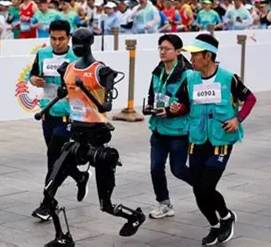
The fascinating Chinese sports showcase of humanoid robots opens up the question often-asked ever since Darwin demonstrated the animal origins of us human primates, of what distinguishes humans from animals. That question usually considers differences such as language, culture, an opposable thumb, or even humour. But all of these differences (with the possible exception of an opposable thumb, but is that surpassed by a prehensile tail?) have been argued, by animal ethologists, as present in some animals to some degree. We have therefore had to accept that we are just evolutionary outcasts from the species that were our forebears.
Artificially intelligent computer software and the humanoid robots they are creating and controlling raise the stakes much higher. They can now mimic all of those characteristic that we cherished deep-down as making us the prime primates. Speech recognition and generation has made huge leaps in the last 30 years. When, in the 1980s, I proudly programmed a computer to recite The Owl and the Pussycat, those listening to the resulting ‘speech’ declared they couldn’t understand it all. Recently I was offered for free an AI spoken rendition of one of my books. Admittedly it didn’t have the educated Liverpool accent that I would have welcomed, but it is pretty convincing. Even the claim of the unique human ability to generate and rely on narratives can be readily imitated by even the earliest versions of ChatGPT.
The future inevitability of the ubiquitous presence of artificially generated humanoids has already been the focus of a lot of science fiction and non-fictional, scientific speculation. It is therefore incumbent on the actual human race to get as clear a picture as may be possible of what demarcates us sentient beings from the robots and their underpinning algorithms.
My claim is that it is the presence of being in a place, whether in imagination or actuality that defines our humanity. It may be possible for computer systems to fake that, but they can never embody it. Each person is in, inhabits, gains meaning and significance from being in a place. Algorithms, and all the unreal creatures they spawn, never have an existence that takes their identity from or recognizes their relevance to a place. This is even true of simulated places. Even the most convincing virtual environments are crafted entities. They are best thought of as ongoing works of art shaped by the shared imagination of both those who experience them and those who create them. They may ape actual locations. It would be difficult to make sense of and use virtual reality if it did not draw on some recognisable aspect of actual reality. But as they can never have the historical, social and personal significance and layers of meaning that being in the world brings with it, they will always be works of imagination.
This difference from being in artificial spaces is causing it to be ever more important to understand the personal, social and cultural significance of real-world places. On the one hand there are horrific, destructive wars over the control of places, on the other, many individuals are increasingly embedded into an existence in a virtual reality, where direct human interaction is becoming rare. Being here, in this place rather than another, highlight the significance of actual, real presence and all it implies. This includes what underlies attachment to place, and how places can be enriching and health giving, or destructive.
No robot has ever cursed itself, and the dog, when tripping over it sleeping by the fire. It has not felt the need to go for a quiet walk in the countryside to clear its head. It has never grieved over a lost home, or had fond memories triggered by walking passed the place where it had its first kiss.
Sadly, these aspects of being present in a place are being eroded by the heads-down focus on our mobile devices, removing us from the direct experience of where we are. With that, some of the significance of who we are is lost. The developers of zoom and other video communication applications were aware of this when they included the option of blurring the background or even changing it totally. This removes the physical, environmental context of people who are engaged with discussions with others. A speaker is put into a limbo that removes the influence of the place where they are.
The invidious embrace of virtual reality may be trying to make robots of us all. Our humanity depends on keeping our feet clearly on the ground. Being here is the foundation of all the interactions with others, out of which emerges culture and genuine experience to make each of us a person.
David Canter’s new book Rethinking the Psychology of Place: Being Here will be published by Routledge in 2026.

























































































The coming apocalypse of artificial beings notwithstanding, there is a metaphysical argument, which only Steven Spielberg seemed to understand.. The human conscience came about only because it was created by other humans, as we arrived on this planet without one. Which is sorta the definition of evolution. Humans are very adept at creating cruelty & evil in other humans, but they also create goodness & mercy in others, which is the only reason why we didn’t exterminate each other eons ago. Which is sorta the goal of evolution. Perhaps creating goodness in machines is possible, which would enable them to… Read more »