A Collection: Behavioral Science Insights on Addressing COVID’s Collateral Effects
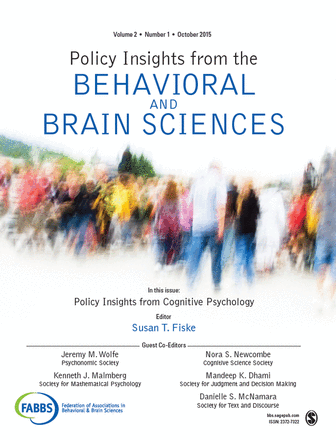
Since 2014, the journal Policy Insights from the Behavioral and Brain Sciences has published invited articles from member societies of the Federation of Associations in Behavioral and Brain Sciences that present brief reviews of behavioral and brain scientific findings relevant to public policy. This journal allows scientists to share research findings with the specific intent to help develop and build sound policies and be a resource for policy- and decision-makers looking for digestible research to inform their next steps.
This combination – current and cutting edge peer-reviewed research and an intentional focus on assisting good policy — has come into sharper relief with the COVID-19 pandemic as individuals, organizations and governments scramble to deal with the disease and its collateral damages on the fly. To help in the decisions, the federation, journal editor Susan T. Fiske, and the journal’s publisher, SAGE, offer this collection of articles as a free resource. In some instances, the article’s authors offer descriptions of their scholarship’s applications in the present moment.
Risk Communication
Evaluating news reports and information and dealing with fake news
- “Helping People Know Whether Measurements Have Good or Bad Implications: Increasing the Evaluability of Health and Science Data Communications” | Brian J. Zikmund-Fisher
- “Health Risk Perception and Risk Communication” | Ralf Schmälzle, Britta Renner and Harald T. Schupp
- “Can’t We Just Disregard Fake News? The Consequences of Exposure to Inaccurate Information” |David N. Rapp and Nikita A. Salovich
- “A Reasoned Approach to Dealing With Fake News” | M. Anne Britt, Jean-François Rouet, Dylan Blaum and Keith Millis
Promoting Healthy Behavior
Increased alcohol consumption, racial disparities in COVID victims
- “Decision Making and Alcohol: Health Policy Implications” |Clintin P. Davis-Stober, Kayleigh N. McCarthy and Denis M. McCarthy
- “Alcohol Misuse Across the Life Span: Insights From Developmental Studies in Behavior Genetics” | Jeanne E. Savage, Elizabeth C. Long, Sally I-Chun Kuo, Megan E. Cooke, Jinni Su, Peter B. Barr and Jessica E. Salvatore
- “Threats to Belonging Threaten Health: Policy Implications for Improving Physical Well-Being” |Lisa M. Jaremka and Naoyuki Sunami
- “Using Behavioral Insights to Increase Vaccination Policy Effectiveness” |Cornelia Betsch, Robert Böhm and Gretchen B. Chapman
- “Too Much Medicine: Behavioral Science Insights on Overutilization, Overdiagnosis, and Overtreatment in Health Care” |Victoria A. Shaffer and Laura D. Scherer
- “Reducing Racial Health Care Disparities: A Social Psychological Analysis” | Louis A. Penner, Irene V. Blair and Terrance L. Albrecht
- “Racial Appearance Bias: Improving Evidence-Based Policies to Address Racial Disparities” |Keith B. Maddox and Jennifer M. Perry
- “Relative Deprivation: How Subjective Experiences of Inequality Influence Social Behavior and Health“| Heather J. Smith and Yuen J. Huo
Relationships Under Pressure
Increased divorce rates and incidents domestic violence
- “Intervening Earlier: An Upstream Approach to Improving Relationship Quality” |Samantha Joel and Paul W. Eastwick
- “Supporting Healthy Relationships in Low-Income Couples: Lessons Learned and Policy Implications” |Benjamin R. Karney, Thomas N. Bradbury and Justin A. Lavner
- “How Intimate Relationships Contribute to Gender Inequality: Sexist Attitudes Encourage Women to Trade Off Career Success for Relationship Security” |Nickola C. Overall and Matthew D. Hammond
Digital Learning
Help in teaching, issues in learning, technology and reading
- “Influence of the Home Linguistic Environment on Early Language Development” | Natalie H. Brito
- “Environmental and Social Factors in Preventing, Assessing, and Treating Problem Behavior in Young Children” | Jeanne M. Donaldson and Jennifer L. Austin
- “Taking a Hands-on Approach to Learning” |Susan Goldin-Meadow
- “Individualizing Student Instruction in Reading: Implications for Policy and Practice” |Carol McDonald Connor and Frederick J. Morrison
“During the COVID-19 pandemic, the public is often misled on the nature of the virus and how to minimize its potential harm. Many citizens do not have an adequate understanding of the biological and social sciences that are needed to meet the challenges. Citizens would of course benefit from a deeper understanding of science, but that is difficult because science is evolving very quickly. However, citizen scientists can at least acquire the fundamentals of scientific reasoning and good questions to ask about any area of science. My colleagues and I have developed technologies on the internet (such as AutoTutor) that have computer agents that hold conversations with a learner in natural language. These systems are designed to improve comprehension skills and scientific reasoning. The hope is that citizens will thereby make more informed decisions about the virus and inoculate themselves from misinformation spread through multiple media outlets.” — Carol Connor
- “Reading Comprehension: Core Components and Processes” | Panayiota Kendeou, Kristen L. McMaster and Theodore J. Christ
- “Youth Literacy and Cultural Theories: A Review of the Science and Implications for Policy” | Elizabeth Birr Moje
- “Reinforcement Contingencies in Language Acquisition: Implications for Language Intervention” |Anna Ingeborg Petursdottir and James R. Mellor
- “Advanced Educational Technology for Science Inquiry Assessment” |Haiying Li Li, Janice Gobert, Art Graesser and Rachel Dickler
Other Pertinent Articles
- “Beyond Intervention: Shaping Policy for Addressing Persistence and Relapse of Severe Problem Behavior” | Christopher A. Podlesnik and Michael E. Kelley
- “Financial Incentives for Reducing Smoking and Promoting Other Health-Related Behavior Change in Vulnerable Populations” | Stephen T. Higgins, Danielle R. Davis and Allison N. Kurti
- “Self-Regulated Strategy Development in Writing: Policy Implications of an Evidence-Based Practice” |Karen R. Harris and Steve Graham
- “Ostracism and Public Policy” |Kipling D. Williams and Steve A. Nida
- “Improving Medication Understanding and Adherence Using Principles of Memory and Metacognition” |Mary B. Hargis and Alan D. Castel
- “Self-generated Memory Cues: Effective tools for Learning, Training, and Remembering” |Jonathan G. Tullis and Jason R. Finley
For a series of quick reads on Policy Insights from the Behavioral and Brain Sciences journal scholarship without a direct COVID focus, CLICK HERE.