NAS Report Examines Nexus of AI and Workplace
“It is impossible,” reads a new consensus study from the U.S. National Academies of Sciences, Engineering and Medicine, “to predict exactly the nature of the coming changes in AI and all their effects on the economy and society.” AI is a tool with the potential to enhance human labor, complement human expertise, and create new forms of valuable work; policy makers, business leaders, AI researchers, employers, and workers all have an opportunity to intentionally design AI systems in accordance with society’s shared values and goals.
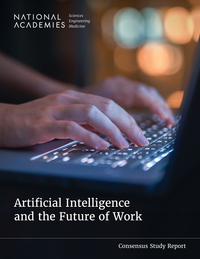
Their recent report on the study, Artificial Intelligence and the Future of Work, argues that “this beneficial deployment of AI would augment collective capabilities, enhance human well-being, and support a workforce that is equipped to meet future challenges.” To reach this goal, analyzing statements claim that it is “imperative to improve near real-time observation and tracking of progress in AI and its impacts on the workforce and to widely share this information to better inform and equip workers and policymakers to flexibly respond to AI developments.” The report, sponsored by the National Science Foundation, follows in the footsteps of a 2017 study from the National Academies looking at information technology and the U.S. workforce. The remit of the committee behind the latest study, chaired by Stanford economist Erik Brynjolfsson and Carnegie Mellon computer scientist Tom M. Mitchell, was to ask questions and not provide recommendations.
Recent advances in AI capability have been of growing interest, particularly with how individuals in the workforce will be impacted as the use of large language model (LLM)-based chatbots and other forms of generative AI continues to increase. The year following the launch of ChatGPT in November 2022 marked a significant turning point for AI technology, as generative models, especially LLMs, became more widely accessible. These models offer capabilities far beyond those of earlier AI systems, including the ability to engage in meaningful conversations on a wide range of topics in multiple languages, summarize lengthy text documents, tackle complex problem-solving tasks, and write computer programs.
Gathering and openly sharing information about developments in AI, its adoption, and the evolving demand for various types of expertise are of key implementations discussed in the report, as well as the broad applicability AI has to a large fraction of cognitive tasks in the economy, offering the promise of significant improvements to productivity and implications for workforce dynamics. At the same time, other areas of AI, such as robotics, continue to evolve, with self-driving cars being tested in several U.S. cities and machine learning applied to vast data sets. Despite these strides, the future trajectory of AI remains uncertain. Current AI systems are still imperfect, often displaying inherent biases, and there is no assurance that the benefits of AI will be distributed fairly.
The report claims that without substantial changes in policies and institutions, the widespread adoption of AI could lead to job displacement, wage gaps, growing inequality, and declining job quality and satisfaction. Additionally, societal risks associated with AI, such as privacy violations, discrimination, threats to democracy, political stability, and national security, must be addressed.
According to the National Academies, AI holds promise for transforming education by making learning more personalized, engaging, and cost-effective, though substantial investments from both public and private sectors will be necessary to expand access to online education, implement safeguards in AI-enhanced learning, evaluate AI’s effectiveness in educational settings, and train teachers to utilize these new tools effectively. AI has the potential to complement human workers by offering relevant information, guidance, and digital safeguards, enabling them to take on a wider range of tasks – in healthcare, for instance, AI could assist by providing healthcare professionals with instant access to specific, up-to-date information about medical conditions, treatments, or equipment, allowing them to make informed decisions quickly.
As AI continues to reshape workforce demands, ongoing access to education and retraining programs will be crucial in helping workers adapt to a rapidly evolving job market. The National Academies’ report explores various aspects of AI’s potential impact on the workforce, including the current state of AI technology, its influence on productivity, its effect on labor demands, its role in education and retraining, and the importance of data collection to measure the changing workforce landscape and training opportunities.