My First Sage Book: The Gift of a Nocturnal Anthropologist
In 2025 Sage is celebrating our origin story. When she was 24 years old, Sara Miller McCune, a female entrepreneur, founded a publishing company with an urban studies journal and $250 from selling an air conditioner, and called it Sage. Origin stories are often ceremonial and unexpected, and only in retrospect show the pivotal significance of their moment. Sage in 1965 was like that. My unexpected origin story with Sage began with the first book I bought when I was in college and ends up with me having a (so far) 22-year career here.
In 1991 as a second-year college student I became a research assistant to an anthropology professor. I was a financial aid student and needed the money. Before the first day of work, I knew three things about him: he was retired; he had taught and influenced Gary Snyder, the famous Beat poet; and he was nocturnal. I was told that last fact to ensure I would never make the mistake of showing up at his house before 3 p.m., which was when he woke up.
David French, professor emeritus, lived across the street from campus in an immaculate white colonial-style house. With Kay French, his lifelong intellectual and research collaborator and wife, he had conducted decades of fieldwork in language and ethnobotany with the community on the Warm Springs Reservation in Oregon. Professor French was in the Boasian tradition of ethnography, which is characterized by a meticulous approach to recording and cataloguing what are perceived as disappearing cultural and linguistic practices. What that looked like in real life was a large basement centered by two small desks at a 90-degree angle, surrounded by teetering stacks of dried plants in manila folders, newspaper clippings also in manila folders, rows and rows of typed index cards of Wasco-Wishram lexicon (the languages spoken on Warm Springs), and four walls lined with every book David and Kay had ever read, all hardbacks. The ceiling was tea brown from David’s 40-a-day Camel filterless habit and there were coffee splashes reaching above the bookcases. The Frenches had just acquired a computer, tucked into a nook under the stairs, which was Kay’s domain.
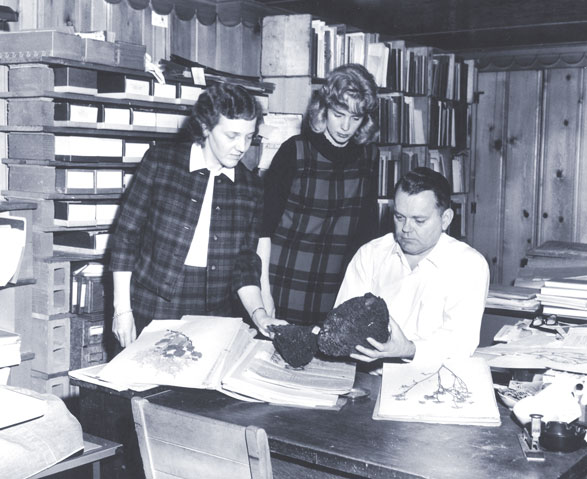
I was paid $5.05 an hour to arrive at 3:30 p.m., after breakfast, and spend three hours working in the basement until they had lunch. The first day was essentially my job interview. David peered at me between towers of manila folders, puffing a Camel filterless, and started like this: “The Greenlanders drink coffee, but the Inuit in Northern Canada drink tea. You’re Canadian, so you should know why. What do you think?” I gave an answer summed up as ‘colonialism’ and he said, “OK, you can stay.” My work continued in that vein – three years of David asking “what do you think.”
I organized index cards for an encyclopedia entry David was writing, cut out newspaper clippings, and after Kay had discovered the referencing program EndNote, spent about one hour of each workday under the stairs entering their life’s bibliography record by record. Whenever a shipment of books arrived – the bibliography was ever-expanding – I was given a pair of white cotton gloves to open the unread hardbacks section by section librarian-style, so that later reading would not crack the spine. Mostly, though, I just talked to David. It eventually occurred to me that my real job wasn’t filing, or even organizing information. It was keeping David occupied while Kay did the actual research work at the computer under the stairs.
Professor French had a relentless, questing curiosity equally balanced by a predilection for storytelling, with an impish punning wit. He liked to talk about naming practices, semiotics, the middle-class rituals of food, the Roma community of Portland Oregon, contemporary witchcraft, Mary Douglas, or Ruth Benedict (whose research assistant he had been). I was agog to hear about his summer collecting plants in France accompanied by Claude Levi-Strauss, the great foundational thinker of structuralism and whom, of course, I was painstakingly studying in an anthropological theory class.
One afternoon in 1992, I arrived in the basement and David told me he and Kay had discussed their satisfaction with my work and had decided to give me a raise. I would now get paid $5.10 an hour, “above minimum wage” as he pointed out. “And,” he added, “I’m going to buy you a book.” He rustled the papers on his desk and pulled out a book catalogue from a company called Sage, which he passed to me through the folder stacks. “You may take this home until next week as I know you’ll want to browse it carefully.”
I knew my choice would be professionally interpreted, if not judged. At that time Sage published as widely across the social sciences as it does now, though more monographs and what we would now call supplementary texts. Then, as now, many titles foregrounded Sara Miller McCune’s four justices (social, economic, environmental, educational), on issues from gender and power (Kathy Davis, 1991) to discourse and racism (Teun van Dijk, 1993) That particular catalogue would have included titles by canonical heavyweights Pierre Bourdieu and Norbert Elias.

The undergraduate in me desperately wanted to show off. However, I wanted to choose a book that I would never check out of the library for my classes: to choose for myself and not because of what David would think. I brought the catalogue back and asked for Norman Denzin’s Images of Postmodern Society: Social Theory and Contemporary Cinema. This being the early ’90s, most campuses were awash in postmodern theory and while I was being taught structure-functionalism and skepticism of any social theory less than 40 years old, I wanted to know what this ‘po-mo’ was about. And I was watching a lot of David Lynch at the time.
“Really?” David said. Judging, more than a little, and puffing his cigarette. “Postmodernism is …. not going to last.” Should I have chosen Bourdieu, or at least something more anthropological? But no, I decided I wanted to read outside my comfort zone, to be curious about something new if controversial, to look differently at the pleasures of storytelling, to regard the familiar and the popular from a rigorous angle, maybe to find my own way to deconstruct something flashy and then tell David. Of course he bought it, along with some more books that I would later don my librarian gloves to prepare for their shelves.
Thirty years later, I remember which book I chose because doing something unexpected in that moment, rather than sticking to the topic involved, is what mattered. We’re not talking about postmodernism today, even though we are about many of the other topics in that 1992 catalogue.
I like to think that Sage book was one of life’s pivots for me: toward roving reading habits, critical thinking, an appreciation for books as gifts, a lifelong commitment to exploring knowledge off the syllabus. More than 10 years later when I was looking for my first job in publishing, amid dozens of editorial assistant and production assist job advertisements I saw one at Sage. I sure knew Sage – I applied for that job in an instant and got it. Two decades on, I wish I could tell David and Kay that I now lead the editorial department in the Sage London that publishes those books for our many international social science markets – and that I think it all started in their basement. He would have had something funny, or wise, or both, to say about that.