Devyani Sharma on Accents
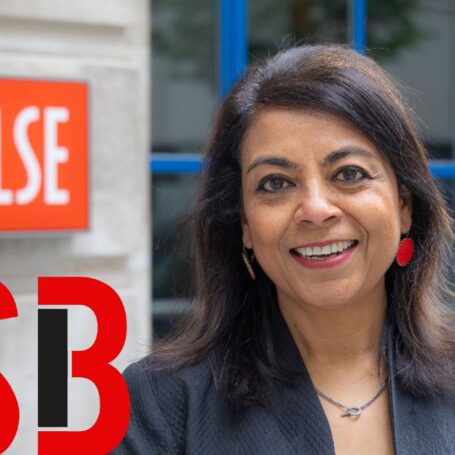
What does your accent – and yes, every speaker has one – say about you? Or perhaps the better question is, what do others hear in your accent? These are the sorts of questions that Devyani Sharma, a professor of language and communication at Oxford’s Worcester College, asks every day, especially about the many English speakers around the world.
In this Social Science Bites podcast, Sharma takes a deep dive into the accents of Britain, where accents have famously been used as markers of social status for years. As she tells interviewer David Edmonds, “the UK stands out as a country that’s organized its whole social system around accent for a very long time.”
While that’s been true historically, Sharma’s own research and public service – through projects like Generations of London English, Dialect Development and Style in a Diasporic Community, and the Accent Bias Britain online resource – has helped reduce the negatives around that.
As she details for Edmonds, “Interestingly, just a reminder that ‘you might be relying on accent as a shortcut and please don’t’ was enough to change recruiters’ behavior. It doesn’t always happen with gender and race anymore, and my sense is that’s because the message has been saturated. People are annoyed to be reminded before doing a recruiting task, but they haven’t thought as much about how much they use accent when judging people.”
To download an MP3 of this podcast, right-click this link and save. The transcript of the conversation appears below.
David Edmonds: What sort of accent do you have, and what does that say about your background and how others think about you? These are the sorts of questions Devyani Sharma is interested in. Devyani Sharma is professor of language and communication at Oxford, and for many years now, has researched languages, dialects and accents, with a special focus on English.
Devyani Sharma, welcome to Social Science Bites.
Devyani Sharma: Thanks for having me.
David Edmonds: We’re going to focus on accents, especially British accents. Let’s start with a very basic question, which is, what is an accent? And does the idea of an accent suggest that some people don’t have one, that there’s a standard way of speaking, and an accent is a kind of deviation from that?
Devyani Sharma: You’re right that a lot of people say, “Oh, I don’t have an accent,” or “That person has an accent.” For a linguist, that’s not really how we think of accents. So your accent is your system of sounds that you use to speak. So even the most standard speaker, your BBC news reader, has an accent, and it’s more a social, political, historical question, which accents get to be seen as not an accent.
David Edmonds: I know you’ve looked at English accents globally, but just looking at the UK generally, is there a way of counting accents? Presumably, accents on a kind of spectrum, and yet cities like Liverpool and Birmingham and Glasgow and Newcastle, their accents seem incredibly different to my ears. Is there a way of categorizing them?
Devyani Sharma: That’s a great question. It’s a very difficult question to answer. So, linguists are as guilty as anyone of categorizing and drawing boundaries where the boundary isn’t that sharp. On the other hand, one way that we can all agree that some region has an accent is when they become mentioned in the public sphere. So, when everyone can agree that there’s a special way that somebody in Newcastle speaks, it can sometimes be imagined, and there’s actually no accent there, but it usually means that everyone has recognized there’s some distinctive linguistic features.
But you’re right that it is a continuous range, so it just isn’t a discrete thing the way we speak. So usually what’s happening is certain pronunciation features are clustering, and the people who live in a certain region all have those but there’s always a boundary that’s a kind of fuzzy area, no man’s land, and in between, area
David Edmonds: Is Britain very rich in accents? I mentioned all those cities, and they’re not very far from each other, and yet the accents, as I say, to my ears, seem very different. Whereas when I go to the United States, which you might expect, would be much more diverse in accents, because geographically, it’s so much bigger, accent wise, it seems less variable. But maybe I’ve got that wrong.
Devyani Sharma: You’re absolutely right. Britain has an incredible diversity of accents. It does have more diversity than others for English. So of course, there are languages, for instance, Hindi in India that has an incredible range of dialects as well and accents. The reason is quite interesting. It’s not as much social as historical and a question of time. Britain, and England specifically for English, has had the most amount of time for tiny differences to develop. So interestingly, if you look at the United States, there’s more accent differentiation on the East Coast than on the West Coast. Just because of time, there hasn’t been enough time for little pockets of communities to develop differences.
But there is a very interesting change now, which is, we communicate across longer distances much more easily. So there’s an open question as to whether accents will actually develop as quickly as they used to now.
David Edmonds: And I also would have thought, not only might they not develop as quickly, but they might break down, whereas in the past, people from Liverpool might not have traveled to Newcastle. There’s just a lot more movement now. So is there a flattening of accents?
Devyani Sharma: There is a flattening, there’s a loss of what we might call traditional dialect and accent features. Things get leveled out when we talk to each other. You and I are talking to each other, and we’re in tiny ways, becoming more like each other, even in half an hour. So that does happen, but it doesn’t mean that everyone will be speaking the same, and that’s a very interesting thing to observe now. I think it’s one of the most exciting things. Usually, we think history has its usual cycles, but something fundamental has changed about how people talk to each other. What I notice is regional differences are becoming fewer, but style differences, for instance, how do people do podcasts? How do people do Instagram stories? They have these different ways of speaking online, and they’re more about social identity than regional identity now.
David Edmonds: That’s interesting. BBC reporters all sound the same because they’ve been socialized into speaking a particular way. I wonder whether and how quickly accents change when one moves into a place with a different accent? My younger brother has moved to New York, and as far as I can tell, he’s been there 30 years, his accent hasn’t changed at all. But is that typical, if I was to move to Newcastle or Liverpool, would my accent slowly evolve?
Devyani Sharma: I love that question. It actually tells you a lot about the status of social groups when you observe that. So you would think it’s quite symmetric, that there’s a regular rate at which your accent accommodates to the new environment, but it depends a lot on the status of the communities in contact. So if a very standard British English speaker moves to Glasgow, they won’t change as much as a Glaswegian would change moving into a BBC job. So, it tells you a little bit about who has power. Not everything. So both of them will change, but how they change, how much they change, depends on some of that. It also depends a little bit on personality, which is one of the hardest things to factor in. It can be quite individual.
David Edmonds: I want to come back to the idea of a hierarchy of accents. But as a social scientist, how do you develop data for the analysis of accents? Where are you getting your fundamental stats from?
Devyani Sharma: It’s very challenging. So, we have to be very empirical with these kinds of generalizations. It’s quite dangerous to just give your opinion, because we are human, too. We have our own biases and assumptions that might be wrong. So, we use a range of data types. If we’re looking at how people actually speak, we need to record from a representative sample of people who have the background we’re making claims about. That can sometimes be very difficult. You mentioned your brother — if we want to analyze what’s happening to him. Who do we group with him? You know, who’s like him? But we do quite large surveys collecting naturalistic speech. It’s very tricky, because as soon as you put a microphone in front of someone, they speak differently. So we have our tricks for getting people to relax and speak in their natural style. But we also work on language and accent attitudes. For that, we have to do things like experiments where we see how people react to voices.
David Edmonds: I would have thought that’s a lot easier than working out things like cadence and so on.
Devyani Sharma: Some features of speech are easier to look at. So, when we talk about what we call phonetics, so consonants and vowels, we can count them up. We still need to check whether I’m being very formal or not, so we don’t want to compare apples and oranges. But what we call prosody, or intonation, is very heavily linked to what you’re saying, how you’re interacting with the person, what’s going on in the interaction. So we have to have slightly more controlled speech production for that.
David Edmonds: Is there a potential for AI to revolutionize the field?
Devyani Sharma: AI is playing a role in so many ways in speech analysis. Just in the kind of work that I do, we’re using it for much larger scale analysis of speech. We’re also starting to use it to generate the samples that people listen to. So it’s been quite difficult to create audio to see how people’s attitudes work. And increasingly, AI is quite good at producing accents that you ask it to produce. So there’s a lot of exploration and experimentation at the moment with that.
David Edmonds: Do you have a story to tell about how different accents emerge? Obviously, they emerge initially because they’re cut off from other areas. But why do particular accents emerge in particular places? Is that kind of a random process?
Devyani Sharma: It’s not at all random. You’re right that there are two extremes. One is isolation over time from another group. You just have the equivalent of genetic drift. The way you speak drifts. You know your children are obviously exposed to the parents’ speech and isolated from others, but they contact. The other extreme is also a source of new accents. So in London, there’s a new accent called multicultural London English, the way that working class Londoners have been speaking over the last 40 years is very different to traditional Cockney. Long term analysis we’ve done — so we have a project now looking at the second generation of people who have grown up in this new accent environment — suggests it was changes in migration patterns to London that meant very different types of English mixed together. That’s related to housing patterns, schooling patterns. That’s why it’s more among working class groups. So that’s the opposite type of accent emergence.
David Edmonds: How many accents in London Do you now identify? I seem to remember that they used to claim that there were 30 accents just in London alone. And I wonder whether that’s been massively contracted.
Devyani Sharma: It’s not been contracted. As you said earlier, it’s really impossible to count, but one of the things we’re doing in a current project is slightly deconstructing the giants of English accents in London. So we have Cockney. We have what’s called estuary English, which is a kind of hybrid between Cockney and Standard English. We have a kind of London standard. We have multicultural London English. So we have, of course, received pronunciation, the king of accents. And we might have these five or six, but the truth is, as you said, there are sub types. It doesn’t mean that it’s a free-for-all and everybody is unique, but we are breaking down, for instance, ethnicity and gender interactions. So young Asian girls speaking in a certain style that marks a very particular social positioning. So, I don’t know if I can put a number on it, but it’s even true for received pronunciation, young women speaking RP, speak it differently to middle aged men, for instance. So you get these intersections of identity.
David Edmonds: Received pronunciation, you called it the King’s English. We used to call it the Queen’s English, of course, and that brings me to something we touched on earlier, which is the idea that there’s a normative angle to all of this, that some accents are the way one is supposed to speak, and that there’s a hierarchy of accents,
Devyani Sharma: Right! It’s absolutely true for the UK. It’s been like that for centuries, and the UK stands out as a country that’s organized its whole social system around accent for a very long time.
It happens more in monolingual cultures. So as you can imagine, if a place is very multilingual, you give up a bit on judging people’s status by accent, because they might be a speaker of some other language, and yet they have prestige. But in English-speaking monolingual countries, it has tended to be that accent prestige is used as a shortcut to assume other kinds of social traits like intelligence, or education, sophistication, appropriateness for elite professions, and so on.
It hasn’t changed too much, so we’ve done some long-term real-time analysis of this, and the standard variety that we feel here on the BBC a fair bit is still always ranked highest. Interestingly, you might think it’s native English accents that rank above nonnative, but their hierarchy has an interesting structure. So French-accented English always gets a good rating, and, not surprisingly, working class urban ethnic minority accents consistently get lower ratings. So, we did quite a lot of research recently on what the consequences of this hierarchy are.
David Edmonds: We’ll get to the consequences. But in this hierarchy so you’ve got the King’s English or the Queen’s English near the top, you’ve got French English quite high up as well. Down the bottom are there cities that come right at the bottom. I’m wondering whether Glaswegian is rated above Liverpudlian, for example.
Devyani Sharma: Yes. So we found a cluster of cities, sometimes termed industrial cities, cities that have a history of an industrial kind of working-class voice: Glasgow, Birmingham, Liverpool, get rated lower. Interestingly, British listeners are very familiar with this hierarchy, so actually it tells you more about what they know about their society than their personal attitudes. So, we do other kinds of experiments to check what they actually think, rather than just repeating, “Oh, I know Birmingham needs to be at the bottom of these surveys.” So they’re almost feeding back to you what they’ve seen in the media, for instance. But interestingly, you see splits where the label Scottish will be rated high, but Glasgow low, so Swansea low, Welsh higher. So listeners or respondents are even making these finer distinctions within a region.
David Edmonds: I don’t suppose you’ve tested this outside the UK. Have you looking at UK accents and how they’re judged by speakers of English in India, for example.
Devyani Sharma: We haven’t done that on the project that we’ve recently done. It’s been focused within Britain. But it’s a very good point that these kinds of fine social meanings are often lost when people have less access to the social system, they interact less. Even migrants coming into a region often misperceive or perceive differently accent meanings. So, when people come into London, they often use working-class features in their speech to sound more British. They don’t realize that they are stigmatized by British people to them, it sounds more British. In the US, for example, British people love going there. Maybe your brother enjoys this. They get heard as very sophisticated regardless of the regional accent they’re using. So they escape some of that judgment
David Edmonds: The implications of this of the hierarchy, what are they? How serious is discrimination based on accent?
Devyani Sharma: We’ve done quite a few studies on that. We worked with a lot of the largest law firms in the UK. So we focus on law — it’s an elite profession that has faced claims of being exclusive or favoring certain kinds of profiles, although it’s also a sector that’s done some of the most to address it. So we did a number of large studies looking at how people react to the accent of a job interview candidate. We found quite mixed results. So some bad news in terms of if we don’t want accent-based discrimination — we found some. But there was also some good news and some kind of intermediate news. So the bad news was we looked at regional accents (and British accents only) and working class accents, we didn’t see that much bias in a job interview context listening to a real speaker against Northern accents as much as working-class London accents. So there was a stronger class bias than regional bias, at least for the few accents we looked at in detail.
So what we test is, if someone gives exactly the same job interview response in an interview, the only difference is accent, do they get rated as less competent? So we don’t say, “Do you like this person’s accent?” And we don’t have a kind of naturalistic “Oh, it could have been the person’s the clothes they wore, what they said.” We keep it exactly the same, except for accent, and we only ask about ability to do the job. So then we really isolate a negative effect of accent.
We also tested whether how confident a person sounds has an effect, because lawyers we were working with said yes, there is quite a lot of prestige. Accent bias. People just assume you’re smarter or better educated with a certain accent. But we care a lot about confidence, and when we tested it, the accent effects were much weaker than how confidently a person speaks. If you’re given nothing else to focus your attention on, you fall back on stereotypes; but the confidence is making listeners pay attention to what you’re saying. And it was very important for us that we found that because some of our audience is young people with accents that face discrimination. So for them to not just hear about bias, their impulse is to mumble because they’re self-conscious. And we go out to young people and say, do the opposite, be confident, and people won’t really rely that much on stereotypes.
David Edmonds: So just to be clear, if you’re confident enough, the discriminatory effect of accent is minimal.
Devyani Sharma: It’s attenuated. So it’s not a complete solution, but it shows how pliable these biases are. You don’t always have to act on them.
David Edmonds: And if you wanted to extinguish the bias altogether on accent, what would one do?
Devyani Sharma: That’s a great question. I work a lot with corporate employers, civil service, NHS teams. Interestingly, just a reminder that ‘you might be relying on accent as a shortcut and please don’t’ was enough to change recruiters’ behavior. It doesn’t always happen with gender and race anymore, and my sense is that’s because the message has been saturated. People are annoyed to be reminded before doing a recruiting task, but they haven’t thought as much about how much they use accent when judging people.
So one element is just a very simple one-sentence reminder that accent is a root for discrimination against social class, ethnicity, gender. But the more important thing this kind of unconscious bias training doesn’t eliminate biases. It makes you conscious of your biases. What eliminates them is a mixed workplace and having good people in roles that they’re good at, and they speak however they speak. The comparison I always make is to gender. Fifty years ago, people were uncomfortable seeing women in certain roles, and they would respond differently. They would have biases. That’s changed so much that it’s very rare that somebody really notices that a woman or my gender has just not become salient. And I think increasingly already, the world of accent bias in professional context is very different to 20 years ago, and it’s weakening because people don’t care. They can see competence through the conventional expectations
David Edmonds: Related to that. I used to work for the BBC for several decades, and when I first started, there were obstacles to get on air for me because I had various speech defects. My. S’s weren’t very good; my R’s aren’t very good. But by the end of my career, people were much more relaxed about very minor speech defects like mine. And I think the same is true of accents, that there was a much wider range of accents allowed to broadcast than there had been when I first arrived.
Devyani Sharma: Yeah, you’re absolutely right. I hear that again and again from people in the media, people in corporate jobs, senior CEO level, people who say I completely changed who I was when I was younger, and I don’t do that anymore. Maybe it’s because I needed to. So it’s hard to separate from when you’re junior, do you actually feel the pressure to do that? Maybe there’s still a bit of that, but I think that really the landscape is quite different.
One thing that’s interesting is a lot of standard accent speakers have asked me, “Isn’t it good to just code switch — have a different way of speaking at work?” And I think what’s missed in that is some people like to do it. I’m probably doing it a little bit right now, talking to you, it’s very natural. It’s a human behavior. But there is also aptitude and desire to do that. Some people don’t really want to do that. It’s kind of selling out their community. And others find it very cognitively stressful to be doing it. They can’t focus on what they’re saying because they’re trying to monitor very artificially. So we steer people away from requiring it, but not, of course, from the option to do it, which is a personal choice.
David Edmonds: We’ve been focusing on British accents. But I know you’ve studied English worldwide, and I just wonder whether the issues are the same. Obviously, the accents are very different, but whether the issues are the same globally?
Devyani Sharma: That’s a great question. It varies a little bit by country. So, for instance, in the US, you see slightly less social class-based accent bias and more race and ethnicity based. That’s the nature of these cultures. It reflects the deeper historical fault lines in these different countries.
I talk to a lot of multinational companies when we talk about accent, accent in the workplace, and I found it very interesting when I have very international audiences. So some, for instance, a big law firm or a bank that has some people tuning in from India, some from East Asia, some from the US, the UK. In the UK, there’s a lot more awareness of this issue, and I encounter generally somewhat more conservative views in certain overseas regions, because there’s still an aspiration to sound British, to use accent for status. So we have slightly different conversations. And what I find is a bit of a polarization, a minority who are realizing that that’s disadvantaging some people. So in India, for instance. But then many people who are just saying people shouldn’t speak so badly, still kind of maybe having the attitudes that the UK had more of 20 years ago.
The other thing that’s been very interesting to do some experiments on is how British ears are changing, how British listeners attitudes to foreign accents are changing. So I work a lot on Asian accents as well, and one experiment I did was to see how British people hear Indian accents. Traditionally, over decades, it wasn’t the greatest accent to have in Britain. You sounded like a foreigner, recent migrant, there was a lot of open discrimination. So you wouldn’t necessarily choose to sound Indian, but things have changed a lot, you know.
So you have these super-wealthy Indian presence in the UK. You have a lot of back-and-forth migration. But what I tested was, is there a general softening of the negative bias against that accent, or is it more complex? And what I found was that there is an age pattern, that younger British listeners really don’t mind an Indian accent. But the big change was when the voice was giving it advice. So I also tested when they were giving personal mental health advice, and in that case, they preferred the British voices. They didn’t really want mental health advice, whether young or old listeners from a foreign voice, especially one with the particular relationship to Britain that it’s had. But with IT, there’s been such a big change that they were very welcoming of an Indian accented it voice. So it shows we don’t have attitudes to accents. We have attitudes to accents in certain roles, and that’s what keeps shifting over time.
David Edmonds: That’s very interesting. How would you characterize my accent?
Devyani Sharma: Your accent to me sounds London area. I wouldn’t say standard, but yeah, what would you say?
David Edmonds: Well, I’m definitely born and bred in the suburbs of London. That’s right. Would you put a class on it? Is it classless?
Devyani Sharma: It’s very hard to say, because you have to think about the person’s childhood, which lays the foundation of the accent, and then their choices during work life. So it I would say more lower middle class childhood, but then you have a layer. I can hear from your accent that you’ve been in public speaking of different kinds, so it’s a mix. But I would say that the layer is later. I wouldn’t say that’s a middle-class childhood, I would say that’s the layer of later work.
David Edmonds: Interesting! So I think my parents would say solidly middle class, right, right? Anyway, well, Devyani Sharma, let me say in my best King’s English, thank you very much indeed. That was fascinating.
Devyani Sharma: Thank you so much.