Ziyad Marar on Noticing
The new book Noticing: How We Attend to the World and Each Other opens with a quote from psychologist William James: “Only those items which I notice shape my mind – without selective interest, experience is utter chaos.” This suggests that what might be considered the anodyne process of noting is in fact both necessary and vital.
That’s certainly the standpoint of the author of that new book, Ziyad Marar. “I think what we each notice and what we overlook,” he says, “offers a fascinating lens into understanding ourselves and each other, because what we notice clues into our experience, expertise, temperaments, neuro-typicality, hopes, fears, motives, needs and much more.”
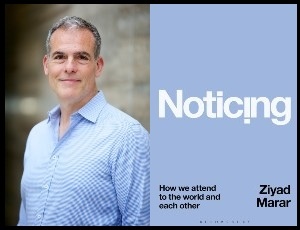
Since Marar, the president of Global Publishing at Sage, has been integral to the foundation of Social Science Space and has been a proven ally of social and behavioral science, we took advantage of our proximity to quiz him about the book and the concepts it explores.
His books — Noticing, published by Bloomsbury today, is his fifth — combine his interests in psychology and philosophy with cultural references like films, TV and novels. He is a passionate advocate for the value of social science and has written and spoken on these themes for many years, often here at Social Science Space. He was elected as a Fellow of the Academy of Social Sciences in 2020.
S3: Your public-facing books – on judgment, happiness, deception and intimacy – might be seen as part of a mosaic that now includes noticing. What larger picture are you aiming to create?
Ziyad Marar: I suppose I’m circling around the puzzle of how we manage to live together as social creatures while being fundamentally unknowable to each other – and often ourselves. I’m fond of a line from the psychotherapist Adam Phillips which I think goes “we are more complicated than we like to appear to be.” It obviously suggests there’s more going on than we might think, but the rider “than we like to appear to be” suggests we are invested in not noticing that reality. We present a simpler self-image as more coherent, rational, nice and in control, while the reality is messier than that.
This last book on noticing is the most direct engagement with that theme, but the previous books all work on that assumption starting with an idea that sounds simple, such as happiness or judgement, and complicating it. I suppose my guiding pre-supposition has been that complicating our sense of self and others is more honest and accurate and increases our chances of living a richer and more meaningful life.
S3: How does the social science imagination play into your approach as both an author – and as a human being?
Ziyad Marar: That relates to the first question because our over-simplified self-perception tends not to take into account the social environment in which we exist nor indeed to the unconscious psychological forces that operate outside our awareness (as I detail in my essay on that question). I lean, in my books, quite heavily on psychology and sociology to make this complicating point. While I enjoy exploring these themes in my books I’m not sure how much I’m able to live my daily life that way. Social scientists have shown us how good we are at overlooking these complexities in a busy world, so I spend more time than I should acting like the fish swimming along, blissfully unaware of the water in which it is suspended. But when I’m writing it reminds me to step back and look past the self-serving story-telling I’m doing most of the time.
S3: Let’s talk about the book specifically. After having written more than 200 pages on noticing, could you now tell me what noticing is in a paragraph or two?
Ziyad Marar: I define noticing as a process of becoming aware, that alters you in some way even if very fleetingly. It’s not just about perception, much of which is happening unconsciously, or awareness which is a more stable state. It’s like the bridging link between the two, whether noticing is incidental and fleeting or highly consequential. I think what we each notice and what we overlook offers a fascinating lens into understanding ourselves and each other, because what we notice clues into our experience, expertise, temperaments, neuro-typicality, hopes, fears, motives, needs and much more. A jealous person notices different things than a secure one. Someone feeling precarious literally sees more threats. And that’s where it gets morally and politically loaded. Who we notice and what we notice about them is uncomfortably linked to power, status, security. I use the Graham Swift novel Mothering Sunday to show how the servant in the book, Jane Fairchild, must notice everything her employer needs while remaining invisible and overlooked herself.
S3: You work as an executive in a social science-rich publishing company. How much social science is just noticing written down?
Ziyad Marar: I’m a persistent advocate of the value of social science because I believe understanding human beings and the societies in which we operate is vitally important. While you get the occasional specialist sociological noticer, like Erving Goffman, social scientists from psychology to political science, from criminology to cultural studies are mainly developing theories, collecting and analyzing data and in myriad ways doing research that goes far beyond everyday noticing (written down or otherwise) and influences everything from social policy to public debate. In fact this work often sheds light on the very idiosyncratic and limited act of everyday noticing itself and how we need research to overcome those, often, self-serving perceptions.
S3: Several times in the book you describe the approach of children to noticing, a sort of naive noticing (if naive were shorn of negative connotations). Do we need more “child” researchers or researching in the social sciences?
Ziyad Marar: The distinction you’re getting at comes from Alison Gopnik who, in her book The Philosophical Baby, provides a useful contrast between the spotlight and the lantern. Our spotlight driven noticing tends to focus on meeting needs, while the lantern mode is a more open kind of awareness, like peripheral vision. The young children we once were exemplify the latter far more than the adults we turned into as we accumulate clearer goals and projects which require focus. And while I think we adults should develop those counter-balancing, child-like lantern style skills I wouldn’t want to elevate that goal to the extent it limits the value of the very useful spotlight. And researchers, to your question, typically need to be in spotlight mode as they test the theories they have developed.
S3: In describing tools to enable noticing, you mention to “want nothing from the scene.” Would you say that to “want nothing from the scene“ is a key tool, or perhaps even the key tool, to critical thinking?
Ziyad Marar: This formulation comes from Marion Milner, who, in A Life of One’s Own, distinguishes between narrow and wide attention which I think of as similar to Gopnik’s spotlight and lantern. She recognizes that adults typically operate with narrow attention and feels that one way to develop the wider version is to ‘want nothing from the scene’. Ie to stop the persistent rise of motives and pre-occupations (whether positive or negative) which narrow down our focus again. And even if it’s a difficult task (to do for an extended period at least), I do think the attempt to go wide can help with critical thinking. Becoming conscious of the agendas or pet theories to which we are prone and our tendency to have confirmation and other biases and the blind-spots that can result, are some of the main blockers to thinking critically.
S3: In writing you sweep from social science to wet science to fiction and even to song lyrics. Would you say that’s (mostly) a conscious decision to be multidisciplinary, an effort to be comprehensive, or just the way you mind/interests work?
Ziyad Marar: Definitely a feature of how my mind works, and distracting to me at times! I’ll be reading a neuroscience article about the default mode network and start thinking of Dennis Potter, the TV dramatist, as he contemplated his impending death, looking at blossoms. But I also hope doing it that way makes for a more interesting read, for some at least. Sometimes the links I make are a bit strained, but I hope they give different readers different ways into the themes I want to explore. Obviously, there’s plenty that people can just skip over if it doesn’t interest them – some want to read about George Eliot and Philp Larkin while others want their psychology and philosophy neat!
S3: If a reader only had one takeaway from ‘Noticing,’ what would you hope that would be?
Ziyad Marar: We all hope to be noticed, seen, justified in a certain way. And it’s understandable that we worry about unreliable potent audiences who may or may not provide that recognition. My suggestion is, rather than worrying too much about being seen, to flip that thought around and to recognize our roles as noticers. To actively notice rather than waiting to be noticed. To be the audience, to take responsibility for the justification we can provide to others by recognizing them in their own terms. This means dialing down the self-absorption that can stop us noticing what people are saying, doing, being in their own terms – what Iris Murdoch called “unselfing” the “fat relentless ego.” It’s hard to do this, but unless we do, there won’t be enough noticing to go around. And by doing so, we may hope to get well-noticed in return.