The Quest for Impact: The Case of Academic History
This looks like it is going to have all the makings of bestseller …
Writing a week ago in Melbourne’s The Age, popular historian Paul Ham launched a frontal assault on “academic history” produced by university-based historians primarily for consumption by their professional peers.
In his article, Ham muses on whether these writings ever “enlightened or defied anyone or just pinged the void of indifference” Lamenting its alleged inaccessibility and narrow audience, Ham asks with incredulity:
What is academic history for?
Ham’s is only the latest in a steady stream of attacks castigating historians and other scholars for their inability to engage the general public effectively. New York Times columnist Nicholas Kristof sent American academia into a collective apoplectic fit with a February column imploring academics to make a greater contribution to policy debates as public intellectuals.

This piece by Paula Michaels originally appeared at The Conversation, a Social Science Space partner site, as “What is academic history for?”
Less convinced than Ham of the purposeful obscurantism of academic writing, Kristof nonetheless met with a sharp rebuke from the academy, which defended its track record for engagement and faulted Kristof for pointing only to the highest profile venues to judge scholars’ participation in debates beyond the Ivory Tower.
As political scientist Corey Robin observes:
There are a lot of gifted historians. And only so many slots for them at The New Yorker.
Scholar-turned-Buzzfeed-contributor Anne Helen Petersen notes that, in combination with a shortage of academic jobs, “the rise of digital publishing has ironically yielded an exquisite, flourishing community of public intellectuals”, as The Conversation itself attests.
But the opening up of a raft of new, online avenues for smart, serious commentary and analysis has no corollary in the book business. If Kristof’s cardinal sin is an elitist reluctance to look beyond the most venerable establishment periodicals, Ham’s central failure is a seemingly wilful blindness to the role market forces play in the publishing industry.
Is there value to scholarship that falls outside the narrow parameters of what is financially feasible for a commercial press? Of course there is, not least because scholarly studies, though often narrowly conceived, nonetheless inform the work of those engaged in topics of broader interest.
Academic historians fail to make their way into Amazon’s Top 100 list not because they are unable or, as Ham asserts, unwilling to write accessibly. I doubt there are many academic historians who, whether out of passion for their subject or sheer ambition, would turn down the opportunity to enjoy a moment in the limelight.
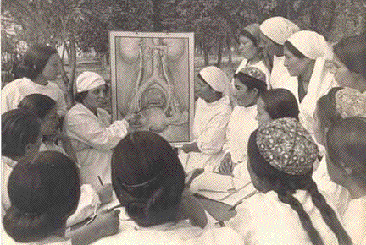
But the path of popular history is closed to most historians because of the very subjects of their investigation. No amount of finesse with the written word would have put my first book, on the history of medicine and public health in Soviet Kazakhstan, on the shelves of Dymock’s. The publishing of popular history is driven not by how scholars write, but by what readers are willing to buy.
Is there value to scholarship that falls outside the narrow parameters of what is financially feasible for a commercial press? Of course there is, not least because scholarly studies, though often narrowly conceived, nonetheless inform the work of those engaged in topics of broader interest.
Take, for example, the work of popular American presidential historian Doris Kearns Goodwin. She investigates first-hand the relevant primary sources, but she also supports her analysis by drawing on works that delve deeply into the more slender crevices of history. The research of perhaps hundreds of historians informs her understanding of the world in which her protagonists operate.
No one would expect every scientist to produce work that was at once highly sophisticated and accessible to the lay reader. There is a depth and detail of analysis that is only of interest to the specialist but necessary for the field’s advancement; we value American astrophysicist Neil Degrasse Tyson’s ability to distill that vast, dense body of scholarship and present it to us with crystal clarity on the TV series Cosmos: A Spacetime Odyssey.
And when he turns to evolutionary biology, far from his own area of expertise, he leans entirely on the research of others. Similarly, Kearns Goodwin and her fellow popular historians rely on the solid, vetted works of academic historians to tell their more accessible stories for popular audiences. That act of translation does not render the original scholarship superfluous, but rather attests to its impact.
Publications are, of course, only one measure of public engagement. Through work in the classroom, academic historians translate and interpret scholarly writings for and alongside students.
They are also out in the community, sharing their expertise in public talks designed for general audiences at museums, at schools, at retirement communities, and elsewhere, such as at the Making Public Histories Seminar Series run by Monash University and the History Council of Victoria and held at the State Library of Victoria.
Not only are academic historians clearly far more engaged with the public than they appear at a first, blinkered glance, but there seems to be ample room for and value in a wide range of intellectual activity. Perhaps it’s time to set aside pot shots and straw men and recognize that the changing terrain of public engagement allows for a multiplicity of voices and forms of expression.
It’s not all about making the bestseller list.