Learned Commentary on the Legacy of January 6 Attack
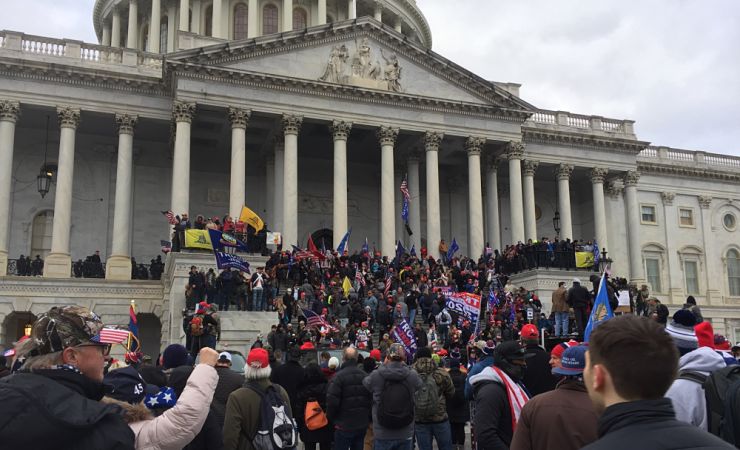
The January 6 insurrection in Washington, D.C. offered social scientists a chance to unlimber the saying about never letting a crisis going to waste. The crisis provided both a natural experiment for current research and a chance to see if past predictions might play out as expected .
While a year after the event is still a little soon for the full weight of academic investigation to have been proposed, conducted, been peer-reviewed and published, and few institutions are overtly recognizing the event’s anniversary, a body of learned commentary has arisen in the last 12 months. We’ve collected a handful of some of the more thoughtful pieces published by SAGE Publishing (the parent of Social Science Space) in the last year that can help make sense of what happened, why it occurred, and what we might expect to see in the near future as a result. Click on the article title to read the article.
“Will Failed Insurrection Lead to Terrorism in the United States?” by Martha Crenshaw | Violence: An International Journal
In this research essay, Crenshaw, a senior fellow at Stanford’s Freeman Spogli Institute for International Studies, applies her five decades of studying political violence to examine possible outcomes of an attack which failed to achieve its goals of maintaining Donald Trump’s hold on executive power. Crenshaw’s erudite examination notes that failure on January 6 may not be a comprehensive as hoped: “Research has shown that terrorism can be an effective substitute for the mobilization of large numbers when that mobilization is thwarted.”
“The Rise of Presidential Eschatology: Conspiracy Theories, Religion, and the January 6th Insurrection” by Bayleigh Elaine Bond, Ryan Neville-Shepard | American Behavioral Scientist
Bond, a political communication graduate of the University of Arkansas, and Shepard, an associate professor of communication at Arkansas, offer a messianic mechanism to understand the devotion of the insurrectionists to Trump. “With QAnon making the opening move, the president morphed into the Savior figure they desired, a role that was normalized by his allies calling the election a spiritual battle. While presidents have invoked God in the past, Trump’s actions marked a turning point in presidential appeals to faith.”
“Memory politics in the future tense: Exceptionalism, race, and insurrection in America” by Piotr Szpunar | Memory Studies
An interdisciplinary scholar at the nexus of communication and political theory, SUNY-Albany’s Szpunar examines January 6 through the lens of the Bush v. Gore decision, in which the popular vote winner of the 2000 presidential election declined to pursue his claims to the nth degree. Spuznar asks if recasting that as a moment of American exceptionalism in turn means we can expect the narrative of the failed insurrection to be laundered of its racist subtext.
“Decline, radicalization and the attack on the US Capitol” by Andrew H. Kydd | Violence: An International Journal
Political scientist Kydd, author of Trust and Mistrust in International Relations, argues “that the attack on the Capitol was the culmination of a decades-long process of decline and radicalization in which the core of the Republican Party walled itself off from challenging information and lost faith in the impartiality of all institutions in society.” While that may mark the apex of anti-democratic impulse, he closes with the somber observation that “the structural conditions predisposing the United States toward political violence may persist for some time.”
Also on Social Science Space
“Might the ‘Sore Loser Effect’ Legitimize Violence?” by James Piazza
“Words Matter: Shamelessly Normalizing Big Lies And Alternative Facts” by Ruth Wodak
“When Ignorance is Anything But Bliss” by David Canter
“Harnessing the Power of a Mob” by David Canter
“‘Once You Engage in Political Violence, It Becomes Easier to Do It Again’” by Naomi Schalit and Ore Koren