Translating Research to Policy: Improving Justice for Women and Girls
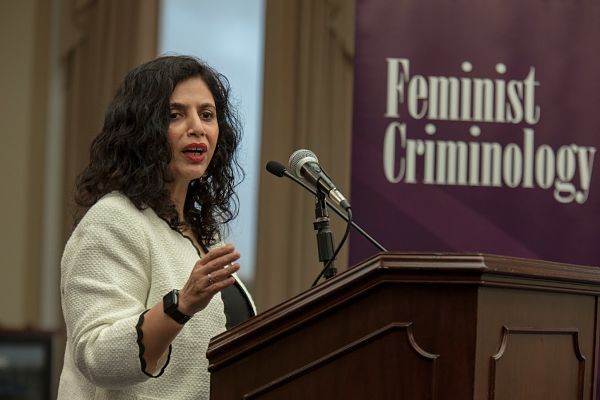
Sheetal Ranjan
Many American institutions have not fully implemented federal Title IX requirements designed to protect college students against gender discrimination and gender-based violence, according to a study by Tara Richards, assistant professor in the School of Criminology and Criminal Justice at the University of Nebraska, Omaha.
In 2015, 33 percent of institutions did not have an appointed Title IX coordinator, 30 percent did not notify students of available interim measures and support to victims of sexual harassment, and 23 percent did not notify students that they could assist in filing reports to law enforcement.
Richards proposed the Campus Accountability and Safety Act to increase training and resources for staff members at institutions and authorize civil penalties on institutions that fail to meet Title IX requirements. She also suggested amendments to the Higher Education Act that would allow the U.S. Secretary of Education to use these penalty provisions to award grants to campuses that comply with federal mandates and respond to campus gender-based violence.
Richards was one of the many researchers who proposed ways to turn their research into legislation to protect women at the first congressional briefing of the American Society of Criminology (ASC).
Held on Oct. 11, 2018, in Washington, D.C., the briefing featured ASC Division on Women and Crime (DWC) researchers from universities across the country presenting their evidence-based suggestions for the improvement of existing policies and legislation, as well as new legislative and funding initiatives. These recommendations reflected the division’s overarching mission of the improvement of justice for women and girls.
“We are here because we believe DW Scholarship should drive policy to improve justice for women and girls,” said Sheetal Ranjan, chair of the Division on Women and Crime and associate professor at William Paterson University, in her opening statement.
The DWC is a branch of the ASC “comprised of scholars and practitioners…who are committed to feminist perspectives on gender, crime and justice.” In her opening remarks, Ranjan emphasized the importance of feminism and gender-focused scholarship in mainstream criminological discourse. “We want you to know that scientists can be feminists, too, and feminists can be scientists.”
Like Richards, 12 other DWC researchers summarized findings in their areas of expertise and presented evidence-based policy changes and initiatives addressing issues such as cyber abuse of women and girls, women in the correctional system and asylum protections for immigrant women. The researchers presented their ideas before an audience of legislative aides, federal agency representatives, justice system practitioners, and faculty and students from nearby universities.
Rosemary Barberet, professor at John Jay College of Criminal Justice and past editor of Feminist Criminology, presented the history of the official journal of the DWC, Feminist Criminology, which has been published by SAGE since it was founded in 2006. Published five times a year, Feminist Criminology also awards an annual Feminist Criminology Graduate Research Scholarship and an annual Larry J. Siegel Graduate Fellowship.
You can read policy essays from this briefing in a special issue of Translational Criminology, the magazine of the Center for Evidence-Based Crime Policy at George Mason University.
Photos and videos from the event are available online.