CASBS Welcomes 2025-26 Cohort of Fellows
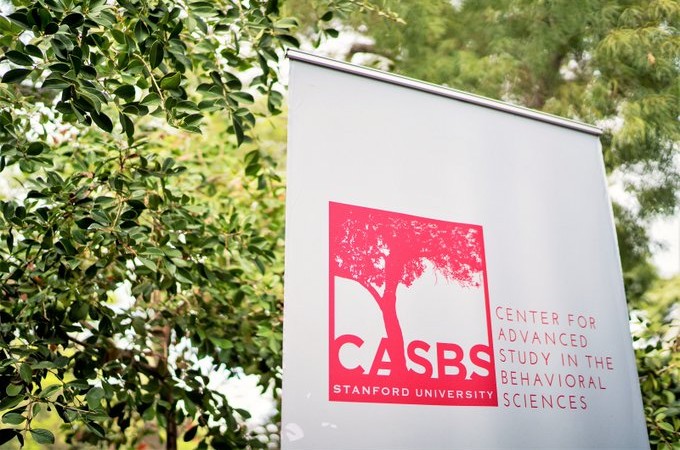
Some 33 individuals from academe and private industry make up the 2025-26 class of fellows from the Center for Advanced Study in the Behavioral Sciences (CASBS) at Stanford University. The class, which arrived at the CASBS campus at Stanford last month, represents 18 U.S. institutions and 12 international institutions and programs; three of the incoming group have been CASBS fellows in the past.
The new fellows work in a variety of fields in the social and behavioral sciences and cognate disciplines, including agriculture, anthropology, business, communication, economics, history, law, philosophy, political science, psychology, public health and nutrition, and sociology.
“With leadership change occurring at a pivotal moment in the affairs of the country and world, it’s imperative that the center ensures an enduring constant: its assembly of a community of superb cross-disciplinary thinkers as members of its residential fellows program. Today’s difficult societal questions and problems demand no less,” said Sally Schroeder, CASBS deputy director.
CASBS itself has had a leadership change. Interim Director Lara Tiedens, herself a fellow from the 2008-09 class, started a one-year term in June.
Several fellows are funded by some of the Center’s partner fellowship programs.
- Stanford-Taiwan Social Science fellow Denise Hsien Wu is supported by the Science and Technology Policy Research and Information Center within the National Applied Research Laboratories of Taiwan.
- CUHK-Stanford University CASBS fellow Seanon Wong is supported by Chinese University of Hong Kong.
- National University of Singapore supports NUS Fellow Bussarawan Teerawichitchainan.
- The first RJ-CASBS Fellow, Loretta Platts, is supported by Riksbankens Jubileumsfond, an independent foundation in Sweden.
- STIAS-Iso Lomso Fellow Nasandratra Ravonjiarison is supported in collaboration with the Stellenbosch Institute for Advanced Study, South Africa.
- VMware Women’s Leadership Lab Fellow Ellen Ernst Kossek is supported in collaboration with the Stanford VMware Women’s Leadership Innovation Lab.
CASBS has three other appointment designations in addition to fellows: visiting scholars (academics who are spouses/partners of fellows), research affiliates (non-Stanford scholars who lead CASBS-based research projects), and faculty fellows (Stanford faculty who lead CASBS-based research projects).
2025-26 Fellows
Maya Altman, Public Policy, Former CEO Health Plan of San Mateo
R. Lanier Anderson, Philosophy, Stanford University
Miroslava Chavez-Garcia, History, University of California, Santa Barbara
Noshir Contractor, Communication, Northwestern University
Kenneth A. Dodge, Psychology, Duke University (fellow in 1989-90 and 1995-96),
Yaffa Epstein, Law, Uppsala University
Elena Esposito, Sociology, Bielefeld University and the University of Bologna
Deepa Fernandes, Communication, WBUR Public Radio
Corey Fields, Sociology, Georgetown University
Ram Fishman, Economics, Tel Aviv University
Alexandre Fortes, History, Universidade Federal Rural do Rio de Janeiro
David Fortunato, Political Science, University of California, San Diego
Vasiliki Fouka, Political Science, Stanford University
Aaron Glantz, Communication, The Guardian
Ian Goldin, Economics, Oxford University
Everett Harper, Business, Trussworks, Inc.
Daniel Ho, Law, Stanford University
Pauline Jones, Political Science, University of Michigan Ann Arbor
Ellen Ernst Kossek, Business, Purdue University
Batja Mesquita, Psychology, KU Leuven (past fellow in 2016-17)
Olukunle Owolabi, Political Science, Villanova University
Loretta Platts, Public Health, Stockholm University
Nasandratra Solofo Ravonjiarison, Agriculture, Antananarivo University
Sandra Ristovska, Communication, University of Colorado Boulder
Rajiv Sethi, Economics, Barnard College, Columbia University
Mary Shenk, Anthropology, Pennsylvania State University
Jeff Spinner-Halev, Political Science, University of North Carolina at Chapel Hill
David Stark, Sociology, Columbia University (past fellow in 1995-96)
Mary Kate Stimmler, Business, University of California, Berkeley
Bussarawan Teerawichitchainan, Sociology, National University of Singapore
Jeanne Tsai, Psychology, Stanford University
Ralph Wedgwood, Philosophy, University of Southern California
Seanon Wong, Political Science, Chinese University of Hong Kong
Denise Hsien Wu, Neuroscience And Neurobiology, National Central University
Wen-Chin Wu, Political Science, Academia Sinica
Linda M. G. Zerilli, Political Science, University of Chicago