 Career
 How Journal Impact Factor Affects Your Career
The Journal Impact Factor: few scholars will be unfamiliar with this controversial metric. Appearing on journal websites, academic CVs, and in hiring decisions—it’s both the most widely used and the most criticized research metric that exists.
Although the Journal Impact Factor (JIF) was originally developed to help libraries make indexing and purchasing decisions for their journal collections, it has become a proxy for quality—not just of the journals academics publish in, but of the academics themselves. Many now believe that publishing work in high JIF journals is an essential step to achieving academic success.
And although many have raised concerns about the JIF’s use — and potential misuse — in current academic evaluation systems, little is known about the extent to which the metric features in tenure and promotion decisions.
To find out, we examined more than 860 review, promotion, and tenure (RPT) documents from universities across Canada and the US for mentions of the JIF. Here’s what we found:
How often is the Journal Impact Factor mentioned in tenure guidelines?
The JIF appeared in several of the RPT documents we collected, especially for institutions that prided themselves on their research outputs.
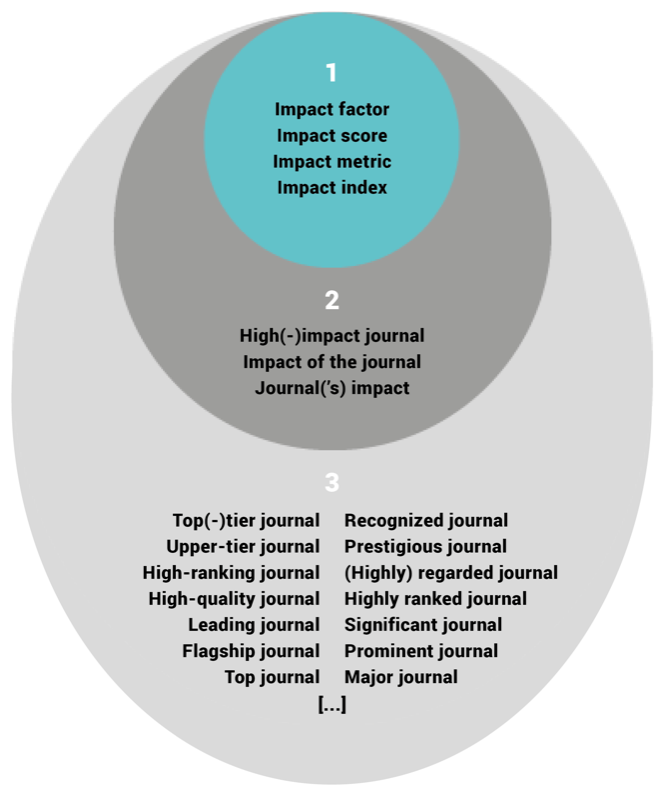
More than 40 percent of research-intensive institutions (R-type) mentioned the JIF, and 18 percent of master’s institutions (M-type) did. We also identified over a dozen terms that alluded to the JIF without mentioning it explicitly, suggesting that our results may be under-representing its use.
Do tenure guidelines support the Journal Impact Factor’s use?
Of the institutions that mentioned the JIF, 87 percent were supportive of its use. Only 13 percent were cautionary about using the metric in tenure considerations. None heavily criticized the JIF or prohibited its use.
For example, guidelines described the JIF as the “most reliable” and “most extensively used” research metric for evaluating faculty performance. Others emphasized that “Publication in respected, highly cited journals… counts for more than publication in unranked journals,” and encouraged candidates to include “information about the Impact Factors or related metrics” in their promotion files.
What do tenure guidelines assume the Journal Impact Factor measures?
Of the research institutions that mentioned the JIF in their tenure guidelines, most described it in one of three ways:
- Over 60 percent associated the JIF with quality. This goes against previous research that has questioned this association. We saw statements like, “Markers of quality of publications may include impact factors of journals, number of citations of published work, and audience of journal.”
- Some institutions—about 40 percent of our sample—associated it with impact, importance, or significance. Documents stated that “metrics such as citation figures, impact factors, or other such measures of the reach and impact of the candidate’s scholarship” would be considered in the tenure process.
- Finally, 20 percent of institutions associated the JIF with prestige, reputation, or status. For example, guidelines emphasized that faculty should “be aware of the prestige rankings of the field’s journals and … publish in the highest-ranked journals possible.”
A long way to go
Together, these findings suggest that the concerns about the JIF’s misuse in academic evaluations are warranted. Not only do universities—especially research-intensive ones—continue to encourage the use of the JIF in RPT evaluations, they also use it to measure aspects of research that it is ill-suited to measure. Until this changes, the potential “impact” of the Impact Factor on our professional futures cannot be underestimated.
Read the full preprint here.