Webinar

Watch the Webinar: How Social Science Advances Our Understanding of Pandemics

June 25, 2021 3071

Scientific research, innovation, and evidence have contributed to COVID-19 mitigation and response. As parts of the globe emerge from a second year of life under pandemic, to what extent have social and behavioral science insights illuminated our understanding of the alignment between human behavior and the recommendations of epidemiologists and public health experts? What gaps remain in our data and knowledge? The webinar

Pandemics have no respect for borders. Yet borders – both at national and sub-national levels – play an undeniable role in determining population vulnerability and resilience in the face of infectious disease. In the United States, almost all aspects of the COVID pandemic have been polarized. Why? How can cross-national and historical analyses inform our perspective of how citizens learn from and engage with scientists, experts, and each other? What do we know, and what remains unsettled, regarding social and cultural influences on science communication, decision making under uncertainty, leadership, governance, the psychological burdens of stress and anxiety, the friction between individual and collective interests, and behavior more generally? In this hour-long webinar, four fellows of the Center for Advanced Study in the Behavioral Sciences (CASBS) Peter Loewen of the University of Toronto, Adrian Raftery of the University of Washington, Prerna Singh of Brown University, and Robb Willer of Stanford University, joined The Atlantic‘s Alexis Madrigal to consider such questions and appraise the state of the art in social and behavioral science research, essential if we intend to prepare for and respond to future pandemics more effectively.

The webinar, part of the CASBS Social Science for a World in Crisis series, took place on June 23, 2021.

This event is produced by the Center for Advanced Study in the Behavioral Sciences at Stanford in partnership with CIFAR, the Public Policy Forum, SAGE Publishing, the Stanford Center on Philanthropy and Civil Society, and the Pandemic Action Network.
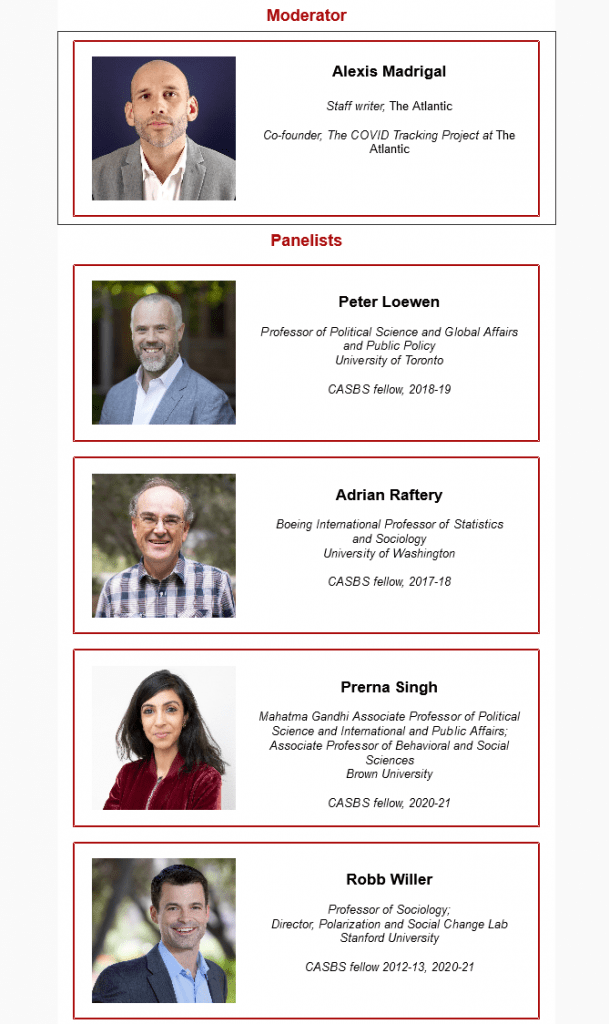

Graphic showing pictures of webinar participants

The Center for Advanced Study in the Behavioral Sciences at Stanford University is a national and international resource that exists to extend knowledge of the principles governing human behavior to help solve the critical problems of contemporary society. Through our residential postdoctoral fellowship programs for scientists and scholars from this country and abroad, we seek to advance basic understanding of the social, psychological, historical, biological and cultural foundations of behavior and society.

View all posts by Center for Advanced Study in the Behavioral Sciences

Related Articles

Political Theory Beyond the Text
Insights
May 11, 2026

Political Theory Beyond the Text

Read Now
Tom Gilovich On the Spotlight Effect
Social Science Bites
May 4, 2026

Tom Gilovich On the Spotlight Effect

Read Now
Whose Work Most Influenced You? Part 6: A Social Science Bites Retrospective
Social Science Bites
April 22, 2026

Whose Work Most Influenced You? Part 6: A Social Science Bites Retrospective

Read Now
Enhancing Scientific Integrity: Progress and Opportunities in the Social and Behavioral Sciences
Event
April 10, 2026

Enhancing Scientific Integrity: Progress and Opportunities in the Social and Behavioral Sciences

Read Now
From Passive Consumption to Active Verification: Embedding Critical Thinking as a Daily Cognitive Habit in Higher Education 

From Passive Consumption to Active Verification: Embedding Critical Thinking as a Daily Cognitive Habit in Higher Education 

In an era defined by algorithm-curated feeds, persuasive misinformation, and increasingly sophisticated AI-generated content, the challenge facing higher education is no longer […]

Read Now
Watch the Webinar: Empowering Social and Behavioral Science Researchers

Watch the Webinar: Empowering Social and Behavioral Science Researchers

In 2024, Sage surveyed social and behavioral science (SBS) researchers from 96 countries to better understand their motivation, if any, to conduct […]

Read Now
Ellora Derenoncourt on the US Racial Wealth Gap

Ellora Derenoncourt on the US Racial Wealth Gap

This Social Science Bites podcast offers a dollop of good news and heaping helping of bad. The good news is that since […]

Read Now
0 0 votes
Article Rating
Subscribe
Notify of
guest

This site uses Akismet to reduce spam. Learn how your comment data is processed.

0 Comments
Newest
Oldest Most Voted
Inline Feedbacks
View all comments