
Mapping the Connections: Understanding the Network of Social Science Editors-in-Chief
A new study on the connections between editors-in-chief in the social sciences reveals significant geographical and gender imbalances in editorial leadership. Male editors are more likely to occupy top positions at journals, while two countries – the U.S. and the U.K. – play a central role in shaping social sciences fields.
The study, conducted by Manuel Goyanes, Luis de-Marcos, Timilehin Durotoye, Triwik Kurniasari, and Homero Gil de Zúñiga and appearing in PLOS One, examines the projected relationships between 4,868 editors-in-chief from 3,320 Journal Citation Reports-ranked journals, investigating how shared institutional and national backgrounds underpin this network of connections.
The findings reveal how editorships can identify key fields, including economics, political science, and education, that connect a broad range of institutions in ways that might otherwise not be obvious. Top U.S. and U.K. universities have substantial editorial presences in these areas, giving them greater reach and influence within the social sciences publishing network.
The study also highlights a lack of female representation on editorial boards, with nearly all research areas being dominated by male editors-in-chief. Notably, male editors outnumber their female counterparts across fields (66.67 percent), countries (76.60 percent), and institutional affiliations (63.16 percent).
What’s the impact – and what can we do about it?
Editors-in-chief, the paper argues, play a critical role in “shaping and disseminating scientific knowledge” (page 15 of the PDF version). Consequently, the geographical and gender-based disparities of editorial boards may have profound effects on the future of research.
The centrality of U.S. and U.K. institutions suggests an editorial concentration that could potentially, the researchers suggest, “influence the decision-making process of scientific publishing in almost all fields” (19). This geographical dominance risks “a significant shortfall in the recognition of empirical knowledge” (19) from other countries.
Similarly, the over-representation of male editors-in-chief “might affect the diversity of research perspectives and the overall direction of scholarship” (10), perhaps narrowing research scope and continuing “a skewed perspective in various disciplines” (20).
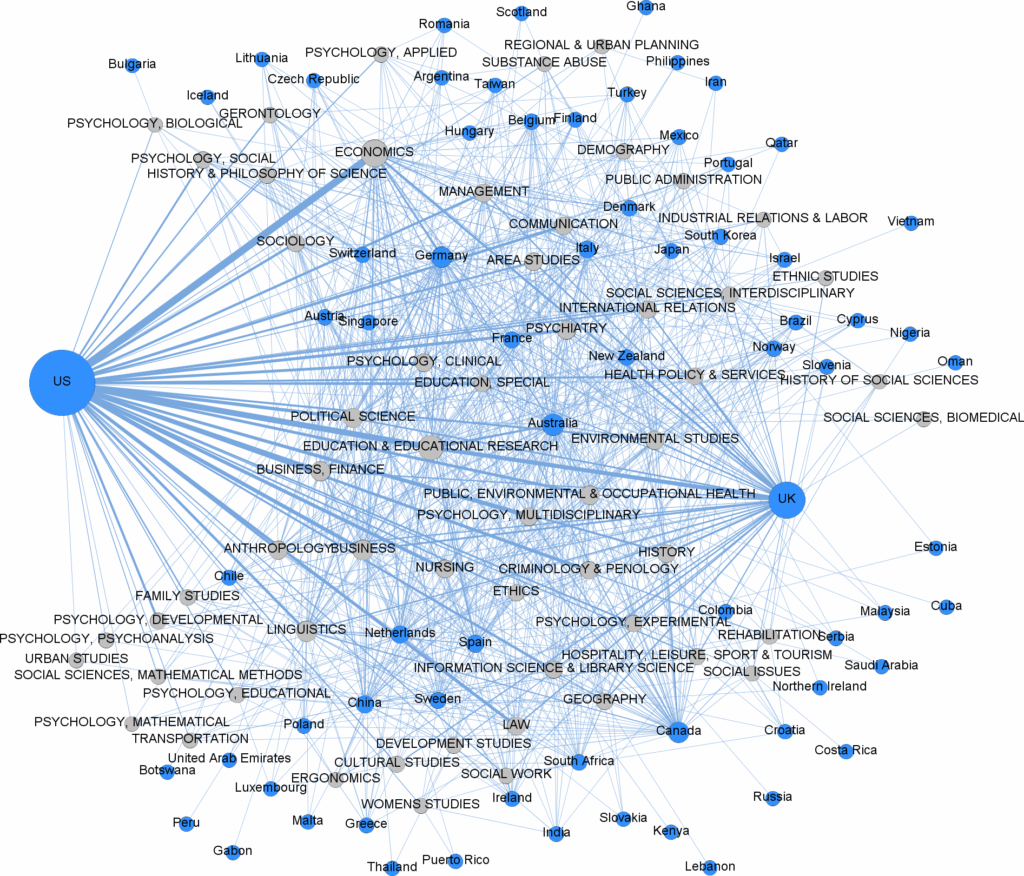
Revealing the dominance of male editors from the U.S. and U.K., these findings demonstrate “the need to create an even balance in editorial leadership” (16). The study indicates that promoting diversity, equity, and inclusion (DEI) within editorial roles could help foster “a more balanced and representative scholarly community” (20).
How can we get there? The researchers offer the following suggestion:
“One of the recommendations arising from our findings as a strategy to address male predominance in the global academic environment is the need to dissipate the monopoly of male EiCs in top Western countries, facilitate further decentralization of editorial authority across less dominant nations, and support a significant increase in the inclusion of female researchers/scientists in journal editorial boards as well as in the byline of publications.” (20-21).
Read the full open-access article for further insights on creating more representative leadership in social science.