Bear Braumoeller, 1968-2023: Prescient Observer of the International Order
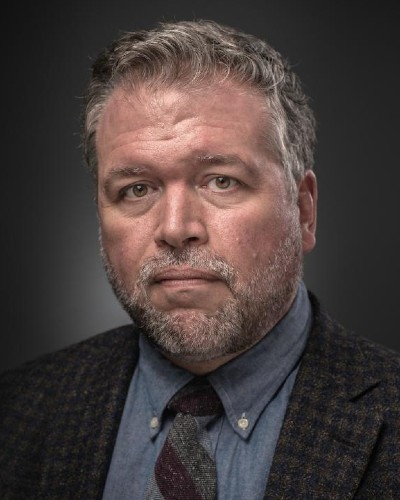
Bear Braumoeller, a political scientist and computational social scientist whose work on international conflict in today’s world seemed especially prescient after Russia’s war on Ukraine, has died in Oslo, Norway, where he was a fellow the Centre for Advanced Study at the Norwegian Academy of Science and Letters. He died after a short illness on May 3 at age 55.
A professor at The Ohio State University, Braumoeller’s multidisciplinary project at the Norwegian Academy examined our understanding of how wars escalate. His most recent book, Only the Dead: The Persistence of War in the Modern Age, argued that the ‘decline-of-war’ thesis most prominently advanced of late by psychologist Steven Pinker is not supported by facts on the ground.
War, he said, is better predicted by following the ebb and flow of the international order rather than perceived improvements in human empathy and morality. In a 2022 Washington Post op-ed on the war in Ukraine he wrote, “My research has shown that members of the same international order rarely fight one another, but frictions between international orders are a common source of conflict.”
His statistical acumen, modeling and historical inquiry (such as parsing the Correlates of War dataset) into the “causes and consequences of war” led him to state that “you don’t see any long-term decline of war, regardless of how you measure it.”
He told the Modern War Institute in 2019, just after Only the Dead was published, “We are a lot like people in an earthquake-prone region that just hasn’t seen a lot of earthquakes recently. Nothing fundamental about the way earthquakes happen has changed, but because we haven’t seen them recently we’ve decided to let our earthquake insurance slide.”
While he did see that humanity had made some progress in pushing an international order that more values peace, we’re not there yet. As he told the 80,000 Hours podcast:
Bear Frederick Braumoeller was born January 31, 1968, in Walnut Creek, California. He earned a bachelor’s degree in international relations from the University of Chicago in 1990, with his senior thesis on “Surprise attack.” He earned a master’s in 1994 and a doctorate in 1998 from the University of Michigan, studying world politics, comparative politics with a focus on Russia, and research methodology. During his studies, the International Studies Association presented him its 1996 Carl Beck Award for best graduate student paper, “Deadly Doves: Liberal Nationalism and the Democratic Peace in the Soviet Successor States.”
He served as an assistant professor at the University of Illinois, Urbana-Champaign, from 1998 to 2000, then moved to Harvard University as an assistant and then associate professor in the Department of Government from 200 to 2007. In 2007 he took a position at Ohio State, where he would remain until his death. In 2019 he was named the Baronov and Timashev Chair in Data Analytics at OSU.
Braumoeller founded the MESO (Modeling Emergent Social Order) Research Lab in 2020, aiming “to combine social-scientific rigor with historical nuance and insight” in studying the conflict and the international order.
His first book, 2012’s The Great Powers and the International System: Systemic Politics in Empirical Perspective, would win the International Studies Association’s Book of the Year Award and the International Studies Association-Midwest’s J. David Singer Award. Braumoeller also authored software packages in Boolean statistics and qualitative comparative analysis and taught at the ICPSR Summer Program in Quantitative Methods of Social Research.
He was named a Fellow of the American Association for the Advancement of Science in 2022, and received a Nobel fellowship in 2016.
Braumoeller was a popular teacher and graduate adviser at OSU. His renown extended past the classroom into the dining room, where in addition to co-founding Slow Food Columbus [Ohio] he was well known for passionately diving into any cuisine or “good, clean, fair” food that could teach him a thing about culture of his own palate.
He is survived by his wife Kristen and daughter Molly.