The Musée des Confluences: Celebrating Secularism and the Sciences
What does one do on a wet Sunday afternoon in Lyon, France? The shopping malls are closed, as are many of the cafes and small shops. The museums, however, remain open. The French state takes culture seriously. If shopworkers have their weekend time protected, museum workers have theirs deferred to Mondays. One option is the Musée des Confluences. This is housed in one of those modern public buildings the French do so well. In this case a bold structure in glass and steel that must glisten in the sunshine on brighter days. It stands on a promontory at the confluence, the intersection, of two great rivers – the Rhone and the Saône. The museum’s name plays on its location to explore other comings together between society, science and environment. Unusually for a science museum, it gives as much weight to the social as to the natural sciences. It is not a museum of sociology or anthropology, but the science content is never divorced from its social context.
In many ways, the Musée des Confluences is the mirror image of the creationist museums that dot the American South. It reflects the nature of the French state and its rigorous exclusion of religion from state-linked activities, especially in education. This goes back to the 1870s and continues to the present, despite occasional conflicts with minorities looking to express their faith within secular public schools. Hijabs, kippahs and crucifixes are equally prohibited within classrooms. They would not be banned for visitors to this museum, but its exhibits refuse to privilege Christian beliefs – or those of any other faith. The account of creation in Genesis is set alongside other narratives from around the world. You can listen to the Biblical version through a handset on the wall for precisely 90 seconds, exactly the same length of time that is given to stories from the ancient civilizations of Asia or the Americas.
The same approach can be found in the gallery devoted to death and the afterlife, which is designed to leave open the question of what, if anything, lies beyond. Christian views of heaven and hell are presented as a European expression of a widespread belief that some essence of our humanity survives death – we might call this a soul but we do not need to. It is unknown and unknowable. Perhaps there is just nothingness and oblivion, although it seems to be very hard for any human society to accept this.
The provocations continue throughout the gallery on science and technology. This is organized around three basic social science themes – organisation, exchange and communication – so that science and technology are not divorced from their context. It both celebrates advances and asks visitors to reflect on their potential costs. The exhibits on medicine, for example, are accompanied by a quotation from Ivan Illich that questions the cultural impact of the search for a utopian world free from death and disease. It is a long way from the ‘gee whiz’ presentation of marvels associated with an older style of science museum. Science here is allied to human purposes, for both good and ill. The visitor, rather than the designer, gets to decide which.
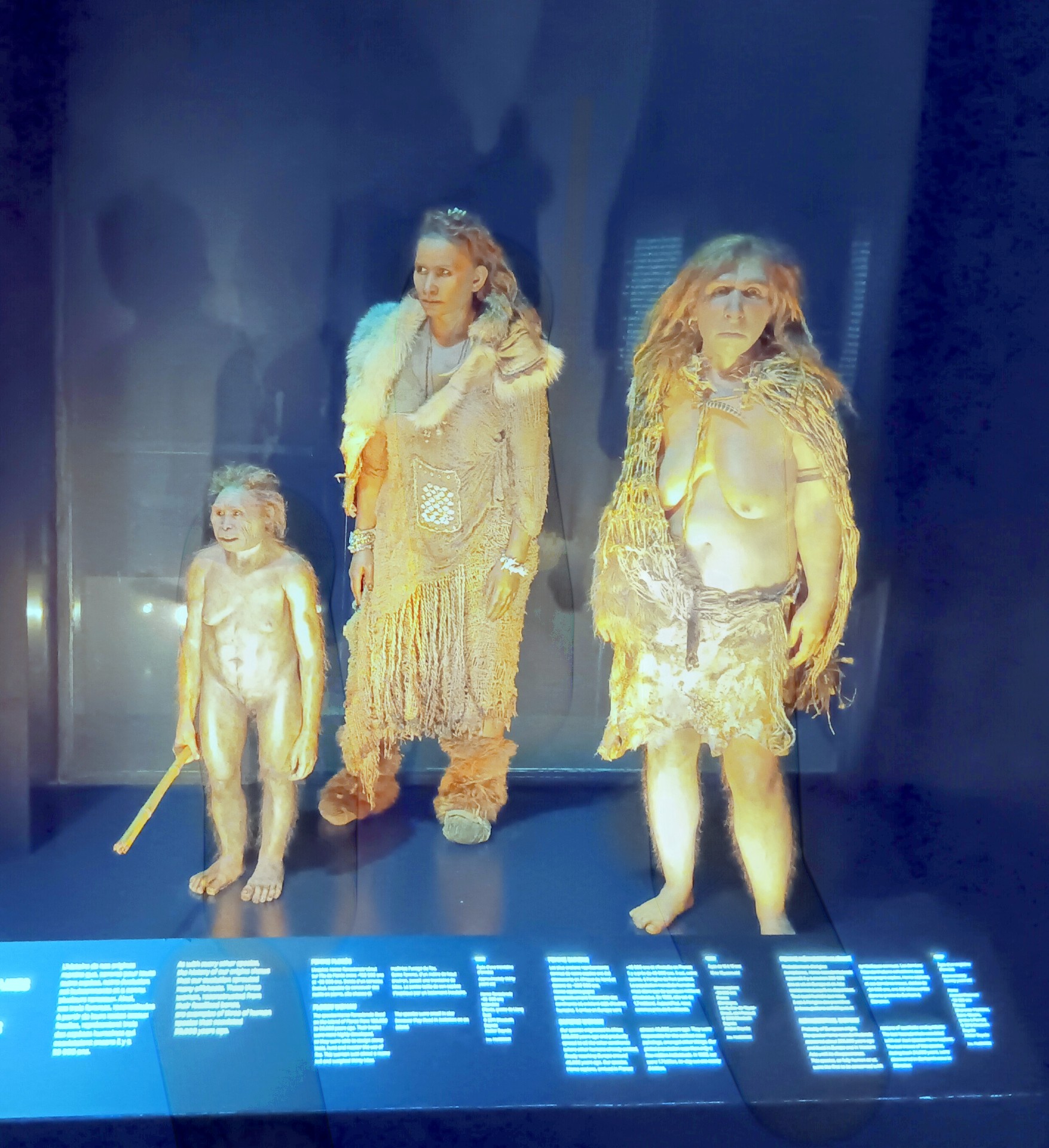
Of course, the biggest contrast to the creationist museum is the relentless focus on the impersonality of evolution through the interactions between species and environment. Humans are not exempted from this. We have experienced exactly the same natural processes as the butterflies whose evolution and speciation is brilliantly displayed. From the start visitors are confronted with the co-existence of three hominins until relatively recently: homo sapiens, homo neanderthalensis and homo floresiensis. The exhibit, pictured above, immediately challenges the model, which older visitors would have learned, of a linear ‘tree of life’ leading inevitably to modern humans. This is helped by the French use of the word buisson, which generally means a bush. It is much closer to Darwin’s own view of evolution. His preferred metaphor was the ‘tangled bank’ that he saw while walking country lanes near his home. Plant species constantly evolved through competition for resources to occupy distinctive niches in time and space. These ideas had a big influence on the Chicago School of sociology in the 1920s and 1930s as an alternative to the linear views of Social Darwinism. This saw white, bourgeois, European men as the ultimate achievement of evolution. Humans, both individuals and groups, who did not conform to this standard were necessarily doomed to extinction. For some it might even be a kindness to accelerate that fate…
Nevertheless, the exhibit does show the difficulty that we still have in transcending that way of thinking. Sapiens woman is dressed in furs and textiles that might feature in a winter collection on a Paris catwalk. Neanderthal woman benefits from some furs but this is not the designer version of naked dressing. Flores woman is entirely naked except for a light covering of body hair. It would be difficult to justify any of this from the archaeological record. Even in more recent times clothing is only preserved in quite specific environmental conditions and there is no artwork from 50,000 years ago that might depict these species. The exhibit reflects modern assumptions about environmental conditions: Europe was colder so hominins must have worn furs; people indigenous to tropical islands wear fewer clothes than those in the Arctic so Flores people must have done the same. However, the display does break with the common images contrasting Neanderthals with Sapiens by the presence of dense body hair. Neanderthal bodies are placed closer to Sapiens than to apes and recognized as bearers of manufactured artefacts.
It is a virtue of the Musée des Confluences that such questions can be asked. It is hard to think where else it would be possible to create such an institution with its relentless insistence that there is nothing special about humans, about the Christian faith or about the products of science and technology. This is not a didactic museum, except in the best sense of encouraging questions rather than imposing answers.
There are many good reasons for visiting Lyon – 16 Michelin-starred restaurants for a start! The Musée des Confluences is certainly another, much more than a diversion on a wet Sunday afternoon.