Can Accounting Impact Employee Wellbeing?
Although many may think of accounting as something abstract that happens only in spreadsheets, a new study shows that accounting can impact our wellbeing. Based on a large survey in a well-known multinational, researchers from VU Amsterdam and Yokohama City University find that participative budgeting practices can yield positive wellbeing effects.
Stress at work
First, let’s consider for a moment the typical middle manager. Sandwiched between top-management and the employees, they often find themselves in stressful situations. A 2025 report by Deloitte found that 40 percent of the managers experienced a decline in their mental health after taking on a managerial or leadership role, and another survey finds that almost three out of four middle managers sometimes or always feel stressed at work. What can be done to reduce their stress and enhance their job-related wellbeing?
Participatory work practices and wellbeing
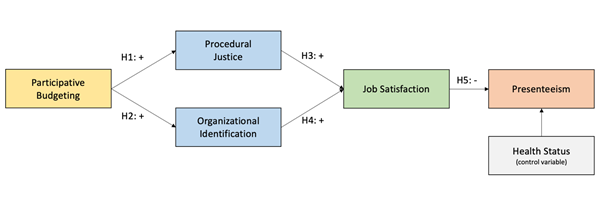
In our study, we find that giving middle managers a greater say in budgeting decisions (also known as participative budgeting) can improve their wellbeing. Participative budgeting allows middle managers to actively shape their department’s financial targets rather than simply following top-down mandates. So, budgeting is less top-down, and more bottom-up.
Our findings suggest that giving managers a greater say in the budgeting process increases their perceptions of the fairness of internal procedures and enhances their bonds with the organization. Together, these factors make middle managers happier with their jobs. So, their job-related wellbeing, of which job satisfaction is an important dimension, increases. But there’s more!
Presenteeism
We all know absenteeism: it is when employees are not present at work for illness or some other reason. In our study, however, we focus on presenteeism, which can best be understood as health-related productivity loss. Put differently, it’s when employees don’t feel well, but still show up at work. As a result, they are less productive than normal, which is what presenteeism is about. Compared to absenteeism, presenteeism is less easy to observe.
In our study, we find that participative budgeting and higher job satisfaction reduce presenteeism. This is an important finding, as it stresses that participative work practices are not only beneficial for employees, but also positively impact organizations through increased productivity.
Positive impact
As stress and mental health issues continue to grow, our study contributes to a better understanding of how everyday organizational practices like accounting can influence wellbeing. Empowering middle managers by giving them a greater say in the budgeting process may be a small change that yields substantial benefits for the entire workforce.
Original study
Van der Kolk, B., Schoute, M., Kuroki, M. (2026). Participative Budgeting, Job Satisfaction, and Presenteeism: Survey Evidence from Middle Managers. BMC Public Health, In press. Link: https://doi.org/10.1186/s12889-026-26572-5