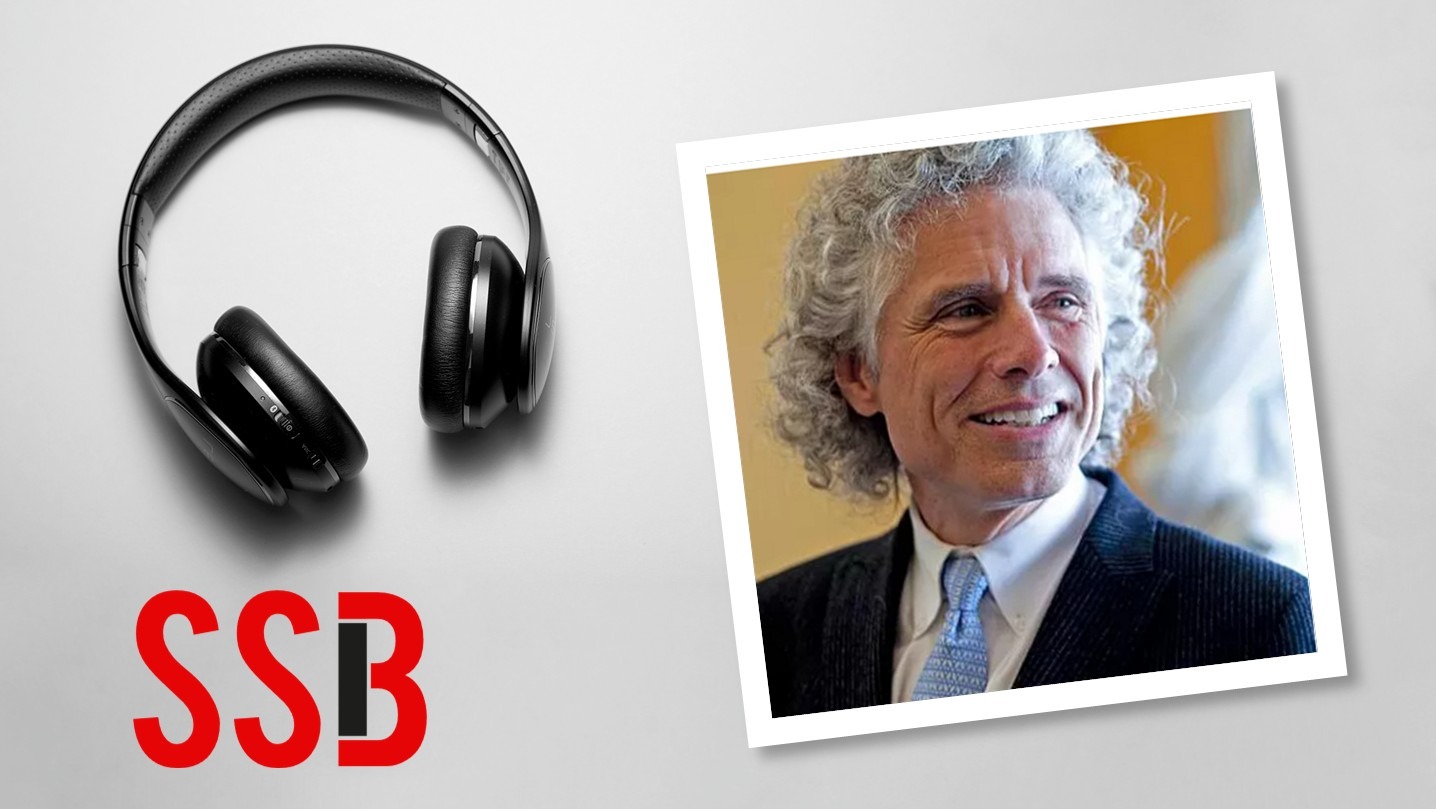
Steven Pinker on Common Knowledge
There is a value to shared knowledge that tends to go unrecognized because it’s so ubiquitous. Nonetheless, experimental psychologist Steven Pinker explains in this Social Science Bites podcast, common knowledge underlies things like paper money, governance, and even coral reefs.
And common knowledge, he makes clear to host David Edmonds, “does not have its ordinary sense of conventional wisdom or an open secret or something that everyone knows, but rather something that everyone knows that everyone knows, and everyone knows that, and everyone knows that, and so on, ad infinitum.”
Possing that shared knowledge – and the knowledge that others share that knowledge – creates the conditions for coordination, and thus action beyond what an individual could achieve. That’s the reason, he says, “that autocrats fear common knowledge of the regime’s shortcomings is that no regime has the firepower to intimidate every last citizen.”
Pinker, the Johnstone Professor of Psychology at Harvard University, details his understanding of the virtues and vices of common knowledge in his most recent book, When Everyone Knows That Everyone Knows…: Common Knowledge and the Mysteries of Money, Power, and Everyday Life. The book, his 13th, continues his streak as one of the most publicly recognized of public intellectuals, including recognition as one of Foreign Policy’s “World’s Top 100 Public Intellectuals” and Time’s “100 Most Influential People in the World Today.” He is also only the second (so far) returning guest to Social Science Bites, having addressed violence and human nature in a 2012 podcast.
To download an MP3 of this podcast, https://traffic.libsyn.com/socialsciencebites/Steven_Pinker_on_Common_Knowledge.mp3 The transcript of the conversation appears below.
David Edmonds: Common knowledge, as we’re about to hear from a returning Social Science Bites interviewee, occurs when we all know something and we all know that we all know it. Harvard psychologist Steven Pinker, the author of When Everyone Knows That Everyone Knows, argues that common knowledge is useful for explaining a whole range of social phenomena. Steven Pinker, welcome to Social Science Bites.
Steven Pinker: Thank you.
David Edmonds: We’re going to be talking about common knowledge. But before we get to what common knowledge is, there’s a puzzle in your book, which I absolutely love, involving spinach and teeth. So would you mind setting that out for us? Don’t give us the answer, just tell us the puzzle.
Steven Pinker: So this has been called the hardest logic puzzle in the world. It’s been around since the early 1950s. It was originally told in not-safe-for-work terms involving adultery, murder, in some versions, suicide. So, I have come up with a safer-for-work version.
It involves a conference of psychologists. Psychologists are socially skilled and garrulous. The meal consists of halibut and steamed spinach, with the danger that some people get unsightly morsels of spinach in their teeth, but psychologists are too polite to point out to another psychologist if they have spinach in their teeth, and there are no mirrors around. Finally, the chairman of the department can’t stand it any longer, and she stands up. She announces, “At least one of you has spinach in your teeth.” As it happens, three of them have spinach in their teeth, but all she says is at least one of them. “Those of you who know that you have spinach in your teeth, when I clink the glass, that would be a good time to clean your teeth.” She clinks her glass once, and no one budges. She clinks it a second time, and no one responds. She clinks it a third time, and the three psychologists with spinach in their teeth all clean their teeth at that moment. And the puzzle is, how did they know that they have spinach in their teeth? It’s a puzzle that requires the concept of common knowledge for its solution, right?
David Edmonds: I’ll leave listeners to think about that as you say, it is related to common knowledge. [Ed. Readers may skip to the end of the transcript for the answer Pinker gives in his boo.] Normally, when we think about common knowledge, we mean something that everyone knows. But that’s not what you mean by common knowledge. What is common knowledge in the sense in which you use it?
Steven Pinker: Yes, I’m using a sense that is standard within game theory and philosophy, particularly epistemology, economics, political science, in which common knowledge does not have its ordinary sense of conventional wisdom or an open secret or something that everyone knows, but rather something that everyone knows that everyone knows, and everyone knows that, and everyone knows that, and so on, ad infinitum. Hence the title of the book, When Everyone Knows That Everyone Knows ….
David Edmonds: OK, now when I was at university, many, many decades ago, I studied for an undergraduate degree called PPE, politics, philosophy and economics. It seems to me that common knowledge can illuminate all three of those disciplines. And I thought one way to frame this conversation would be to go through them one by one. So let’s start with economics. The modern economy relies on trust in the banking system. We all know that. We all know that we can trust the banks to keep our money safe. Is that a fair description of what keeps the economy afloat? And if so, how can that go wrong?
Steven Pinker: Indeed, paper currency, the value of paper currency, exists by virtue of common knowledge. Why do you accept a piece of paper in exchange for something of value. Well, because you know that other people will accept it and in exchange for something else of value. Why would they do that? Because they know that still other people would accept it. So the value of currency is an example of common knowledge, and it can unravel when the common knowledge evaporates, such as during a period of hyperinflation, where merchants furiously raise prices because they think that their wholesale price is going to go up. Workers demand greater salaries because they know that the things they want to buy are going to go up. Employers are forced to increase wages to keep their employees, and so on.
Conversely, even a bank can fail when it is subject to, as we say, a bank run, where people furiously withdraw their savings, not necessarily because they think that the bank is insolvent, but because they fear that other people might think it’s insolvent, if only out of fear that still other people might think the bank is insolvent. And since no bank has the reserves to redeem all the savings of all the customers at once, a bank can fail if everyone wants to withdraw their savings at the same time. So it can be a self-fulfilling prophecy. Like many phenomena of common knowledge, since people don’t have the brain power to actually hold in mind, I think that they think that the still other people think that still other people think your head starts to spin after a couple of levels of embedding. But in practice, what generates common knowledge is an event that is salient or public or conspicuous or out there. In the case of financial information, it can be a rumor, a declaration, say by a central banker, which is why central bankers watch their words very carefully, because they can become self-fulfilling, a signal that not only everyone perceives, but crucially, everyone perceives that other people are perceiving. That can generate panics, speculative bubbles and other economic phenomena. So when Franklin Roosevelt said, in the depths of the Depression, “the only thing we have to fear is fear itself,” that wasn’t a feel-good bromide, that was a literal statement of the economic facts.
David Edmonds: But this is interesting, because this is an example where common knowledge is a bad thing, as it were, because when there’s a run on the bank, if we didn’t all know that other people were worried about the bank, then the bank would be safe.
Steven Pinker: Yes. And conversely, common knowledge can rescue the bank, and more generally, the financial system, if people know that other people know that their savings are secure, which is why in American banks, there is a prominent seal of the Federal Deposit Insurance Corporation, the government agency that backstops banks, sometimes a brass plaque next to the entrance of the bank, or a big decal in the bank’s window. When you see that insignia and it’s in a public-enough place that you know that other people are seeing it, you know that other people know that the government will backstop the bank, and there’s no reason to withdraw funds. Now, prior to FDIC, deposit insurance, depression innovation, banks would often flaunt conspicuous opulence, even in small towns. The banks would have ostentatious marble pillars and gilt lettering and big lobbies, sometimes a source of resentment, like, “hey, it’s our deposits that they’re using for this luxury.” But in fact, it was a way to reassure depositors that the bank had deep enough pockets that they did not have to fear a self-fulfilling bank run.
David Edmonds: So that’s just one example of the relevance of common knowledge in the economic domain. Let’s talk about politics. In totalitarian regimes, common knowledge is something that the government often wants to prevent.
Steven Pinker: Exactly. It is a bit of a puzzle why autocracies do not have freedom of the press, freedom of speech, even freedom of assembly, which are enshrined in the constitutions of democracies. You might think, well, the government has the guns; like let people bitch and moan all they want. It is bound to be ineffectual. But the reason that autocrats fear common knowledge of the regime’s shortcomings is that no regime has the firepower to intimidate every last citizen. I like to quote a line from the movie Gandhi, in which the eponymous character tells a British colonial officer, in the end, you will leave because 100,000 Englishmen simply cannot control 350 million Indians, if the Indians refuse to cooperate. Now we could have said if they refuse to coordinate, and coordination is the gift that is granted by common knowledge. Common knowledge depends on it, people acting in concert on the same page toward the same common goal, must not only know that their counterparts are acting in concert with them, but know that their counterparts know that they know, because otherwise the counterparts may not coordinate out of fear that you won’t coordinate, if only out of fear that they won’t coordinate and so on, ad infinitum. So coordination of any kind requires common knowledge.
We’ve already talked about the financial system, which is a kind of large-scale coordination, but it’s also the case in, say, movements toward regime change. Everyone might be aggrieved with the government. Each one might be fearful that they’re the only one, that everyone else is content, and that’s what the establishment tries to enforce. If everyone knew that everyone else knew, no one would have to fear that if they were the only ones standing up, they could be picked off one by one by the government. If everyone stands up at once, the government can be powerless, which is why they often fear public demonstrations, for good reason.
Nicolae Ceaușescu, the dictator of Romania, held a public rally where he miscalculated that his adoring subjects would come out to bask in the wisdom of the Dear Leader. One person started to heckle Ceaușescu. It became contagious. The entire crowd turned against him. He was not only out of power, but shot and hanged within days.
David Edmonds: I remember it well. Christmas Day, I believe it was.
Steven Pinker: I think that’s right, yes. And so I like to illustrate this with a joke from the old Soviet Union, where a man is handing out leaflets in Red Square, and sure enough, the KGB arrest him, take him back to headquarters, only to discover that the leaflets are blank sheets of paper. They confront him: “What is the meaning of this?” And he says, “What’s there to say? It’s so obvious.” Now, the point of the joke was he was generating subversive common knowledge. He didn’t have to share a particular message. What he had to share was the knowledge that he and by extension, anyone who accepted the leaflets knowing why he was handing them out now knew that the others knew that there was a reason for discontent. He was generating a subversive common knowledge, which is also why, in a case of life imitating a joke, Putin’s police have arrested people for carrying blank signs.
David Edmonds: Is coordination impossible without common knowledge? Or does common knowledge just facilitate coordination?
Steven Pinker: In some circumstances, it’s literally impossible. In real life, we don’t have to guarantee coordination with 100 percent certainty. We can accept it with a certain probability. Also, I mentioned that conspicuous signals can generate the common knowledge necessary for coordination. In some cases, you can be hardwired that the conspicuous signal triggers coordination without the knowledge actually being entertained in the minds of the coordinators. I give the example of coral which don’t even have brains to think with which what’s called the Great Barrier Reef Annual Sex Festival at the full moon, they all release their eggs and sperm into the water. The problem being, how do they coordinate on a particular day to do it, because they’ve got to find each other in the briny deep. But by using the full moon as a coordination signal, they can synchronize the release of gametes and achieve the benefits of coordination, where they bypass the actual common knowledge because they don’t even have a brain to think with, but the conspicuous signal goes directly to the coordination.
Now, we humans, of course, are not hardwired with a few responses. Our social life depends on novel innovations, like currency, like governments, and many other rituals of social life, because we dynamically use conspicuous signals mediated by common knowledge to allow us to coordinate.
David Edmonds: We’ve touched on economics. We’ve touched on politics. I want to talk a little bit about philosophy, or rather a small branch of philosophy, namely ethics and norms, moral norms, which, again, seem to be grounded in the fact that we all understand this is the way we’re supposed to behave. You have somebody in the White House at the moment who seems to breach every norm. I suppose I’m getting a bit used to it, although he still has the power to shock me, but I wonder what that is doing to the common knowledge of norms.
Steven Pinker: Yeah, so a norm is something that exists because everyone knows it exists. So, it’s a phenomenon of common knowledge. And we have countless norms that regulate our social life. It’s not as if they’re enforced by the police, such as, you don’t flamboyantly boast and brag. You don’t tell obvious lies. You don’t insult people to their face. When you’re seated at a dinner table, you wait for other people, everyone to be served before you eat. You don’t blow your nose in the tablecloth. You don’t pass gas or belch. You don’t expose certain body parts. A long list, and they can change over time. You don’t tell ethnic jokes, which used to be commonplace when I was young, even on broadcast television, you can tell jokes about how stupid and bumbling Polish people were – that is now taboo. Now those exist because everyone knows they exist. If they are flouted in a public setting, in other words, it’s common knowledge that someone violates it and gets away with it, and everyone sees the violation, the norm may cease to exist, which is why a lot of social life consists of policing norms.
In a pathological case, you get social media shaming mobs for people who breach various political and racial and sexual niceties. The norm policing does have a function, but if the violation is public, the norm can cease to exist because it only exists because people think it exists. And indeed, what Trump has done repeatedly, to people’s shock, is he has violated norms that have existed in both sides of the political spectrum in the UU for decades, such as insulting war heroes and veterans and parents of deceased soldiers, insulting women’s looks to their face, calling his political opponents with schoolyard insults, constantly boasting about his own achievement, something that just people just you don’t do in public. Well, you don’t do them, because everyone knows you don’t do them, and when you do do them, and contrary to prediction after prediction, it did not mean the end of his political career, then there’s the danger that the norm itself may cease to exist. And there are some signs of it unraveling.
That it isn’t just Trump, but you have things like Elon Musk, for a while, his ally, doing things that would be unthinkable for the CEO of a major corporation to have done 10 years ago, such as blatantly lie, circulate fake news, conspiracy theories, insult his opponents. CEOs used to be a model of propriety, decorum, simply because any fear that there was instability at the top could lead to a self-fulfilling sell off of the company’s shares.
Anyway, Trump got away with it. Musk is sort of getting away with it. But other politicians, Pete Hegseth, supporters like Christopher Rufo, are insulting, bragging, trolling, so there is a fear that the norm is unraveling in front of our eyes.
David Edmonds: You touched on social media, and I feel a bit like a broken record on Social Science Bites, because I often end up asking about social media because it has such a powerful influence on so many of the topics we discuss. But you pointed to it there as a way of enforcing norms, as though perhaps that’s a positive aspect of social media.
Steven Pinker: Well, it can be, but for the fact that there are certain activities in human life where norms of propriety and conventional wisdom can get in the way of the mission of those institutions, in particular science, academia, journalism, where the truth is a superordinate goal, and just avoiding things that might offend someone can get in the way of what social science and academia are in the business of doing.
David Edmonds: In your description of common knowledge, one thing that I’m puzzled about in social science, and I used to ask lots of social science academics this question, is whether there’s a normative component in what you’re trying to do, or whether you’re just giving a descriptive account of various phenomena.
Steven Pinker: Well, I try to be clear as to when I’m doing what in a chapter called “The Canceling Instinct,” I look at academic cancel culture from two viewpoints which I distinguish. One of them is a participant in the academic freedom cause, in which I say I really do believe academic freedom is necessary for academia to do its job, and I explain why. But then I also switch into psychologist mode, and I ask, why do people even have the urge to cancel, to censor, to punish for the content of ideas? So that’s the descriptive part, after I set aside the normative part of saying, “I do think this is a bad development,” but then why are people tempted to do it in the first place, a separate question.
David Edmonds: OK, well, I think we’ll leave it there. I think listeners all know that, they all know what common knowledge is. I’m going to let them work out the solution to the spinach teeth problem. If they can’t work it out, they can read the answer in your book. [Ed. … or look below!] But Steven Pinker, for now, thank you very much indeed.
Steven Pinker: Thank you.