‘Tino’ Cuéllar Named Director of the Center for Advanced Study in the Behavioral Sciences
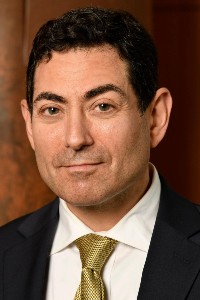
Mariano-Florentino “Tino” Cuéllar, a former justice of the Supreme Court of California and currently the president of the Carnegie Endowment for International Peace, has been named the permanent Sara Miller McCune Director of the Center for Advanced Study in the Behavioral Sciences at Stanford University. He will take on the new role in July, succeeding CASBS’ interim director, Lara Tiedens, who took over for a departing Sara Soule last summer.
Cuéllar is no stranger to Stanford or to CASBS. In 2000, having earned a bachelor’s in government and political psychology from Harvard and a law degree from Yale, he received a doctorate in political science from the university, then joined the faculty the next year. Over the next 14 years he was named the Stanley Morrison Professor of Law in 2012, was director of the Freeman Spogli Institute for International Studies from 2013-15, co-director of the Center for International Security and Cooperation from 2011-2013, and chaired the board for the Institute for Innovation in Developing Economies at Stanford’s Graduate School of Business.
At CASBS, Cuéllar chaired the board of directors from 2016 to 2021, and was co-chair of the search committee that selected Soule.
In his new stint at Stanford, Cuéllar will also be the Shriram Family Director of the Knight-Hennessy Scholars, replacing the program’s founding president John L. Hennessy.
“Returning to Stanford at this juncture is an enormous honor – the place has long been pivotal in my life and embodies values I admire,” a Stanford news story quoted Cuéllar. “Here, we have an extraordinary opportunity to advance the frontiers of knowledge and prepare leaders to take on today’s most urgent challenges while strengthening the longer-term foundations for a better future.”
Speaking directly to his role at CASBS, he added, “The opportunity is to challenge boundaries and hidden assumptions, connecting curiosity-driven research to the most daunting and complex problems the world is facing. As we bring its model fully into the 21st century, CASBS has the location, the history, and the ambition to ask big, cross-cutting questions – from how to make democracy more resilient to how a world of fraying ties, both social and geopolitical, can manage to stay connected as it evolves.”
Cuéllar has had an active life outside of academe, too. He has been president of the Carnegie Endowment for International Peace – founded in 1910 to empower “world-class policy experts [to] produc[e]research and actionable ideas to help address the world’s most challenging problems” – since 2021.
Before that, in 2015 he was appointed to the California Supreme Court. Cuéllar who was born in Matamoros, Mexico, and came to the United States with his family at age 14, was the first immigrant from Latin America to serve as a justice. Of note, during his time on the bench he still taught at the Stanford Law School and was affiliated with the Stanford Institute for Human-Centered Artificial Intelligence.
Cuéllar has been very involved in study the nexus of governance and AI, and in 2024 was named to the Joint California Policy Working Group on AI Frontier Models. That too proved attractive to CASBS. The news story cited above quotes CASBS Board Chair Abby Rumsey, saying, “Tino Cuéllar returns to CASBS with a clear vision for how the social sciences will engage with powerful technologies such as AI and bioengineering, technologies that challenge the very notion of the human.”
His scholarship has also landed Cuéllar advisory roles for three U.S. presidents, including President’s Intelligence Advisory Board, the U.S. Department of State’s Foreign Affairs Policy Board, and the White House Domestic Policy Council. He has been co-chair of the bipartisan Belfer Center-Carnegie-Nuclear Threat Initiative Task Force on Nuclear Proliferation and American Security and currently chairs the board of the William & Flora Hewlett Foundation, and is a member of the Harvard Corporation and American Academy of Arts and Sciences.