



Could Distributed Peer Review Better Decide Grant Funding?
The landscape of academic grant funding is notoriously competitive and plagued by lengthy, bureaucratic processes, exacerbated by difficulties in finding willing reviewers. Distributed […]

In February officials with the National Science Foundation, the National Institute of Standards and Technology, and the National Science Board trooped up […]
‘Don’t judge a book by its cover – federal funding for odd or frivolous sounding research pays enormous societal, health, security, and economic dividends to the American taxpayer,’ argues a member of the steering committee for the Golden Goose Award.
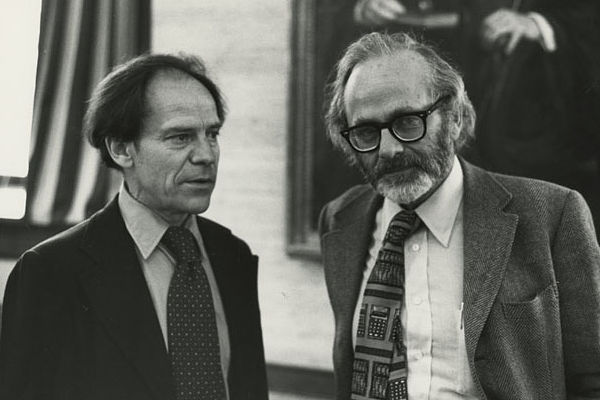
Two neurophysiologists who brought kittens into their lab to study vision have been honored with the Golden Goose Award for federally funded experiments that once sounded silly but provided important benefits to society.
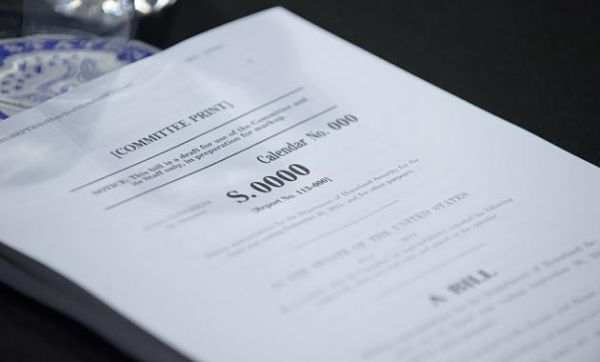
Howard Silver examines the process in which federal research funding is arrived at — and points out how the process is, or isn’t, working in this Congress.
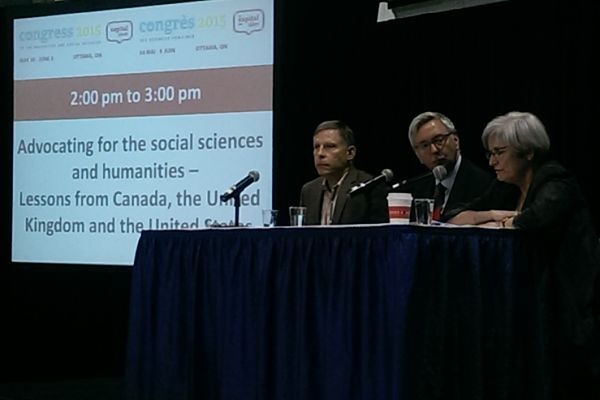
A recent panel drew social science advocates from three countries – Canada, the United Kingdom and the United States – to the same stage to discuss preserving the disciplines’ sometimes tenuous hold on support from policymakers

The U.S. Senate Appropriations Committee has pushed a bill that deprecates federal research spending for social science to the Senate as a whole.
Legislation that would squeeze out social science and geoscience spending from their traditional share of the National Science Foundation budget will be heard by the Senate Appropriations Committee on Thursday.

Were a psychologist to win federal funding for an experiment that involved offering 3-year-olds marshmallows, it’s likely that grant would eventually be cited on the floor of the House of Representatives as yet another example of silly and wasteful spending on social science.


Jürgen Habermas, a globally known social theorist whose explorations of democracy, validity and communication have gained new prominence in the current moment, […] People often see science as a world apart: cool, rational and untouched by persuasion or performance. In this view, scientists simply discover […] “Research impact” means different things to different people. Some refer broadly to how science changes behaviors, beliefs, or practices outside academic institutions. […] David Canter considers informal places where people socialize, suggesting they’re an arena ChatGPT and other LLMs can’no’t replicate. As someone who lives […] It’s become cliche since Clive Humbly coined it in 2006, but data is indeed the new oil. It’s a mantra repeated by […] In September 2025, The Guardian reported about a lawyer in Australia having faced sanctions due to false citations. These citations were not […]
EXPLORE
Impact

Jürgen Habermas, 1929-2026: Exponent of the Public Sphere
READ MORE

Scientists Should Keep in Mind It’s Called the ‘Marketplace of Ideas’ for a Reason
READ MORE

Survey Finds Social Scientists Feel Unsupported in Seeking Societal Impact
READ MORE
Innovation

Reaching Parts to Which AI Has No Access
READ MORE

Andrea Medina-Smith on Making Research Data More FAIR
READ MORE

A Status Check on Hallucinated Case Law Incidents
READ MORE