A Cry From Canada: Freedom of Expression Under Attack at Our Universities
Tolerance is one of the most familiar words in the English language. By definition it is neither virtue nor vice and may be either, depending on context. Its subject matter is usually negative; we don’t tolerate things we like — we endorse or affirm them. We tolerate things we do not like but that we know we must not suppress or prohibit.
In our private lives, our tolerances may be closely aligned with our likes and dislikes. In our public lives, they must be informed by normative rules and values that frame our social order. Fundamental among these is freedom of expression, described by Chief Justice of Canada Beverley McLaughlin as “the indispensable condition of nearly every other freedom.”

This article by Peter MacKinnon originally appeared at The Conversation, a Social Science Space partner site, under the title “Freedom of expression is under attack at our universities”
Freedom of expression is also an “indispensable condition” of the university “commons.” I define this as the space for the debate, discussion and collaboration that are both inherent in, and essential to, the idea of the university.
This commons has been tested so often in recent years that it is not hyperbole to describe it as a contemporary battleground over its boundaries.
The battles over freedom of expression
Some high profile examples of the battles that have occurred:
- At Concordia University, the once and future prime minister of Israel, Benjamin Netanyahu, was silenced by protesters.
- At the University of Ottawa, a scheduled speech by controversial American commentator Ann Coulter was cancelled because of safety concerns.
- At the University of Calgary, anti-abortion demonstrators were subject to non-academic discipline and legal charges.
- At Brock University, University of Toronto, and Queen’s University, Halloween costumes touched off heated debates over racism.
- At York University, a mural depicting a Palestinian protest was at the centre of a controversy involving a donor.
- Campaigns to link Israel’s policies on Palestine with apartheid in South Africa generated controversies on more than one campus.
- A yoga instructor’s free class at the University of Ottawa was cancelled upon encountering resistance from student leaders alleging cultural misappropriation.
- A Laurentian University professor was removed from a course for asking students to sign a waiver agreeing to transfer to another section of the same course if they found his use of bad language in class to be offensive or uncomfortable.
- A University of Toronto professor was told that he must use genderless pronouns.
- A Ryerson professor and School of Social Work director was accused of “a violent act of anti-Blackness, misogyny and misogynoir” when he left an anti-racism meeting on campus.
- The director of McGill University’s Institute for the Study of Canada resigned in the wake of controversy precipitated by an article he wrote for Maclean’s magazine.
What is going on?
Members of the general public who hear of these events might well ask, “What on earth is going on in our universities?” Those within them would be wise to ask the same question.
Are these examples of tensions that must play out in the interests of inclusion? Or are they behaviours that diminish our commons and threaten its vitality?
So what is going on at our universities? Do the above examples represent the normal machinations of institutions committed to the search for truth struggling with new realities? Are some of them illustrations of political correctness run rampant?
There is no single answer, no one generalization that summarizes the collective. But there are themes to be drawn out from them.
First, freedom of expression is under attack in our universities — not a deliberate, organized attack, but an accumulation of episodes that diminish its significance in comparison to other considerations.
Second, the concept of universities as intellectual spaces is also under attack as a result of intellectual laziness accompanied by ideology and anger. The result, too often, is not a contest of ideas; it is a struggle for power.
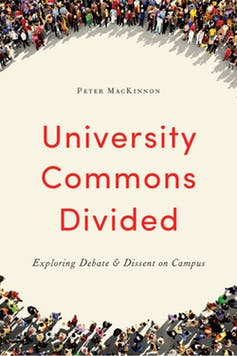
This post is excerpted from the new book University Commons Divided: Exploring Debate and Dissent on Campus, published by University of Toronto Press
Behaviors undermining freedom
Anyone who has worked for long at one or more of our universities will attest the examples listed above are not exceptional or unusual instances of attitudes and behaviours undermining freedom of expression on campus. This freedom is seen by many as one among competing values rather than the “indispensable condition of every other freedom” described by Chief Justice McLaughlin.
The concept of universities as intellectual spaces has suffered too, though not only because they interfere with freedom of expression.
Intellectual work is hard work, and those committed to it must take the time to inform themselves carefully, to think their way through complicated questions, and to test their thinking in the marketplace of ideas. This requires disciplined, patient effort and a determination to engage and listen to others.
The path of less resistance is an easier path. It features emotion over intellect and denunciation instead of argument, and is aggravated by quick and ready access to publicity and organization through social media.
The Economist was referring to Donald Trump’s presidential campaign when it wrote:
“There is a strong case that, in America and elsewhere, there is a shift towards the politics in which feelings trump facts more freely and with less resistance than used to be the case. Helped by new technology, a deluge of facts and a public much less given to trust than once it was, some politicians are getting away with a new depth and pervasiveness of falsehood. If this continues, the power of truth as a tool for solving society’s problems could be lastingly reduced.”
These words have wider import. Rather than yielding to this shift, or being complicit in it, our universities should lead in the struggle against it.
That struggle begins with a re-commitment to freedom of expression as the first principle in their missions.