HEPI Offers Clarion Call to Protect Free Speech on Campus
Concerns that free speech is being whittled away on university campuses, at least in the United Kingdom, are overblown, with the biggest threat originating not on campuses but from the government and its Prevent program. That’s a key takeaway in a new paper from Britain’s Higher Education Policy Institute, Free Speech and Censorship on Campus.
The report is based on a lecture delivered by Corey Stoughton — both advocacy and acting director of the human rights organization Liberty and a former counsel for civil rights in the U.S. Department of Justice under President Barack Obama — delivered at Oxford University late last year.

While Stoughton takes issue with some standard ripostes about maintaining a ‘marketplace of ideas’ on campus – “‘The answer to bad speech is more speech’ is simply not a satisfactory response. It is a shallow excuse that fails to acknowledge that not everyone has equal access to speech, and not everyone will be heard” — she nonetheless argues that “compromising principles of free speech on campus would be an enormous mistake.”
She offers two primary reasons, both hinging on the idea that restrictions tend to backfire. Her first arguments is that shutting down the speech rarely silences the message, and often strengthens it.
“A second, and by far the most important, reason to question equality-based arguments for limiting free speech on campus is that they almost always prove counterproductive to the cause of equality. The tools we give universities to limit speech in the name of equality will be used to undermine equality. A university is an institution of power and a bureaucracy. Any rule administered by a bureaucracy that allows censoring of speech creates the risk of the arbitrary exercise of power.”
Stoughton cites the Prevent strategy in the Counter-Terrorism and Security Act 2015, which in part “imposes on universities a duty to ‘have due regard to the need to prevent people from being drawn into terrorism.’ Statutory guidance on this duty requires universities to check that speakers are not likely to express ‘extremist’ views and, if they may express such views, to either take steps to limit the speech or, if they cannot limit the speech to manage the risk, force the cancellation of the event.” Calling Prevent ill-conceived, she says it has “had a demonstrable chilling effect on free speech in universities.”
“There are few justifications for limiting free speech beyond current laws,” said HEPI’s director, Nick Hillman. “That is true whether it is students wanting to block provocateurs from speaking or government ministers mixing up the prevention of terrorism with blocking legitimate free expression.”
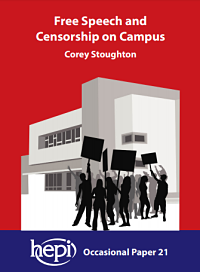
This is not the first foray by the Higher Education Policy Institute, or HEPI, into questions of freedom of expression. It surveyed university students and published the results as Keeping Schtum? What students think of free speech in 2016, and released two reports last year: An analysis of UK university free speech policies prepared for the Joint Committee for Human Rights and Cracking the code: A practical guide for university free speech policies. HEPI is a non-partisan and independent institute that offers evidence-based arguments to address higher ed issues across Britain.
The HEPI report focuses specifically on Britain’s universities, although given Stoughton’s American roots the report is full of examples drawn from the U.S. experience, including opening anecdotes comparing and contrasting two cases at the University of California at Berkeley: Stokely Carmichael in 1966 and Milo Yiannopolous in 2017.