Chopping Away at the Myths Attached to Management Theory
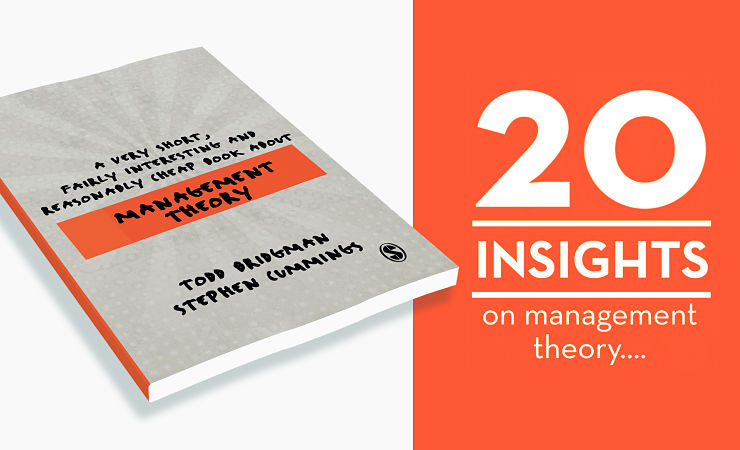
Today we bring you the story behind A very short, fairly interesting and reasonably cheap book about management theory, a new book by Todd Bridgman and Stephen Cummings and put out by SAGE Publishing, the parent of Business & Management INK and Social Science Space. Bridgman, an associate professor in the School of Management at New Zealand’s Victoria University Wellington, and co-editor in chief of the journal Management Learning, and Cummings, professor of strategy and innovation and co-director of The Atom Innovation Space at Victoria University, explain how seeing the development of management theories routinely misrepresented in the classroom motivated them to write this book.

There’s a game you might have played called ‘telephone’. Players form a line and the first person whispers a message in the ear of the second person, who repeats the message to the next person, and so on. The final person announces the message to the group. Typically, the message at the end is very different from that at the beginning.
In our research, we’ve found that there’s a similar dynamic at play regarding how the foundational theories of management are represented in textbooks over time. The ideas the theorists originally developed and wrote about are often quite different to what students are presented with. For example, Abraham Maslow’s ideas about motivation are indelibly linked to the now famous Pyramid, even though Maslow never saw things this way (the Pyramid of Needs was created by a business consultant 17 years after Maslow developed his theory). The foundational model of managing change, Kurt Lewin’s “Unfreeze-Change-Refreeze,” was not presented this way by Lewin: it’s a simplification created by early textbook authors.
Our book uncovers these and other myths that have grown around management’s most popular theories. We argue that much of the misrepresentation is unintentional: textbook authors are required to condense and simplify theories for students, and as with any reduction elements of the original are left behind. But there have also been purposeful efforts to distort original messages in ways their creators would not have foreseen or agreed with. We explain how this happens and explore who gains and who loses from these distortions.
Our process of questioning how management theories are presented in textbooks is also a creative exercise. For example, we can come to see Maslow not as the architect of a flawed pyramid, but as someone who saw freedom of expression as a precondition for the satisfaction of human needs. And by challenging the conventional histories of management ideas we are freer to create new histories that shine a light on people, places and ideas that have been ignored or forgotten by conventional management theories, such as indigenous and pre-colonial peoples, minority populations, and more gender-diverse perspectives. So, while the focus of this book is on management theory, we don’t see this as just an academic exercise. If we can think about theory differently, we should be encouraged to act differently too. Consequently, the book’s ultimate aim, its manifesto if you like, is to encourage people to manage differently – because the narrow way management is currently practiced needs to change.
While we think these are important ideas for anybody interested in the future of management, we’ve written the book to be used as a teaching resource for advanced undergraduate level students and those on postgraduate programmes who have studied an introduction to management course. The book is structured around 20 insights on management theory and there are animations about each at the SAGEStudents’ YouTube channel. Here’s the link to the playlist and we’ve embedded the first video in our series of 21 videos, on “New Foundations of Management,” below.