HEPI Report Examines Conversation Universities Should Have With Media
“Talk to any vice-chancellor these days about how they feel universities are treated by the media,” writes veteran journalist Rosemary Bennett in a new report commissioned by the Higher Education Policy Institute, “and you are likely to get a gloomy response. To many, it seems they went from national treasures to the doghouse, and are now routinely castigated as overly commercial, greedy and more interested in institutional expansion than educating the next generation.”
“It can sometimes feel,” argues Adam Tickell, vice-chancellor and president of the University of Sussex, in the report’s foreword, “as if a broad political consensus around the value of both university research and a university education has completely vanished.”
At the same time, interest in Britain’s higher education system is growing, and dramatically. Bennett notes there were over 7,000 stories about universities in the United Kingdom’s leading national daily and Sunday newspapers in 2020. “What has taken place in recent years is not media bashing or a vendetta but simply greater scrutiny that is a natural consequence of the growth of a sector whose annual operating expenditure is now close to £40 billion. Added to this are the far greater proportion of young people going to university and, perhaps most importantly, substantial tuition fees and student debts.” And so, just as industry and government are expected to be more clear, fair, and truthful in their communications now, so too are universities.
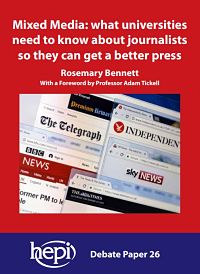
In Mixed Media: what universities need to know about journalists so they can get a better press, Bennett addresses the universities’ routine silence in public discussion of education. “Universities have not helped themselves by treating these three issues as matters of secondary importance, and more generally by not clearly explaining what exactly £9,250 a year is paying for. It is not enough to say a degree means a better career, a higher salary or a more fulfilling life. An explanation has to focus what is on offer during the years of study. This has become particularly pressing with teaching moving online during the pandemic and libraries and other facilities shut or hard to use.”
With more stories on the front page and a new inquisition into higher education, universities have become an “important consumer story.” Yet universities have not been so clear with their communities, of faculty, students, and parents. As the media portrays stories on the triumph of student causes and articles in support of whether they are getting a good deal, the relevance, value, and quality of university education is a hot topic in the press amidst the move online and coronavirus pandemic. It does not help universities that there have been sharp increases in unconditional offers and grade inflation.
Bennett writes that while universities are accomplished at promoting their research in the media, “I suggest they put equal effort into promoting their role in education. What new teaching methods are proving successful?” She tackles key issues universities and higher education industry face today, such as the increase in senior manager salaries, free speech, and the process of fostering ‘safe spaces’ for students, and the ‘Oxbridge obsession’ which coincides with the decrease in ‘snobbery’ about new or small universities when depicted in the press.
This is not the first foray by the Higher Education Policy Institute, or HEPI, into how higher education institutions engage with the media. In 2017 HEPI sponsored a report by the late Richard Garner, at the time the longest serving UK education correspondent, titled Return on investment? How universities communicate with the outside world. Bennett notes that her journalistic journey – most recently education editor of The Times after spending 10 years as a political correspondent based at Westminster and as social affairs correspondent at The Times – led her away from the “historical sweep” of Garner’s report toward a comparison of how higher education in treated relative to those other sectors in the spotlight.
As with the increased demands for corporate responsibility and larger transparency from companies in other sectors, universities and higher education can also benefit from having a dialogue and communication with their audiences through the press and with the media. Bennett urges universities to join these public discussions, along with the broader debates about the economy, mental health, and free speech, where they have “expertise that would be very valuable.”