
The Impact of Global Value Chains and Wage Bargaining Agreements on Wages
Joanna Wolszczak-Derlacz, Dagmara Nikulin, and Sabina Szymczak from Gdańsk University of Technology discuss their recent paper “Global value chains and wages under different wage setting mechanisms” published in Competition & Change.

The motivation behind our study is the debated effects of international trade processes, including the fragmentation of global production captured by global value chains (GVCs) on labor market outcomes such as wages. Additionally, it is clear that labor marker institutions significantly influence the determination of workers’ wages. Collective wage bargaining, train union density, active labor market policies, and minimum wages are among the key factors in the complex wage setting mechanism in developed and developing countries. In our research, we take into account simultaneously the relationships among GVCs, wage bargaining schemes, and wages. We consider three degrees of wage coordination: the national, industry, or enterprise-level and the scenario of no existing collective pay agreements. In contrast to previous studies, we conduct a cross-country study. We merge a rich database derived from the 2014 European Structure of Earnings Survey (SES) containing employee data from 18 European countries with sectoral data on world-output tables (WIOD). Eventually, our dataset covers almost nine million observations. We formulate the following research questions:
- What is the association between workers’ wages and different wage bargaining schemes?
- What is the impact of GVC participation on wages? Does it depend on the degree of wage coordination?
- Do the linkages among wages and wage bargaining schemes depend on the position of a given sector in the GVC (closer or further from the final demand)?
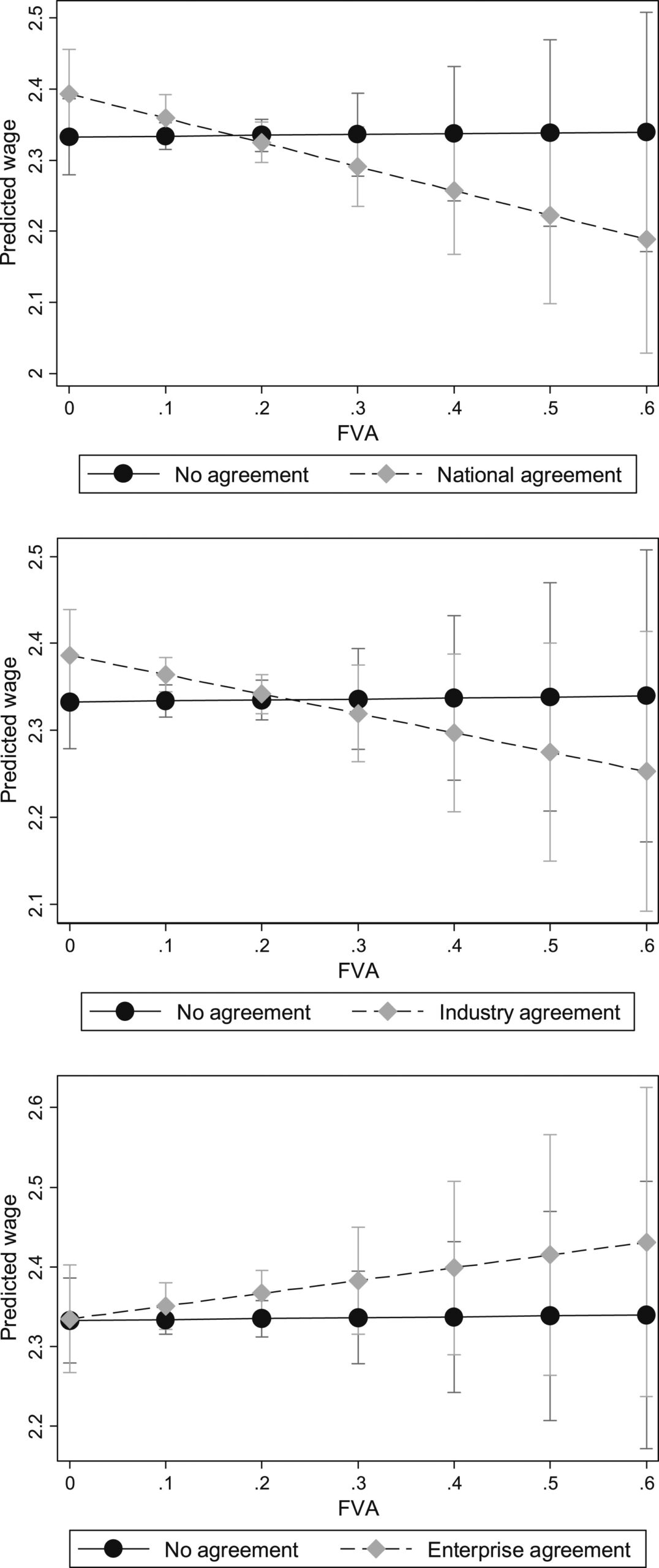
We find that workers covered by any type of collective pay agreement typically receive higher wages than those without any agreement. The largest impact is on wages negotiated at the enterprise level. Additionally, we find evidence that under national wage bargaining schemes, greater participation in GVCs results in lower wages, which confirms previous evidence. However, this adverse impact of GVCs is not observed under enterprise-level bargaining schemes. Hence, the downward pressure on wages caused by participating in international trade may be weakened by institutional factors. Considering that European countries tend to move towards the decentralization of wage bargaining, as postulated by many agencies and institutions such as the European Commission and European Central Bank, our results constitute an important empirical contribution.
Nevertheless, this study has some limitations. First, we focus only on one aspect of the labor market, namely, wages; however, the impact of GVCs can be also materialized through employment channels. Second, our data are limited to employed individuals. Finally, we use only the level of wage bargaining coordination as a proxy for labor market institution background, whilst another aspects of regulation in the labor market (e.g., the strictness of employment legislation) may also be taken into account.
Although production relations based on GVCs have recently slowed due to the spread of COVID-19, and it is unclear as to how quickly they will recover, the future of international relations may depend heavily on institutional factors. Harvard professor of economics Pol Antràs even argues that “the main challenge for the future of globalization is institutional and political in nature rather than technological.”