Harvard’s Claudia Goldin Receives Nobel for Work on Gender Labor Gap

Economic historian and labor economist Claudia Goldin on Monday received the Sveriges Riksbank Prize in Economic Sciences in Memory of Alfred Nobel 2023, commonly known as the Nobel in economics. The citation from the Nobel Committee cited Goldin “for having advanced our understanding of women’s labor market outcomes.”
“Understanding women’s role in the labor is important for society,” Jakob Svensson, chair of the Committee for the Prize in Economic Sciences, was quoted. “Thanks to Claudia Goldin’s groundbreaking research we now know much more about the underlying factors and which barriers may need to be addressed in the future.”
Listen to Claudia Goldin on our Social Science Bites podcastGoldin, 77, is the third woman to receive the economics prize and the first to receive it solo. She is the Henry Lee Professor of Economics at Harvard University, and was the first woman offered tenure in Harvard’s economics department. She co-directs the National Bureau of Economic Research’s Gender in the Economy group and directed NBER’s Development of the American Economy program from 1989 to 2017. Her most recent book is 2021’s Career & Family: Women’s Century-Long Journey toward Equity.
As an economic historian, Goldin has taken a long view of the gender disparity between men’s and women’s earnings, drawing on two centuries of data from the United States to illustrate the problem, its evolution, and to locate solutions.
“Goldin showed that female participation in the labor market did not have an upward trend over this entire period, but instead forms a U-shaped curve,” the Nobel Prize organization writes. “The participation of married women decreased with the transition from an agrarian to an industrial society in the early 19th century, but then started to increase with the growth of the service sector in the early 20th century. Goldin explained this pattern as the result of structural change and evolving social norms regarding women’s responsibilities for home and family.”
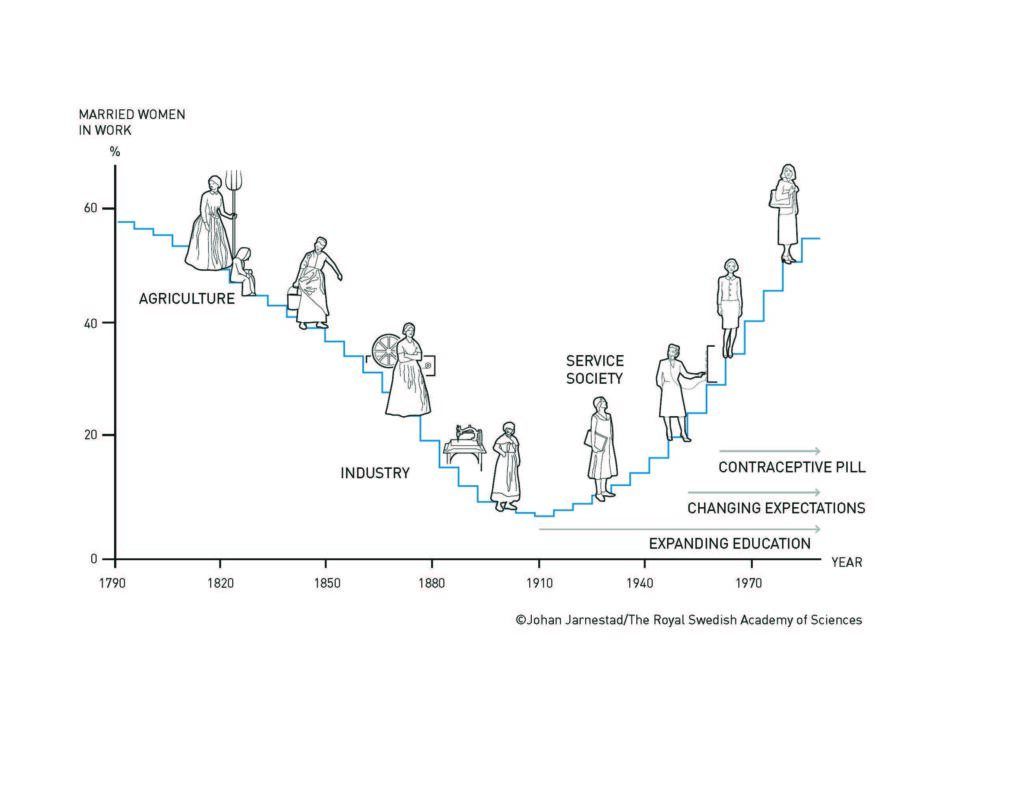
As gaps in schooling and job choice has diminished, one key driver keeping the gap alive the gap, Goldin has found, is the arrival of children, especially the firstborn. While easily available contraception has offered new opportunities for women, those “social norms” around child rearing continue to slow progress.
“Despite modernization,” the Nobel organization said, “economic growth and rising proportions of employed women in the twentieth century, for a long period of time the earnings gap between women and men hardly closed. According to Goldin, part of the explanation is that educational decisions, which impact a lifetime of career opportunities, are made at a relatively young age. If the expectations of young women are formed by the experiences of previous generations – for instance, their mothers, who did not go back to work until the children had grown up – then development will be slow.”
Goldin was president of the American Economic Association in 2013 and was president of the Economic History Association in 1999/2000. She is a member of the National Academy of Sciences and the American Philosophical Society and a fellow of the American Academy of Political and Social Science, the American Academy of Arts and Sciences, the Society of Labor Economists (which awarded her its Mincer Prize for life-time contributions in 2009), the Econometric Society, and the Cliometric Society. She received the IZA Prize in Labor Economics in 2016, the 2019 BBVA Frontiers in Knowledge award, and the 2020 Nemmers award, the latter two both in economics.
Her books include 1990’s Understanding the Gender Gap: An Economic History of American Women and 2018’s Women Working Longer: Increased Employment at Older Ages, written with another Harvard economist, her husband Lawrence Katz. Their 2008 book, The Race between Education and Technology received the 2008 R.R. Hawkins Award for the most outstanding scholarly work in all disciplines of the arts and sciences.
The Nobel prize comes with a cash award of 11 million Swedish kronor, or a little over US$1 million.