The Authors of ‘Artificial Intelligence and Work’ on Future Risk
During the final stages of editing the proofs for Artificial Intelligence and Work: Transforming Work, Organizations, and Society in an Age of Insecurity, it was announced that British-Canadian computer scientist Richard Hinton, the ‘Godfather of AI’, had been awarded the 2024 Nobel Prize in Physics. Just a year earlier Hinton joined other members of the AI intelligentsia in warning that that generative AI and large language models – the technology that underpins chatbots – may soon be more intelligent than humans and could precipitate profound risks to society and humanity. AI describes a field that combines computer science and robust datasets to mimic the problem-solving and decision-making capabilities of the human mind. The transformative effect of AI is comparable to that of electricity, the silicon ‘chip,’ and the internet. However, as our book explores, AI already poses immediate tangible risks and harms to workers, society, and our planet.
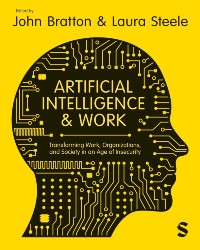
Edited by John Bratton and Laura Steele, Sage, 2024. Pre-order a copy or request an inspection copy..
AI and Work brings together critical scholars from management and across the social sciences to explore the effects of AI on work, organizations, and society. Class, gender, race, and ethnicity – major axes of structural inequality – provide a useful lens through which to examine the impact of AI. We asked each contributor to specifically address the questions of who benefits and how? when it comes to the development and deployment of AI systems, as well what guardrails should be introduced to protect the interests of workers and wider society.
The collection opens by providing a brief historical analysis of past waves of technological change and, in doing so, helps us make sense of present debates on the effects of AI. We critically explore six well-known work-related themes – job displacement, time, skills, control, surveillance, and the interconnection between work, gender, and family – the leitmotifs of work under capitalism.
Predictions that technology causes job replacement has featured in popular debates since the Industrial Revolution. Whereas machinery in the 19th and 20th centuries eclipsed physical capabilities, AI – particularly in the form of generative AI – encroaches upon intellectual and creative capabilities.
Time has been a feature of work since the factory system. Platform-mediated work, a symbol of the ‘gig economy’, might offer workers flexibility and autonomy – a workplace ‘free of bosses.’ But AI makes self-autonomy a ‘mirage.’ It incorrigibly colonizes time, penetrating paid work, and non-work activities, thus blurring the work–life boundary. The rise in platform work has coincided with the rise of global supply chains, and a decline in full-time secure work in the Global North casting millions into precarious employment.
Driving concerns around AI-enabled decision-making is whether AI exacerbates existing gender/race and ethnicity inequalities and proxy discrimination. These insights help explain the other important point made by authors: algorithms are designed by fallible human beings (typically white men), and consequently are not a blank slate; they are inscribed with an ideology; a system of ideas, choice preferences, and values which form the basis for decision-making.
Addressing the role of AI in the climate crisis is now urgent. AI can have both beneficial and adverse effects on climate change. In terms of benefits, AI’s role extends to extracting valuable insights from extensive datasets. On the flip side, AI’s carbon footprint is growing exponentially because the AI ecosystem entails significant energy requirements, mainly sourced from fossil fuels, which result in substantial greenhouse gas emissions.
Capitalism by itself is an amoral system that requires guardrails. AI and Work discusses the need for AI regulation. In organizations, governance mechanisms, such as Algorithmic Impact Assessments, potentially offer a pathway to create ‘good’ work and go some way towards addressing AI’s gender bias and its discriminatory effects. The book calls for investment in AI in the Global South to ensure all countries can share in an AI future. Without ensuring global inclusion in the datasets, algorithms, and system development which determines who benefits from AI, any AI policy is deficient.
Finally, as has been the case with a minority of others before us, we share Richard Hinton’s aim which is to awaken the reader to the grave risks and harms of AI.