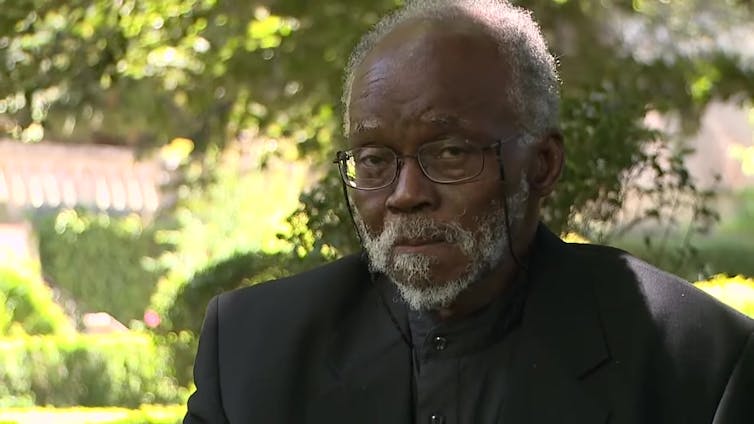
Valentin-Yves Mudimbe, 1941-2025: The Philosopher on the ‘Invention’ of Africa
Congolese thinker, philosopher and linguist Valentin-Yves Mudimbe died on April 21, 2025 at the age of 83. He was in the US, where he had lived for many years.
A towering figure in African critical thought, Mudimbe’s work – translated and studied worldwide – has profoundly shaped postcolonial studies. He leaves a groundbreaking intellectual legacy on the colonisation of knowledge and the condition of Africans.

At a time when debates on decolonizing knowledge are gaining ground, Mudimbe’s passing invites us to revisit the work of a thinker who, since the 1980s, paved the way for a radical critique of imposed “categories”. He wanted to help rebuild intellectual frameworks which imagined and defined Africa on its own terms, not through the labels or categories imposed by colonial powers.
As a specialist in postmodern and postcolonial theories, I think he had considerable influence on the field of postcolonial studies.
He was one of the most influential African thinkers of the 20th century. His impact did not come from activism, but from careful, sustained intellectual work. With his seminal work The Invention of Africa (1988) he profoundly disrupted African and postcolonial studies. His work went far beyond the usual east-west divide.
A journey between Africa and exile
Valentin-Yves Mudimbe was born in 1941 in Jadotville (now Likasi), in the Democratic Republic of Congo. His early education took place in a Benedictine monastery. Later, he pursued further studies at Louvain in Belgium.
His religious education left a lasting mark on his thinking. It shaped his critical approach to knowledge. His work often explored the connections between language, power, and how ideas become institutionalised.
In 1970, Mudimbe returned to the newly independent Congo. He began teaching at the National University of Zaïre. The country was then caught between postcolonial hope and growing disillusionment.
Under Mobutu Sese Seko’s regime, the political atmosphere grew stifling for independent thinkers. The state had adopted the rhetoric of “authenticity,” turning it into a tool of control. Faced with this ideological stranglehold, Mudimbe chose exile in 1979.
He relocated to the US, where he taught at Stanford and later Duke University. There, he continued his work of critical deconstruction. Yet, despite his physical distance, he remained deeply committed to Africa’s future.
Deconstructing the ‘colonial library’
First published in English in 1988 as the The Invention of Africa, the book was translated into French in 2021 under the title L’Invention de l’Afrique, (Présence africaine).
Mudimbe offers much more than a critique of colonial representations. He examined the “colonial library.” It refers to the vast collection of religious, anthropological and administrative texts that, for centuries, framed Africa as an object to be studied, dominated and “saved.” Mudimbe was always careful not to accept ideas just because they were passed down. Instead, he was always looking for new ways to think freely and independently.
Unlike Edward Said, the Palestinian-American literary theorist and critic who exposed how the West constructed a mythologized “Orient,” Mudimbe revealed something more insidious. He showed that Africa was often imagined as a void to be filled. It was cast as a cultural blank slate, which helped justify the colonial mission.
This radical deconstruction raised a crucial question: how can we produce knowledge that does not, even through critique, reproduce the very colonial frameworks it seeks to challenge?
The book’s impact was profound, resonating across Africa, Europe and North America. It created an intellectual foundation for thinkers like Achille Mbembe, Souleymane Bachir Diagne and Felwine Sarr, who, in turn, continued to explore what truly decolonised African thought might look like.
Building something new
Mudimbe was never satisfied with existing structures. He aimed to build something new from the ground up. For him, liberating Africa required a rebuilding of knowledge systems. He rejected the assumption that western intellectual frameworks alone could define Africa. He also warned against essentialist temptations – the trap of creating new conceptual prisons in the name of authenticity.
His thinking followed a rigorous method: analysing discourse, questioning inherited categories, and dismantling false assumptions.
This demanding work aimed to empower Africa to think for itself without cutting itself off from the rest of the world.
His fiction – Between Tides (in French, Entre les eaux. Dieu, un prêtre, la révolution), Before the Birth of the Moon (Le Bel Immonde in French), Shaba Deux : les carnets de mère Marie Gertrude – embodies the same refusal to be stereotyped.
His characters navigate colonial legacies, state nationalism and rigid identity politics through stories of displacement and fragmented memory.
Language itself becomes a battleground for creativity in his novels. Sharply crafted, his prose captures the diversity of contemporary African experience. Through both his literary and philosophical works, Mudimbe consistently insisted that identity is never a given. It is always a construct to be questioned.
A living legacy
As Africa navigates complex geopolitical transformations and redefines its cultural identities, Mudimbe’s intellectual legacy proves more vital than ever. His work challenges us to recognise that true liberation extends beyond political sovereignty or cultural revival. It requires the radical work of reinventing how knowledge itself is produced and validated.
Mudimbe’s lasting legacy urges us to remain intellectually vigilant in a world where knowledge is constantly shifting. He challenges us to reject rigid categories, embrace complexity with care, and make room for uncertainty instead of rushing to resolve it.
For Mudimbe, to decolonise knowledge means relentless critique paired with creative reconstruction. It means building pluralistic and open frameworks that honour Africa’s diverse experiences without nostalgia or complacency.







![Share Your Most Surprising Policy Citation for Chance to Win $500 [Closed]](https://www.socialsciencespace.com/wp-content/themes/conferpress/images/default_thumbnail-new-border.jpg "Share Your Most Surprising Policy Citation for Chance to Win $500 [Closed]")