Videos

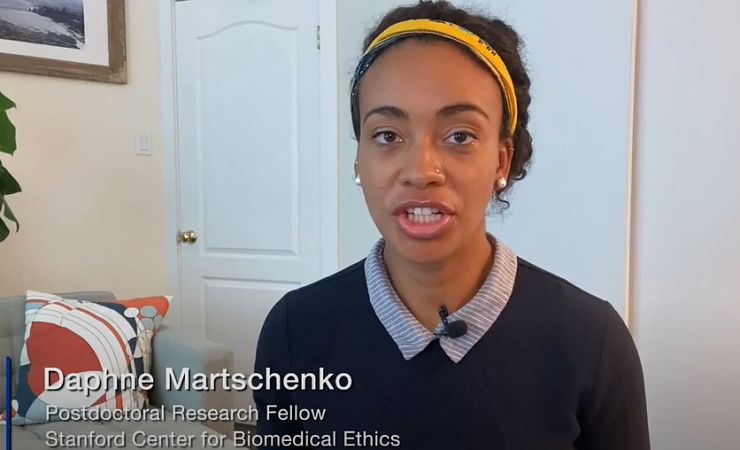
Watch the Video: What Are Biosocial Sciences and What Are They Doing in Education?

April 6, 2021 3799

“Imagine students had individualized education plans tailored using their genetic data, what kinds of families would have access to this genetically sensitive school system? And what would it mean for educational equity? Our world is full of technological advancements that were previously unimaginable.” 

Read more about Daphne Martschenko at her website.

Meet Daphne Martschenko, a research fellow at the Stanford Center for Biomedical Ethics, a BioFutures Fellow in the Stanford Department of BioEngineering, and co-founder of the international Race, Empire, and Education Research Collective. In the next in our series of ‘At Home’ videos (filmed in 2020) we asked Dr. Martschenko to break down what the biosocial sciences are and what they mean for education and education research. You can read more about the biosocial sciences in this Research in Education special issue, which she guest edited.  

“Today in education, the biosocial sciences are shifting how we think about and understand the student, the teacher and what it means to educate. Our views of ourselves as learners and educators are more malleable than they once were. The biosocial sciences are transforming conversations about stress in high stakes education environments. They’re influencing our views on mindfulness, and on how to enhance education systems. The field is changing the ways in which we build schools, and how teachers think about their students and how best to teach them. And yet, amidst all this transformation, we are to remind ourselves of the age old threats of racism, classism, sexism, and biological determinism. proactive steps will need to be taken to avoid repeating past and justices. So what can we do? Where do we start?” 

Watch the short video to find out! 

Sage, the parent of Social Science Space, is a global academic publisher of books, journals, and library resources with a growing range of technologies to enable discovery, access, and engagement. Believing that research and education are critical in shaping society, 24-year-old Sara Miller McCune founded Sage in 1965. Today, we are controlled by a group of trustees charged with maintaining our independence and mission indefinitely. 

View all posts by Sage

Related Articles

Who Do You Trust More: Your Colleagues or Your AI?
Artificial Intelligence
May 22, 2026

Who Do You Trust More: Your Colleagues or Your AI?

Read Now
What Does It Mean Now That AI Is Creating Academic Papers?
Higher Education Reform
May 15, 2026

What Does It Mean Now That AI Is Creating Academic Papers?

Read Now
Academic Authorship Confronts Ghosts, Gifts and Gender
Higher Education Reform
May 14, 2026

Academic Authorship Confronts Ghosts, Gifts and Gender

Read Now
Anti-Universities, Archives and Abolitionism: Alternative Models to the University
Higher Education Reform
May 6, 2026

Anti-Universities, Archives and Abolitionism: Alternative Models to the University

Read Now
The Visual Authority Trap

The Visual Authority Trap

The challenge: Students tend to perceive attractive looking results as more trustworthy. This is the aesthetic bias, a behavioral phenomenon where humans […]

Read Now
From ‘Which Database?’ to ‘Under What Conditions?’: Teaching Critical Thinking Through Search Tool Selection in an AI Age

From ‘Which Database?’ to ‘Under What Conditions?’: Teaching Critical Thinking Through Search Tool Selection in an AI Age

A few years ago, if you asked students where they began their research, the answer was predictable: “Google” or “Google Scholar.” Today, […]

Read Now
The 3E Cycle: Establish-Examine-Evolve as a Structured Model to Foster Critical Thinking

The 3E Cycle: Establish-Examine-Evolve as a Structured Model to Foster Critical Thinking

In university classroom, I once asked my undergraduate students if a particular policy decision had strengthened or weakened the national economy. Few […]

Read Now
0 0 votes
Article Rating
Subscribe
Notify of
guest

This site uses Akismet to reduce spam. Learn how your comment data is processed.

0 Comments
Newest
Oldest Most Voted
Inline Feedbacks
View all comments