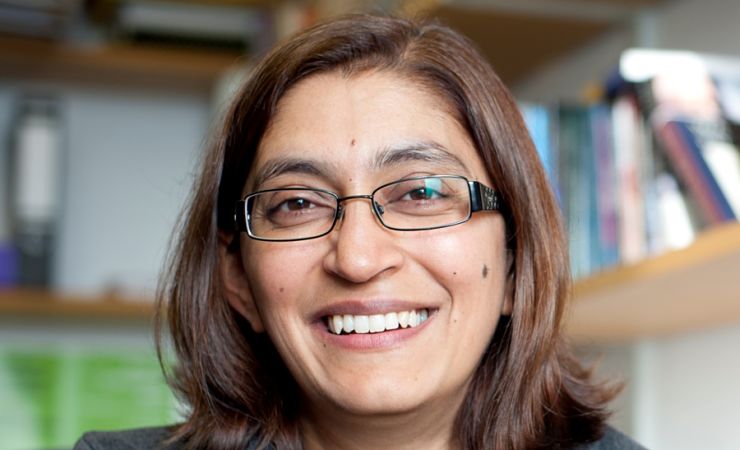
Gurminder Bhambra on Three Challenges for Reparatory Social Science
Sociology, and the broader social sciences, are shaped by the idea that the ‘modern’ world is their special domain of investigation. It is contrasted to a ‘non-modern’ world that is seen to be the concern of anthropology, and a ‘pre-modern’ world that is typically the concern of historians. However, this modern world is a colonial world, albeit that colonialism and empire are largely absent from the social sciences.
If standard accounts have elided the relationship between colonialism and modernity, then accounting for this relationship requires us also to transform sociology. Here, I draw out the key concerns of a reparatory sociology that follow once the role of colonialism in the shaping of the modern world is recognized. I do this by building on work both within and outside the academy.

Notably, a reparatory sociology must recognize the significant claims for reparations made by activists now and in the past. This includes the significant work of Hilary Beckles, CARICOM, and Rastafari Movement UK, in the context of slavery and indigenous dispossession in the Caribbean; and that of Shashi Tharoor and earlier figures such as Dadabhai Naoroji in relation to colonial drain from the Indian subcontinent. It is activism such as this that has brought about academic engagement with the idea of reparations for colonialism.
The issue of slavery and Black experience, in particular, was the focus of a research symposium on “Reparative Histories” organized by Anita Rupprecht and Cathy Bergin and published in Race and Class in 2016. This was followed by articles by Colin Prescod and Catherine Hall addressing the relationship between calls for reparations, the archive, and the writing of history itself.
The question of reparative futures has been picked up Arathi Sriprakash and colleagues who seek to rethink the relationship between the past and futures oriented to questions of repair and justice. Olúfemi O. Táíwò similarly argues for reparations to be seen as a future-oriented project; one that develops a constructive view of reparations rooted in philosophical concerns of distributive justice.
Over the last couple of years, I have sought to examine these issues through and for the social sciences (see my May 2021 talk at the LSE and subsequent journal article). A reparatory sociology, I suggest, requires a reconsideration of the histories that are taken to be central to it as well as a reorientation of our conceptual understandings as a consequence. It further requires us to be committed to epistemological justice in our practices. Here I identify three crucial challenges:
Historical
European modernity, organized in terms of the industrial revolution and the French revolution, has long been argued to be the central defining frame for the social sciences. However, much research has argued for the necessity of addressing the global conditions of these events as well as acknowledging other world historical processes and, indeed, the interconnections between them.
Arguing for the histories of Europe to be understood as colonial histories is an inclusive move that seeks to account for the shape of Europe (and the world) today as a consequence of global practices of domination and appropriation. It is these histories that have produced the modern world and need to form the basis from which we rethink the social sciences, including sociology.
Conceptual
The nation state is proposed as a primary unit of analysis across the social sciences. The period that is seen to give rise to the modern nation state, however, is precisely a period of colonial expansion that saw some European states consolidate their domination over other parts of the world within imperial formations. Yet, what is seen as ‘external’ domination is rarely theorized as a constitutive aspect of the ‘modern state’.
The argument that we should move from using the nation as the unit of analysis to working with a broader approach that takes seriously colonial and imperial histories has implications for the way in which we understand political issues in the present. The political communities of European states extend beyond national boundaries with implications for how we should understand borders as functioning within practices of appropriation and exclusion. Once we acknowledge the broader histories that have shaped us, this has implications for the concepts that we develop on the basis of a proper consideration of those histories.
Epistemological
Epistemological justice, which I argue is central to any reparatory sociology, requires an address of the ways in which colonization, slavery, and indenture were integral to the project of modernity. Such processes structured knowledge claims within theories of development and ‘progress’ as well as its institutions, such as universities, but were rendered invisible in representations of its ‘civilizational’ project.
Epistemological justice, then, involves recognition of the knowledge claims of others in terms both of respect and (re)constructive response; whether in terms of disagreement or agreement. A central aspect of this would be an ethical practice of scholarship that acknowledges the work that has already gone on by those whose activism has forced our attention, as well as engaging productively with critiques and contestations around their implications for contemporary politics, including the politics of knowledge production.
As I argued in the inaugural issue of the Global Social Challenges Journal, a reparatory sociology requires both the repair of the social sciences as well as being invested in the collective address of the inequalities legitimated by standard social science. Recognizing the modern world as the colonial global world enables us more adequately to contextualize events and processes that are often presented as separate and to understand them within a connected frame of reference – one committed to repair and transformation, and a world that works for us all.
- Gurminder K. Bhambra’s recent book, Rethinking Modernity: Postcolonialism and the Sociological Imagination; Connected Sociologies
- A video lecture series on Colonialism and Modern Social Theory with John Holmwood
- A Social Science Bites episode, “Gurminder K. Bhambra On Postcolonial Social Science“