Whose Work Most Influenced You? Part 6: A Social Science Bites Retrospective
Every guest on the Social Science Bites podcast is queried about their area of expertise, and hence the questions tend to differ in each podcast. But interviewer David Edmonds does ask one specific question of each guest – what piece of social or behavioral scholarship has most influenced you? And that answer never is included in the guest’s final episode. Instead, we save them up for quick-fire montages we present on an occasional basis.
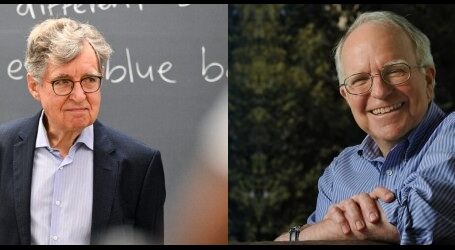
In this sixth edition of the tradition, five past guests on the podcast — James Scott, Steven Pinker, Claudia Goldin, Harvey Whitehouse, and Daniel Kahneman — are cited by more recent guests. A range of public intellectuals who haven’t appeared on Social Science Bites also make appearances, such as EO Wilson, Paulo Freire, Richard Dawkins and Pete Singer, as well as some 20th Century scholars who should have been better known — like Else Frenkel-Brunswik and the recently passed Robert Trivers — and scholars of the 21st Century currently making their mark, such as Nim Tottenham, Leah Boustan, and Siva Vaidhyanathan.
To download an MP3 of this podcast, right-click on the link. The transcript of the conversation appears below. And to hear the original episode of of guest in this montage, click on their bolded name in their introduction.
This is Social Science Bites with me, David Edmonds. Social Science Bites is a series of interviews with leading social scientists and is made in association with Sage Publishing.
Over the past few years, I’ve been asking leading social scientists the answer to a simple question: Which piece of social science research has most inspired or influenced them? I’ve compiled their answers into a series of montages. Here’s the latest one.
>>>
Hi, I’m professor Crystal Abidin. I’m the director of the Influencer Ethnography Research Lab at Curtin University, and I’m an anthropologist who studies internet culture. The piece of work that has influenced me the most, if I may say, spoiler alert, thick-skin self-promotion, is a collection that I put together with my colleague Gabriele de Seta. It was provocatively titled, “Private messages from the field: Confessions on digital ethnography and its discomforts.” It was published in the Journal of Digital Social Research, and we talk about how, as ethnographers, when we present our work at conferences or in books and papers, you really only see the polished version of things, and nobody really talks about how hard research is. And so we wanted to get into the messy detail of how to navigate all those difficulties before we’re ready for the spotlight on stage.
>>>
My name is Daron Acemoglu. I’m an institute professor at MIT. There are many that I could cite, but since the political scientist James Scott has recently passed away, I’ll say his book Seeing like a State, because it highlights how distortionary it is to impose designs on diverse people from above. And his focus is on what states do, which I think is a very important part of it. But today we are reliving the worst part of his predictions via the tech industry imposing those designs on people.
>>>
My name is David Autor. I’m a labor economist at the MIT Department of Economics. I guess I’m going to say it’s the book How the Mind Works by Steven Pinker that really helped me to understand how incredibly nuanced and powerful human capabilities are. We are constantly solving problems that have no solution, right? We take two-dimensional data from our eyes and turn it into a 3-D model of the world. There is no such thing actually as perception that doesn’t depend on cognition that does depend on actually processing, which is depends on educated guesses about what the world looks like. And so that actually helped me to think about how computers, what they do, although it seems so impressive to us, is actually quite limited relative to what we do and how that’s good. That complements us, right? Doesn’t just make us obsolete, it makes us better, because we have so many limitations along with our great strengths. And so Pinker’s book, in addition to being beautifully written, like everything Steven Pinker has ever written, was so incredibly enlightening. So when I was doing my graduate student, I was really thinking hard about thinking hard about these questions about technology, computers. People are saying, “Oh, computers, they’re skill biased.” I’m like, “What does that mean?” So yeah, I think that piece of social science research was seminal for my thinking.
>>>
I’m Mukulika Banerjee. I’m professor of anthropology at the London School of Economics and Political Science. So Charles Taylor, the Canadian philosopher, has a wonderful article called “To follow a rule,” and in that, he outlines the idea of social imaginaries, which he says are how people make sense of the world. Social imaginaries are something that are above common sense. It’s not just common sense, but neither is it high political theory, either. It’s not philosophy. It is a general understanding that is shared by people, and I find it an extremely useful term, because it brings in the social and imagination. Now the social is important because we still haven’t understood, especially in our discussions of democracy, how the liberal project or understanding individual rights has taken us so far away from understanding communities or what brings people together. Now, Charles Taylor, as a communitarian himself, has pushed back against that across his work, but in this particular piece, he talks about how people know how to live with others. The second half of social imaginaries by evoking the imagination is just as important, because unless you are able to imagine the kind of future you want to create, the kind of society you want to be, the kind of person you want to be, you are nowhere. And that imagination is drawn as much from art and music as it is done from ideas and ideologies. And so I would say that of all the wonderful things I’ve read, that’s been the one thing that’s really helped me creatively, think of new ways of conceptualizing democracy.
>>>
I’m Iris Berent. I’m a professor of psychology, I am a mother, and I really love what I do in science. Noam Chomsky, by far. This is really what brought me into this field. I tried to understand started with questions about music and the universality of music. I thought that the way Chomsky talked about human nature was really my guide into cognition. That’s what brought me into this field, and I owe him, and I think we all owe him a huge debt of gratitude.
>>>
I’m Paul Bloom. I’m a professor of psychology at University of Toronto and an emeritus professor at Yale University. The discovery from social science and accompanying papers that has most influenced me is work by Tom Gilovich on the spotlight effect. Gilovich did a series of studies, finding that people tend to radically overestimate how much people notice them. He did studies, for instance, where he had people put on an embarrassing T-shirt and walk around campus, and he asked them, “How many people noticed your embarrassing T-shirt?” “Everybody!” And then he asked people and said, “How much did you notice this guy’s T-shirt?” And they said, “No.” And he did this over and over again in a range of different ways. And the reason why it’s useful is it kind of helps me realize that when I make an ass of myself, I notice it. This is the seat of my consciousness. I noticed that probably most other people don’t care. They’re worried about making an ass of themselves, themselves. And similarly, when I’m in the midst of some triumph, I realize as well that I am not in the spotlight. No one else cares as much as I do.
>>>
I’m Nick Camp. I’m an assistant professor of organizational studies at University of Michigan. So the book that’s most influenced my thinking is The Geography of Thought by Richard Nisbett. I was working part time in the library. I was shelving this book. It’s about culture and how it influences basic psychology. I thought this is a crock of BS. I’m not even going to shelve it. I’m going to read it. And it really converted me, not just to cultural psychology, but to using the scientific method to answer these big questions about people and about society.
>>>
Hi, I’m Janet Currie. I’m a professor of economics and public affairs at Princeton University, where I run the Center for Health and Wellbeing. One of the pieces of social science I think that’s been most influential was Claudia Goldin’s book called Understanding The Gender Gap. Claudia Goldin won the Nobel Prize this past year, and she won it for starting a whole new research area in economics, thinking about gender economics, and the book pulled together a lot of historical data and contemporary data and really addressed some important myths and showed that they weren’t true. The title is about the gender gap. So thinking about women earning 80% of what men earn on average, she showed how much that ratio had changed over time, and what kind of factors in the economy were related to the change. So just seeing that, you could start a whole new research area doing something that other people weren’t doing, that you could overturn conventional wisdom just through careful measurement and argument. That was very inspiring to me as a graduate student.
>>>
Hi, I’m Ellora Derenoncourt. I’m an assistant professor of economics at Princeton University. I’m a labor economist and an economic historian. So one of the social scientists who has been most influential for me is Leah Boustan, whose work on immigration, historically in the United States, has served to bust certain myths that we have about immigration and its effect on the economy. And one study in particular, “A Nation Of Immigrants: Assimilation And Economic Outcomes In The Age Of Mass Migration,” bust the myth that there were big changes in the ability of immigrants to assimilate into the U.S. economy over time. Instead, those patterns of declines in convergence were actually driven by differences in the characteristics of incoming arrival cohorts. And the key innovation was using individual-level data and following individuals over time, as opposed to cross-sectional data on the U.S.-born versus immigrant workers.
>>>
I’m Devyani Sharma. I’m professor of language and communication at the University of Oxford. The work that’s been most influential in my thinking is the work of William Labov, who founded the field that I work in, which is quantitative sociolinguistics. He was an American sociolinguist who started out as a chemist, but brought a completely new way of looking at language variation to research on language. It founded a completely new field. And the reason he’s been so influential for me is that he really brought together the biggest patterns of language variation. When you look at a city, why do people speak like that? Down to why an individual’s personal identity, or even their cognition, influences the way they speak as well. He brought together these two ends of the extremes of how language works in a single paradigm.
>>>
I’m Dimitris Xygalatas. I’m an anthropologist and a cognitive scientist at the University of Connecticut. One particular book that I remember reading and being amazed by was E.O. Wilson’s book, Consilience. I specifically remember reading this on my terrace growing up in Greece, probably as a college student. And it was through this book that it came to the realization that the fragmentation, the division that we see across academic disciplines, is actively hurting our understanding of human nature, and that if we are to understand human nature, we need to do it in a way that brings together different disciplines and that creates a unified form of knowledge.
>>>
I’m Julia Ebner, and I’m a researcher at the University of Oxford Center for the Study of Social Cohesion, where I lead the Violent Extremism Lab. I’m also a post-doctoral researcher at the Calleva Center for Evolution and Human sciences, and my research focuses on radicalization dynamics, psychological patterns in violent extremism and terrorism. The most influential social sciences journal article for me has been Harvey Whitehouse‘s paper, “Dying for the group: Towards a general theory of extreme self-sacrifice,” which was published in 2018 in Behavioral and Brain Sciences. It’s at the intersection of several different disciplines. It’s been influential because it really consolidated a lot of the previous research to form an overarching theory about why people are willing to, for example, commit suicide attacks, or why people are willing to commit extreme forms of self-sacrificial violence.
>>>
My name is Alex Edmans. I’m a professor of finance at London Business School. I’d say the work of Daniel Kahneman, so most people will know about his work through his best-selling book, Thinking, Fast and Slow, which I’ve read and is indeed excellent. But I actually read his research before his book came out, when I was a PhD student. So I was a PhD student when behavioral finance was really taking off, and it was seen as controversial, because people believed in traditional rational finance. But Kahneman’s work showed that this was not based on just fluff, it was based on evidence and experiments and science, and this really changed my view, and this is why I ended up being very susceptible and very open to the idea of biases rather than pure rationality.
>>>
Rob Ford, professor of political science, University of Manchester. Well, I think the book that has had the most influence on me in the round and in the long term is probably Political Change in Britain by David Butler and Donald Stokes, which is sort of one of the great landmark studies. It was the first big election study done in Britain, where you actually did a mass survey of voters. This had never been tried before, and it’s so rich. I mean, I’ve reread it about four or five times. They really try everything. You know, these days, we’re much more specialized, and also there’s just much more literature out there. They were basically staking out the whole field, and they didn’t know what they were going to find, so they were trying everything. And there’s all sorts of stories in there about generational change, about issues rising and falling. There’s a big bit about immigration in there, about how the parties behave, how they’re perceived, what matters to voters, about parties and what doesn’t I mean, it’s terrific. When I read it, I just thought, “Wow, you really can do some really magical stuff with the humble social survey.”
>>>
I’m Alison Gopnik in the Department of Psychology, Philosophy and AI Research at the University of California at Berkeley. My favorite study is a study by Nim Tottenham, who’s actually a neuroscientist, that stems from a study with young mice. The most canonical result in all of psychology is that you put a mouse in a maze, it goes down one arm in the maze, nothing happens. It goes down the other arm. It gets shocked. It avoids ever, never goes down the arm with a shock. Yeah. Well, it turns out that’s not true for juvenile mice. So if you do it with young mice, they actually prefer to go down the arm that leads to the shock. And Nim found that the same thing was true with 3- and 4-year-old children, that they actually would rather get the information that you get from the shock, even if it’s at the cost of the shock.
And that seems kind of crazy, but of course, if you think about it, the problem with avoiding the shock is that you’ll never find out that sometimes there’s cheese at that end of the maze, or that sometimes the shock isn’t there. And anxiety disorders are the result of the fact that you don’t actually go out and explore after you’ve had a negative experience.
But there’s a wonderful catch to this, which is that both for the mice and the children, they’ll prefer to explore, but only if the mother is present. So for the mice, if the mother is within view, then the juveniles will explore. And for the children, if a caregiver has been present, then they’ll explore. And I think there’s something really foundational about not just human life with children, but human life in general, about that, about the fact that it’s love that lets us learn, it’s our .. what might seem like contradictory parts of our lives, our attachment and love and security and our curiosity and exploration, those are really just two sides of the same coin, and we see it most vividly in young children.
>>>
Hi, I’m Joshua Greene, and I’m a professor in the Department of Psychology and Center for Brain Sciences at Harvard University. Well, I was blown away by Peter Singer‘s work when I first encountered him, and in particular the shallow pond argument. I mean, the idea that we would feel a strong obligation to save the life of a child who’s drowning right in front of us. And yet, as Singer pointed out, there are children who are drowning in poverty all over the world. Why don’t we feel less of an obligation to them? And that insight just had an enormous effect on me. I mean, it is both horrifying to kind of experience one’s own sort of inconsistency and callousness, and then at the same time, incredibly motivating and invigorating to think, “Wow, fortunate people here in the affluent world have this kind of superpower. How do we use it?” And that has been a guiding question for me.
>>>
I’m Bruce Hood, professor of developmental psychology and society at the University of Bristol. Probably the most influential piece of work that is in regard, I suppose it’s partly in the social sciences, but it’s also very much in the biological sciences, is Richard Dawkins’ The Selfish Gene. I read that book in my early 20s, and it totally transformed the way I viewed human psychology. To really understand it as a systematic approach, understanding it from an evolutionary perspective, really was a Zeitgeist for me. It really radically changed my view on all the factors which contribute to human psychology.
>>>
I’m Jens Ludwig. I’m the Edwin A. and Betty L. Bergman, Distinguished Service Professor at the University of Chicago, and I’m the Pritzker Director of the University of Chicago Crime Lab. For me, the research that’s had the biggest impact on my thinking is Danny Kahneman’s wonderful book Thinking, Fast and Slow. The most obvious reason is that it has given me such a profoundly new and different insight into human decision making and cognition. It’s just transformed my understanding of the world as a social scientist. But also, the other reason, the icing on the cake, is that it has given me a profoundly different understanding of me as a human being. You know, one of the ways that I think about that book is we are all born with this amazing tool, which is the human mind, and nobody ever hands us an owner’s manual. And I think of Danny Kahneman’s book, Thinking, Fast and Slow as like the owner’s manual we wish we all had for our own minds.
>>>
I’m Katie Milkman. I’m a professor at the Wharton School at the University of Pennsylvania, and author of the book How to Change. And I also host my own podcast, called Choiceology. Oh, this is so easy for me. This is an easy answer. It’s the book Nudge by Richard Thaler and Cass Sunstein, and the reason why is that they highlight a way of looking at the world and recognizing that in every environment where we make choices, the environment is shaping those choices. We actually have the opportunity to architect our environments in ways that are advantageous, that will favor choices that are better for us, better for welfare. They’re focused very much on policymakers and giving them the insight that we can, for instance, set wise defaults, default people into saving for retirement so that they won’t have to take any steps in order to make that happen, or ensure that everyone makes an active choice about whether or not they want to be an organ donor, rather than passively, sort of not becoming one. And this could save many lives. So that’s where they focus. But it gave me the insight that has guided most of my research, which is that we can also use nudges to be more effective personally. And actually, when I talked to Richard Thaler about my book How to Change, he said, “Oh, it’s a book about snudging. You could call it smudge because it’s about self-nudging.” And while I’m glad I didn’t call it Snudge, I think he’s exactly right.
>>>
I’m Safiya Noble. I am the David O Sears endowed Presidential Professor of Social Science at the University of California Los Angeles. Siva Vaidhyanathan’s book, The Googlization of Everything (And Why We Should Worry) is the single most influential book that inspired me to write Algorithms of Oppression. I think he was one of the first people to help us understand the power, the outsized power, of this company. And really inspired me to think about the way that company is affecting vulnerable people and racial and ethnic minorities and women. And I love him, and I love that book.
>>>
My name is Tejendra Pherali. I work at University College London. I’m professor of education, conflict, and peace. I think this is very difficult for me to say, because the field of education and conflict does not have a long history, and therefore the scholarship that informs my field comes from both educational sciences, but also conflict studies or international relations, political science and so forth. Nevertheless, for me, Paulo Freire’s work has been incredibly influential, and I often draw upon his ideas of critical consciousness to inform my thinking and theoretical analysis. It enables me to look at the role of teachers in facilitating this critical consciousness and social transformation for peace.
>>>
My name is Steve Pinker. I am a professor of psychology at Harvard University. Probably the idea that has influenced me the most did not even originate in social science, but in evolutionary biology. This is the set of analyses by the biologist Robert Trivers on human cooperation and conflict, as predicted by patterns of genetic overlap and non-overlap. So Trivers has analyzed dynamics within the family and showed that there, even though, of course, blood is thicker than water, we are closer to our genetic relatives, more altruistic, more caring, more intimate than with strangers. There are also seeds of conflict within families. Since every child is related by 50% of shared genes with his or her sibling, but is related by 100% of her genes to himself or herself, there is partial overlap and partial conflict.
Likewise, when it comes to the relations between parents and offspring, a parent is related to each child by 50% which means that parents are selected to treat their children equitably, but each child wants a somewhat greater portion of the parental investment for himself, which means that the child’s idea of what the parent should do and the parent’s idea of what the parent should do differ. Hence, you have the seeds of parent-offspring conflict.
When it comes to romantic partners. They have a common interest in their common children. They have a potential divergent interest in temptations for infidelity, in the pull of their own genetic relatives, and in one of them possibly dying before the other.
In the case of friends and allies, there’s an overlap of interest in the potential for gains in trade by trading favors that leave each one better off. There’s also the seeds of conflict in the possibility of defection, one of them taking a benefit without reciprocating.
Finally, Trivers has talked about a possible conflict with the self, where we all have an incentive to present our best self to others, to be the most effective liar, you have to believe your own lies. So there might even be a dynamic within the self of self-deception. We believe our lies to tell them more effectively to others. So every major human relationship – husband-wife, brother-sister, parent-child, friend-friend, even self-self — has a complex pattern of both overlap of interest and conflict of interest, which I think explains much of the complexity of human social life.
>>>
My name is Ramanan Laxminarayan. I am founder and president at the One Health Trust and a senior research scholar at Princeton University. Well, I would say Garrett Hardin’s “Tragedy of the Commons,” because that really underlies everything that I think about when I think about antibiotic resistance. But that’s such a fundamental paper that has defined all of the sorts of commons problems that we encounter, whether in environmental economics or in infectious disease, pandemics, all of them fit into that very nice description of how the commons work or don’t work.
>>>
Hi, I’m Setha Low. I’m distinguished professor of environmental psychology, geography, anthropology and Women’s studies at the Graduate Center of the City University of New York, and director of the Public Space Research Group. I mean, I think it’s all the 60 years of social contact theory that was written by social psychologists. What it did for me was confirm what I was seeing ethnographically as an anthropologist, giving me everything from experiments to quantitative studies over a long, long period of time that confirmed that what I was seeing in the social world, that public spaces, people coming into contact, had all these positive benefits, that it indeed, even at a psychological level, made a difference, and had been making a difference, and had been observed long before I started working.
>>>
So I am Megan Stevenson. I’m a law professor at UVA. I’m trained as an economist, and I’ve done a lot of research about various criminal legal programs and interventions using the toolkit of applied econometrics. Ah, interesting question. So I would say one of the most impactful pieces of social science for me was a large randomized control trial that studied the impact of job training programs for people recently released from prison. You know, giving them things like subsidized employment, help with their resume, help with interviews. And this program was not successful. You know, it had short-term impact. It got people jobs for the short run, but it didn’t have any lasting impact in terms of new arrests or employment. And this really changed my thinking about these types of limited scope interventions that we studied with randomized control trials, and the power and the impact that they’re likely to have in the world.
>>>
I’m Tavneet Suri. I’m a professor of economics at the MIT Sloan School of Management. It would be the Diffusion of Innovations by Everett Rogers. A lot of my career has been working on how technology diffuses in poor countries. Like if we really think that one of the big problems of development is that we need to kind of close income gaps, and technology is a way to potentially do that, how it diffuses is very key to that. So a lot of my earlier work was about agricultural technologies. I’ve done a bunch of work on mobile money, where it’s diffused very fast. We can build all the technology we want to solve problems. If it doesn’t diffuse and get adopted, it’s not going to solve any problems. And so thinking of the process of how people think about adopting new technologies is very different than the technology creation problem. And I sit at MIT, where there’s lots of technology creation, but the social science piece needs to think about, “Well, there’s still this human process through which it gets adopted, maybe adapted and used in a particular context that might be even very different from the initial thought around that technology.”
>>>
Hi. My name is Dr Leor Zmigrod. I’m a political neuroscientist and psychologist and the author of The Ideological Brain. One of the most influential pieces of social research for me is this amazing line of work done by a pioneer in the 1950s called Else Frenkel-Brunswik, who was this Austrian-American scientist, psychologist, who actually was the second author of a very famous book called The Authoritarian Personality, but she herself did incredible research with children, interviewing thousands of children about their prejudice and xenophobia, and she inspired me hugely in order to understand what it is that makes a mind prejudiced, and what it is that makes a mind tolerant, and why we can even trace those early signs of prejudice to children’s ways of thinking, and we can even identify which children will become very tolerant and which might turn towards prejudice. And I think her work, although it was done 70 years ago, was done methodologically in such a rigorous way and conceptually so inventive that I recommend it to anyone who wants to think carefully about the nature of prejudice and ideology.
>>>
You’ve been listening to a special edition of Social Science Bites, a podcast made in association with Sage. Social Science Bites has now built up an extraordinary archive of interviews with leading social scientists. To listen to these interviews. Go to socialsciencespace.com.