Book Review: The American Non-Dilemma: Racial Inequality without Racism
 The weather is getting cooler and it’s the perfect time to cozy up with a good book.
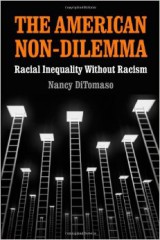
Nancy DiTomaso : The American Non-Dilemma: Racial Inequality without Racism. New York: Russell Sage Foundation, 2013. 432 pp. $42.50, paper.
You can read Standford University Professor Brian Lowery’s review from Administrative Science Quarterly‘s OnlineFirst section:
When I was in college, an organization of primarily young white men would periodically hold a bake sale. The point of these sales wasn’t to raise funds but to call attention to what the group saw as discrimination against whites on college campuses. The prices for their baked goods were meant to reflect this racial inequality. While I don’t remember the exact prices, here is an
approximation: whites = $1.00, Asians = $.50, blacks and Latinos = free. I doubt they sold many cookies, but they did express their belief that whites were unfairly treated on college campuses. While most of their dismay was directed toward affirmative action policies, in my short conversations with members of this group, their concerns were not limited to affirmative action. They thought ethnic minorities were getting special treatment while whites were getting the short end of the stick. By just about any objective measure, whites were better off than most ethnic minorities. But not only did these racial inequalities not cause these particular whites moral angst, they also felt that whites were aggrieved.
DiTomaso’s book suggests that the lack of concern about ethnic minorities’ disadvantages, which allows for events like the bake sale, is commonplace. Whites are surprisingly unconcerned about racial inequality, at least when understood as minority disadvantage. She suggests that whites are not bothered by racial inequality because they do not believe they contribute to its existence. The vast majority of whites believe that racism is wrong—that people shouldn’t be mistreated simply because of their ethnic backgrounds. Unless they see themselves as racist, this belief allows whites to see themselves as blameless. DiTomaso does not share this perspective. She proposes that even if no whites are racist, it would be an error to conclude that whites do not contribute to racial inequality.
Click here to read the rest of the review from Administrative Science Quarterly. Like what you read? Sign up from e-alerts for all the latest news and research from Administrative Science Quarterly!