Social Science Bites Makes Leap to Print
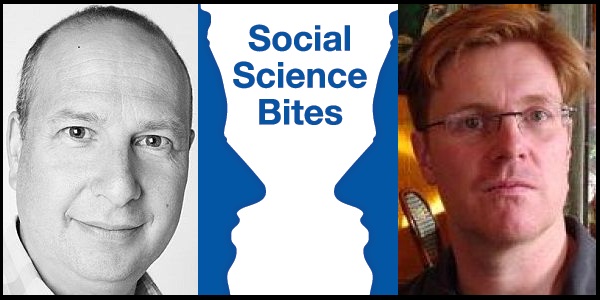
Dave Edmonds, left, and Nigel Warburton
Starting in 2012 every month Social Science Space has featured a one-on-one interview with an esteemed social scientist discussing one of their personal favorite topics of investigation. Those interviews, conducted by “freelance philosopher” Nigel Warburton and BBC journalist Dave Edmonds, are called ‘Social Science Bites’ and appear as podcasts – i.e. something you listen to, not something you read.
This month, a collection of 18 of these podcasts has been released by Social Science Space’s parent, SAGE Publishing in book form – i.e. something you read, not something you listen to. In Big Ideas in Social Science, Edmonds and Warburton talk with intellectuals such as Steven Pinker, Ann Oakley, Lawrence Sherman, Kate Pickett, Robert J. Shiller and Doreen Massey about important questions facing academe and society itself, starting with the fundamental ‘what is social science?’ asked of philosopher Rom Harré.

The question-and-answer chapters feature sessions with experts from many disciplines — sociology, politics, economics, criminology and geography — which are divided into four general areas: “Fields of Enquiry,” “Births, Deaths & Human Population,” “Social Science Through Different Lenses,” and “Politics and Social Science.” Emblematic of the strength of the Social Science Bites series is the marquee appeal of some of the social scientists who didn’t make this volume: Nobel laureate Angus Deaton, political scientist Ivor Crewe, sociologist Saskia Sassen …
Social Science Bites was inspired by the Edmonds and Warburton’s Philosophy Bites podcast series, which has had more than 27 million downloads since its debut in 2007. That series has spawned, so far, three bound collections drawn from its 353 and counting conversations. Social Science Bites, by contrast, is currently at 38 podcasts, which from day one have been among the most popular posts on Social Science Space.
“We’ve reached a huge audience through podcasting,” Edmonds said of the various Bites endeavors. “One of the many interesting aspects about our podcasting experience is the relationship we have with our audience. We get much more feedback from listeners than I do from my BBC programs. There’s something quite intimate about the podcast…especially when, as they usually are, they’re produced by enthusiasts. Listeners have a sense of ownership over their favorite podcasts, and feel a connection with the podcast makers – and that’s gratifying.”
Turning the tables a bit, we made Edmonds the subject asked to answer some additional questions about the genesis and direction of the series.
Social Science Space: Can you tell us a bit more about Social Science Bites? How they were formed and why did you chose to be a part of this project with SAGE Publishing?
David Edmonds: We had been making Philosophy Bites for several years when the head of SAGE’s global publishing, Ziyad Marar, approached us. Ziyad listens to Philosophy Bites mainly, I believe, at night, when he can’t sleep – we help nudge him back into a slumber. In any case, Philosophy Bites had found a niche with people interested in philosophy. Ziyad wondered whether we could pull of the same trick with the social sciences.
Why are series like this — and the resulting printed collection — important for both engaging with and formulating discussions around social science?
Traditional media can find it difficult to cover ideas emerging out of academia – they’re often regarded as too remote or technical to be of interest to a general public. The internet has opened up publishing and broadcasting in myriad ways. Universities can now put lectures online. The problem is that these institutions don’t usually edit what they put online – nor do they reflect very hard about the audience. We like to think that we are good at making ideas accessible and engaging, and that we serve as useful conduit between the academy and the public.
One question you always ask your guests is ‘do you consider yourself a social scientist’ or ‘is the work you do social science.’ As a philosopher and as a journalist, would you consider yourselves to be social scientists, or the work that you do social science?
No. I –David — don’t regard myself as a social scientist. My academic background is in philosophy – not a social science. My day job is in journalism – making BBC programmes. Naturally I reflect on the subjects and methods I use in putting programmes together, but not in any systematic way. I definitely regard those involved in the rigorous deconstruction of journalism – in what is usually called cultural or media studies – as social scientists. Mind you, many of these academics display an embarrassing ignorance about the actual practice of journalism, and could benefit from a spell at the coal-face.
You have interviewed several dozen people across the series. What was the most surprising thing that you heard throughout the podcast and the book? Did anything change your own way of thinking?
I have an experimental and empirical bias. I like social science which comes up with hypotheses, tests them and finds them confirmed or refuted. So, for example, I was fascinated to hear about Lawrence Sherman’s experiments about whether an arrest or a warning was more effective in combating crime.
From the people that you have met and the topics that you have discussed, what came out of conversations that you would you deem to be the biggest threat to social science and the biggest opportunities prevailing the field?
The biggest threat and the biggest opportunity are one and the same. Because of the way universities are set up, academics often find themselves in departmental silos. Yet many of the people we’ve interviewed have to draw on a range of disciplines. Take criminology again. You can’t understand the causes and solutions to crime without psychology, political science, sociology, economics (including behavioral economics), and so on. That, perhaps, hints at the biggest opportunity – a rethinking of social science, so that academics do not find themselves too narrowly pigeon-holed, and inter-disciplinary cooperation can flourish.
If you could have one guest from the past and one from the future, who would you chose and what question would you most like to ask them?
From the past: Karl Marx. What are his views on ISIS, Jeremy Corbyn, London property prices, and The Apprentice.
In the future: Thomas Picketty. Does he agree with K.Marx about ISIS, Jeremy Corbyn, London property prices, and The Apprentice.