Seeking a Better Way to Evaluate Teachers

Robert Pianta finds that students do better when their teachers engage in “responsive teaching,” by providing strong emotional support, instructional support for specific concepts, and clear classroom organization and management. (Photo: Intel Free Press/Flickr/CC BY 2.0)
Sadly, Pianta has found that the quality of teacher-student relationships is generally low, but he has developed some promising ways to improve those relationships and the student outcomes that depend on them.
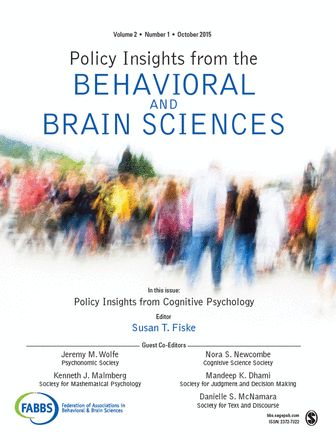
The Federation of Associations in Behavioral and Brain Sciences, or FABBS, with SAGE, the parent of Social Science Space, publishes the journal Policy Insights from the Behavioral and Brain Sciences. This journal features research findings in the sciences of mind, brain, and behavior that are applicable to nearly every area of public policy. The third issue features 18 articles focused on education research.
For generations, policymakers and school leaders assumed they could judge teachers based on gut feelings, or they relied on checklists of classroom practices. Then as a movement grew to reward good teachers and remove bad ones, student performance on standardized tests became a popular marker of teacher effectiveness. But few of these methods have been supported by research showing that they actually separate the wheat from the chaff. Pianta’s work is different, both because of the level of rigorous research he has conducted and because of the elements of teaching on which he focuses.
Pianta and his colleagues look beyond what educators teach to how they do it. They find that students (especially at-risk students) do better when their teachers engage in “responsive teaching,” by providing strong emotional support (for example, being warm and encouraging), instructional support for specific concepts, and clear classroom organization and management. Teachers vary quite a bit from one classroom to another, and the same teacher can vary in her own level of support from day to day or from one class period to the next. But those with more consistently high scores have students who perform better and are more well-adjusted.
Those kinds of scores are not easy to come by in today’s schools, however. “The quality of students’ interactions with teachers is, on average, modest at best,” Pianta writes, citing evidence that high percentages of students say teachers don’t understand or support them and their needs. In one large national study of first, third, and fifth grade teachers, trained observers found that:
- Less than 10 percent of students had teachers who scored highly on emotional and instructional support;
- Students had few opportunities to interact directly with their teachers; more than 85 percent of teacher-student interactions were in teacher-directed, whole-group instruction or individual seatwork;
- Teachers failed to provide helpful feedback to students;
- Student engagement was “generally passive and compliance oriented;” and
- Classroom activities tended to focus on basic skills rather than analysis or problem solving.
Fortunately, Pianta and his colleagues have translated their findings into promising methods for improving teacher-student relationships and teacher quality. A validated evaluation measure called the CLASS (Classroom Assessment Scoring System) that assesses emotional, instructional, and organizational support is increasingly used in classrooms, especially to evaluate preschool teachers. In fact, it is now required in Head Start centers recompeting for funding. And Pianta and his collaborators have also developed models for coaching teachers on how to improve on the CLASS dimensions. Some districts employ mentor teachers who use the CLASS as a framework for helping teachers strengthen their practice.
For those without such supports, Pianta and his colleagues created a program called My Teaching Partner, which allows teachers to videotape their teaching, send it to a coach, and receive feedback via phone or Internet. The approach has impressive results, including greater gains in student literacy skills and decreases in problem behavior. A study of 500 preschool teachers also found that teachers provided more and better feedback and support for critical thinking.
The CLASS and My Teaching Partner are being used to good effect in schools around the country, but they are far from universal. As teachers’ unions and state legislators do battle over using standardized test scores for teacher bonuses and teacher firings, Pianta’s work might give them pause. Teacher observations are both costly and time intensive, but perhaps it’s time to invest in better teacher evaluation to get better student results.