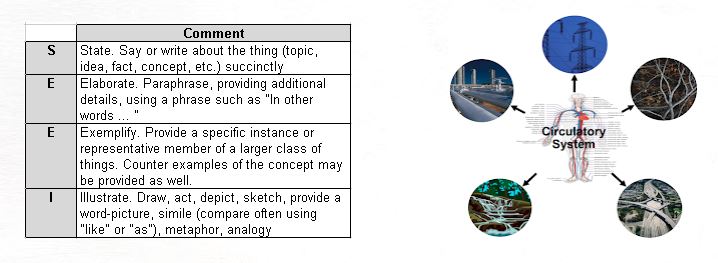
Teaching Foundational Concepts by Using the SEE-I Process

One of the challenges we all face when teaching a foundational concept is making sure that student comprehension is strong and that they will be able to apply the concept throughout the course. SEE-I is one excellent process that helps students master foundational concepts. SEE-I stands for State, Elaborate, Exemplify, and Illustrate. To state, we precisely say what we are trying to communicate. When we elaborate we expand on our brief statement, and when we exemplify we provide an example. To illustrate we provide a picture, diagram, analogy, or something else that helps reify the concept.

One of the foundational concepts in sociology is the sociological imagination. Let’s work through the SEE-I process for the sociological imagination. In chapter one of Sociology in Action, Korgen states that the sociological imagination is “the ability to connect what is happening in our own life and in the lives of other individuals to social patterns in larger society.” An elaboration of the sociological imagination might be that Mills says that the sociological imagination give us the ability to see the relationship between our own individual biographies and the society in which we live. In other words, when we elaborate we re-state definitions. We say the same thing in a different way or in a more expansive way. One of my favorite ways to get students to elaborate is to simply ask them to “say more about that.” Korgen goes on to provide an example of the sociological imagination by referring to college student debt. Figure 1.1 and Figure 1.2 provide illustrations of the how student debt affects a majority of college students. Korgen shows students that if they are having a problem with paying for college, it is not simply an individual problem but rather a social problem and that our own individual lives are connected to patterns in the large society.
My guess is that you go through a very similar process of stating, elaborating, providing examples and illustrating foundational concepts. The SEE-I process simply asks us to have students do so. Using the SEE-I process, we challenge them to do the intellectual work that we often do for them and practice putting sociology in action in a very basic way.
See https://sites.google.com/site/qepcafe/modules/express/state-elaborate-exemplify-illustrate-see-i for another example of working through the SEE-I process.
***
Maxine P. Atkinson is Professor of Sociology at North Carolina State University and co-Editor of Sociology in Action.