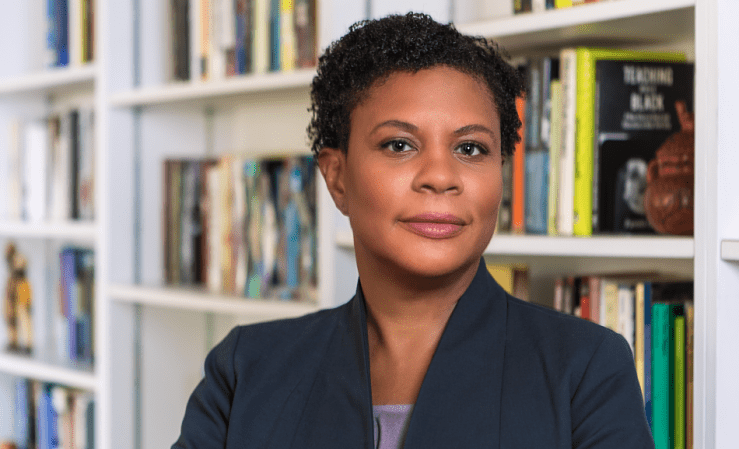
Alondra Nelson on Genetic Testing
Sociologist Alondra Nelson calls it “root-seeking” – individuals wanting to know their ethnic background. Knowing who your people were as a way to know who you are verges on being a human need – witness the Hebrew Bible or the carefully tended genealogies of royal houses.
In her own seeking, Nelson has studied the rise and use of direct-to-consumer genetic testing as made popular by companies like 23andme, Ancestry.com and AncestryDNA. Those firms and others promise to decode, at least in part, stories found in your own chromosomal makeup. As Nelson achieved other career milestones, including being the current president of the Social Science Research Council and the Harold F. Linder Professor at the Institute for Advanced Study, she’s also spent close to two decades unraveling the story of consumer genetic testing, accounts of which resulted in two of her books, Genetics and the Unsettled Past: The Collision of DNA, Race, and History and The Social Life of DNA: Race, Reparations, and Reconciliation after the Genome.
In this Social Science Bites podcast, Nelson describes her particular interest in those root-seekers whose journeys usually aren’t always captured in antebellum church registries or in tales passed down in the same hamlet through countless generations. She’s focused on the descendants of people ‘stolen from Africa’ in the slave trade, who make up so much of the African diaspora.
In surveys and later in extensive interviewing among the African-American community, Nelson found a great deal of interest among Black Americans in DNA testing despite some historical misgivings.
“Marginalized communities, and in the context of the U.S., African-Americans in particular, have a very understandable historic distrust of genetic research and medical experimentation,” she explains to interviewer David Edmonds. “So the fact that African Americans were early adopters in this space is surprising given that history. What’s not surprising is the genealogical aspiration that many African Americans are trying to fulfill – a profound and pronounced and often very living and present longing sense of loss and longing about identity, original family names, of points and places on the continent of Africa where one’s ancestors might have come from.”
She also learned, as her investigations branched out from surveys of the genealogical community to interviews with test-takers, that “getting the test results was really the beginning of the endeavor, rather than the end.
“What in the world did you think you could do with this information, besides filing it away in a drawer and telling your family that we now know that we have Ibo, Yoruba, whatever the test provided for ancestry?” Answering that question meant Nelson’s own approach must evolve.
“That transformed the methodology to a kind of ethnographic methodology that I call the ‘social life of DNA’ in which I followed what happened with the test, what happened with the information, what did they think that these genetic inferences could do with the world. That really opens up a whole other space of thinking about the importance of genetic testing.”
Part of that space she explored is uniquely American. For much of (White) America, one’s ethnic ties to the ‘old country’ – to be Irish or Italian, say — are a linchpin of identity. “That’s not been available to African Americans,” she notes, whose roots are assigned to a large swathe of sub-Saharan Africa, since specific roots were eradicated when now enslaved peoples arrived in the New World. “People lost their given names, lost the languages of their foremothers and forefathers,” Nelson said.
“[P]art of the work of what slave-making entailed was taking people from often very different places on the continent of Africa, with different languages, cultural norms, religious backgrounds and to create out of a multicultural and multiethnic diverse group of people of different backgrounds a ‘caste’.” These enslaved Africans were henceforth categorized as a race, and that race was assigned the caste of enslaved person.
Genetic testing, in turn, opens up that ‘Black box’ of lost identity and reveals what place and culture forebearers were likely ripped from. (Nelson, for example, had her own code analyzed and discovered a component of her heritage was inferred to be from what is now Cameroon.)
In this podcast, Nelson also talks about how Black Americans may respond to their growing awareness of their inferred genetic identities, how this might impact the reparations debate in the United States, and why people are primed to be emotional at reveals of their genetic heritage.
In addition to her two books on genetic testing, Nelson writes extensively at the nexus of science, technology, and social inequality. Her publications, for example, include the books Body and Soul: The Black Panther Party and the Fight against Medical Discrimination and Technicolor: Race, Technology, and Everyday Life. She is also editor of “Afrofuturism,” an influential special issue of Social Text.
To download an MP3 of this podcast, right-click HERE and save.
For a complete listing of past Social Science Bites podcasts, click HERE. You can follow Bites on Twitter @socialscibites and David Edmonds @DavidEdmonds100.


























































































This is most interesting and very high quality – what Mintzberg calls ‘intellectually rigorous’!