Lori Patton Davis Sees 1954 ‘Brown’ Decision as But a Booster, Not the Vaccine

Many positive outcomes in equality are attributed to the ground-breaking 1954 U.S. Supreme Court decision, Brown v. Topeka Board of Education, but in an annual lecture honoring that ruling, Lori Patton Davis sees much of that celebration as terribly premature.
Patton Davis, professor of higher education and student affairs at The Ohio State University, argued that Brown – in which the court ruled that racial segregation in public schools was unconstitutional – was not a cure, nor did it fully address the public ills or centuries of racism and white supremacy. “We have to be thoughtful about Brown being the great black hope, when so much was lost in the process,” she said in her lecture, “Still Climbing the Hill: Intersectional Reflections on Brown and Beyond.” The lecture occurred on October 21.
The American Educational Research Association inaugurated the Brown Lecture, now in its 18th year, to commemorate the 50th anniversary of the Brown v. Board of Education decision. As AERA notes, the ruling was important to social science because the High Court took scientific research into account in issuing its landmark ruling. AERA itself advances knowledge about education, encourages scholarly inquiry related to education, and promotes the use of research to improve education and serve the public good.
On her own account, Patton Davis’s research has been cited in multiple publications and funded by grants from the Spencer Foundation, the Lumina Foundation, the American Psychological Foundation, and numerous other organizations. She is known for her cross-cutting scholarship on African Americans in higher education, critical race theory, diversity initiatives on college campuses, Black girls and women in educational and social contexts, and college student development.
Spotlighting the outsize contributions from Black girls and women in the ferment that led up the Brown was one of three “narratives” that Patton Davis’s lecture explored. Noting that the majority of plaintiffs were women in Brown, she argued that the role of Black women and girls in that moment has been obscured. “We miss them because we’re not socialized to see them as actors,” she said, and that as a result this essentially “subject[s] them to wholesale erasure.”
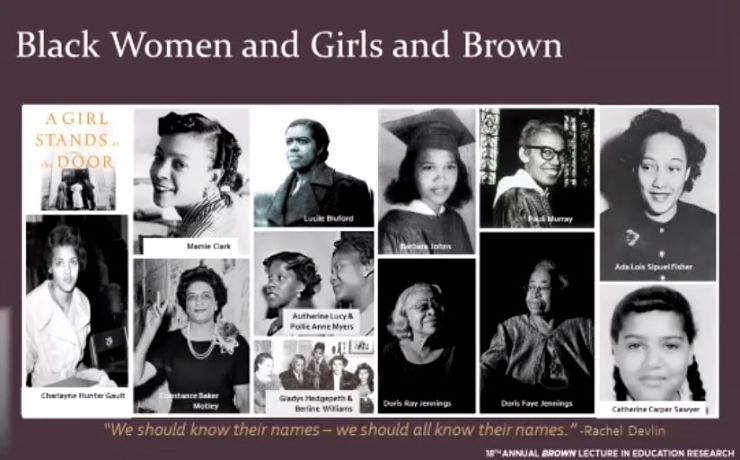
In a bid to reverse such erasure, Patton David highlighted the heroes of higher education cases that preceded Brown, including women such as Ada Lois Sipuel Fisher, who successfully sued the University of Oklahoma six years before Brown; Constance Baker Motley, who wrote the original complaint in Brown; and Lucile Bluford, who unsuccessfully sued the University of Missouri 11 times (and which closed its graduate school of journalism rather that admit a Black woman into it).
That those examples all focused on higher education emphasized another narrative of Patton Davis’s lecture: “Higher education is rarely if ever in our collective consciousness with regard to Brown, yet desegregation in higher education paved the way for Brown.”
She then cited both cases and laws that institutionalized segregation, such as the 1890 Morrill Land Grant Act and 1904’s Berea v Kentucky, which upheld the idea of “separate but equal” in higher education, and six cases which eroded those barriers, starting with 1933’s Hocutt v. Wilson and 1936’s Murray v. Pearson. (Patton Davis is past president of the Association for the Study of Higher Education and was elected the inaugural director of equity and inclusion on the American College Personnel Association’s governing board.)
Of course, erosion is not removal, and Patton Davis noted we are still dealing with remnants of segregation in higher education, especially in serving historically Black colleges and universities (known colloquially as HBCUs). Public HBCUs are owed many millions, she said, and court cases still attempt to set things right. It’s a situation, she added, in which progressive steps are repeatedly reversed by regressive ones “that make progress indistinguishable.”
In her last narrative from the lecture, Patton Davis likened racism and white supremacy to COVID-19. Building on this public health crisis metaphor, she urged listeners to “think of [racism and white supremacy] as a dangerous, contagious virus” which Brown has not “dissipated.”
“Think of Brown not as a vaccine but as a booster,” she said, citing the 13th, 14th and 15th amendments to U.S. Constitution as the original vaccine. Meanwhile, she urged new boosters as new variants of racism arise, such as efforts to ban teaching critical race theory.
Patton Davis closed her lecture with a series of recommendations:
1) Adopt an activist racial realist stance
2) Embrace the power of anger
3) Reimagine whiteness
4) Ask different questions
5) Learn from HBCUs and give them what they’re owed
6) Be more conscientious and reflective.
Looking to the Brown decision itself, she argued that while there are small victories to celebrate on an arduous mountain climb, but don’t mistake those small crests as the equivalent to reaching the peak.