The Pivotal Role of Educational Leaders in Achieving Racial Equity in Schooling and Education
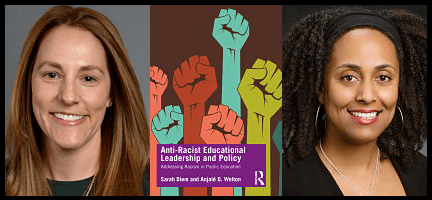
Today, the University of Toronto’s Shezadi “Shelly” Khushal compares her own life experiences with what she drew from reviewing the book Anti-Racist Educational Leadership and Policy: Addressing Racism in Public Education by Sarah Diem and Anjalé D. Welton. Khushal’s review is available open access in the journal Leadership.
The horrific misconduct and gross negligence toward George Floyd sparked a global uproar in the fight against racism, bringing to light deeply entrenched systemic racist practices prevalent in structures, systems actions and behaviors.
As a racialized woman raising racialized children, I think about the impact of racism on identity, mattering and belonging; and on student academic performance and outcomes. For this reason, I have engaged in the scholarship of anti-racist educational leadership. Anti-racist education means: (1) curriculum that goes in-depth about communities of color; (2) learning about oppression and how students can advocate for themselves; (3) empowering students through the power of voice; and (4) addressing the role of leaders in bringing about meaningful transformation and change.
Educational institutions have a responsibility in addressing and eliminating racism. Equally, school leaders have a moral, ethical and legal responsibility to those they serve and lead. The onus must be placed first and foremost on educational leaders to engage in critical self-reflection, which includes examining their own racial location and identity (including individual biases, prejudices and deficit ideologies), and understanding the power and privilege they carry. This is important because without the understanding of one’s biases and gaps in knowledge, leaders are unable to adequately address issues of race in schools. This means, examining assumptions, decisions, actions, interactions and the assumptions underpinning organizational policies and practices and the intentional and unintentional impacts.
As I engage more deeply in this work, I wonder, How often do leaders engage in critical self-reflection? What tools do they use to gauge their biases and prejudices? Who holds them accountable?
In my quest to understand why injustice and oppression continue to persist, I reflect on what it is that must change – in schooling, in leadership, in ourselves. In schooling, a whole school approach to reform is necessary. All stakeholders, from leaders to educators to students to parents to communities, must actively and intentionally resist Eurocentric Western paradigms deeply rooted in systems, structures and policies. Leaders must accept and acknowledge that coloniality is not a thing of the past; rather, it is ongoing and ever-present in day-to-day practices, in books, standards for academic performance and cultural patterns. Leaders must examine their own positionality and power in order to challenge the status quo. Leaders must advocate for a shift from deficit thinking to asset thinking, and they must implement mandatory training in human rights, anti-racist, decolonizing and cultural competencies (that is action-oriented). Only then can leaders begin to create a culture of diversity and inclusion.
Finally, I contemplate what my own anti-racist philosophy is, and what I can do, in my capacity as an emerging scholar, to ensure that curriculum values diversity of approaches and perspectives. I ask myself, what can I do to create space for diversity and how can I encourage others to understand the importance of disrupting, dismantling, unlearning, re-learning and rebuilding?