Why Are Marketing Analytics Skills Vital, and How Can Business Schools Teach It?
When I joined academia from industry in 2013, I noticed that the discipline of marketing was mainly informed by theory with little practice. Working as a head of social media for a London agency in the late 2000s and in digital marketing in the early 2010s, I found there were discrepancies between marketing in practice and what was being taught at business schools. As part of my academic role, I set the goal to better equip students for marketing jobs by bringing practice into the classroom. I hoped this would help close the digital skills gap and feed the talent pipeline of my former industry.
While digital marketing is now much better represented in academia compared to 2013, through monitoring job ads and direct conversations I had noticed an increasing industry demand for data and digital analytics skills. This spurred me on to find out what knowledge and skills our graduates needed for an entry-level marketing role that required analytics. I was also interested in whether business schools’ current approaches to teaching marketing analytics was effective in preparing students for these jobs.
To answer these questions, my co-author Justina Setkute of Technological University Dublin and I decided to look at this issue through the eyes of practice. We compared marketing analytics theory with its use in marketing practice, and analyzed practitioner views from academic and large-scale industry sources. What we found was compelling: Yes, there is a body of research and theory on analytics in marketing, and the subject is taught in some institutions. However, there is a lack of coherence, with multiple terms and definitions, and little consensus on whether current approaches to teaching it are effective.
This opened a gap to explore the knowledge and skills required for analytics in marketing practice. Our review confirmed that digital marketing was now the main discipline, and we built a practice-informed model to help educators build analytics capability into their marketing curriculum. A surprising finding of our analysis is that this requires soft skills alongside technical skills and knowledge, because data needs to be communicated effectively to become actionable. The resulting digital marketing analytics capability model is shown below.
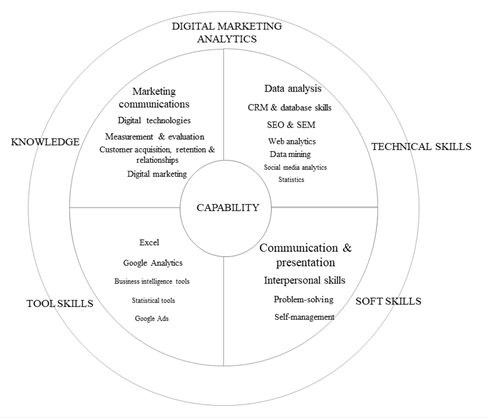
This model should be used holistically when building a learning activity because each component is needed to build the capability. For example, marketing communications and measurement & evaluation (knowledge) could be combined with web analytics (technical) and Google Analytics (tool) in a live client project, where students practice communication, presentation, and interpersonal skills (soft) to share their findings with an external client.
We wanted to create something practical and visual, so that busy educators can more easily expose their students to the key practices of the modern marketing industry while building students’ (and their own) digital analytics capability.
We hope that our paper, “Analytics Capability in Marketing Education: A Practice-Informed Model,” published in the Journal of Marketing Education, helps educators integrate their teaching of marketing analytics in a way that is applied and practical. We also hope our research helps business schools better develop work-ready graduates and meet the needs of its students and the marketing industry.