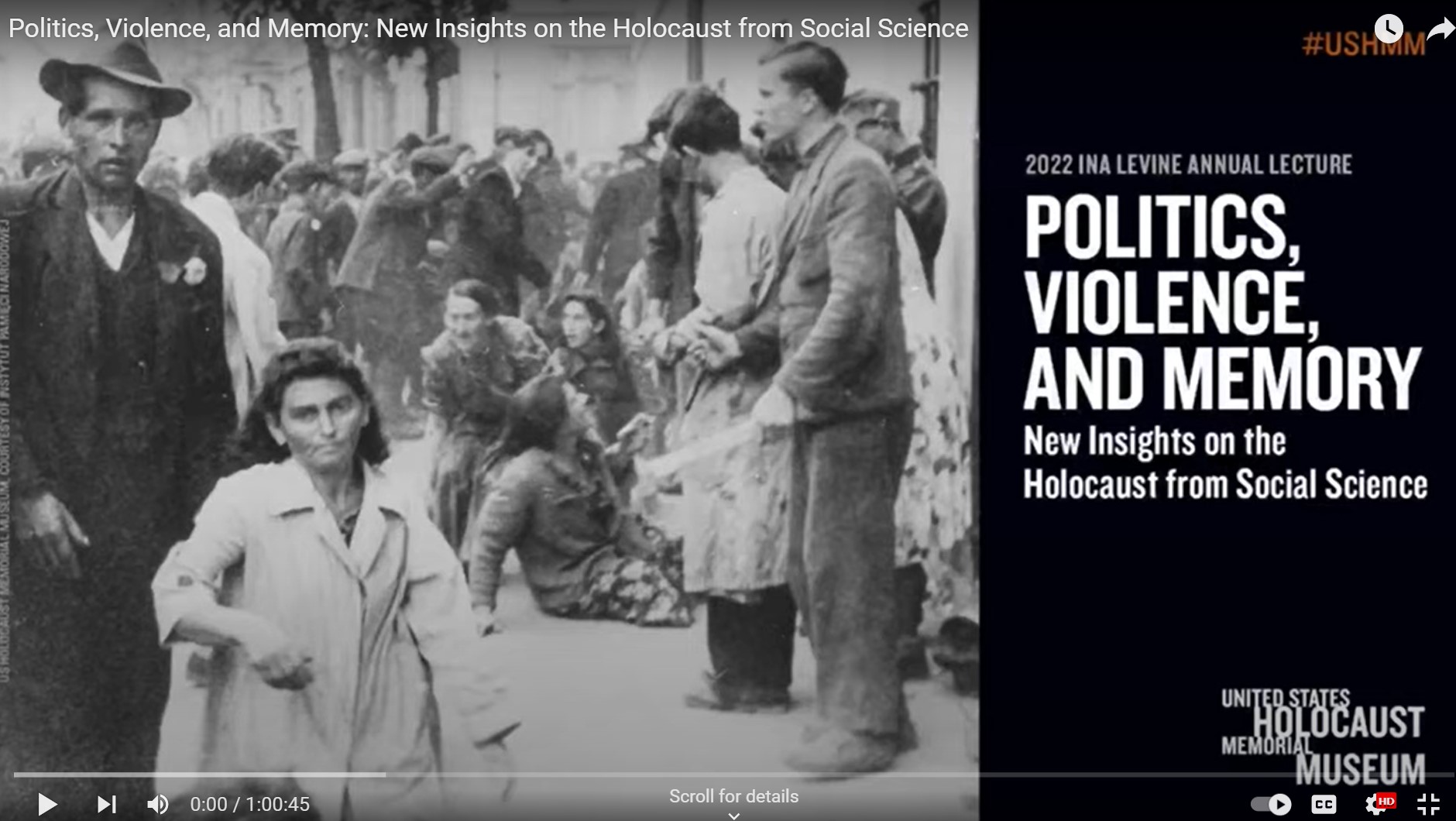
Watch the Talk: Insights on the Holocaust from Social Science
Why did some Polish and Ukrainian communities violently attack their Jewish neighbors while others did not during World War II? What local minorities assisted Jews in unexpected ways? How did the killing centers continue to affect economic and political behavior in their areas over time? And how does the Holocaust, both the events themselves and how they are remembered, affect policy and economics today?
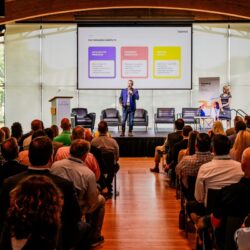
All great questions for social scientists, but as Jeffrey Kopstein details in this Ina Levine Annual Lecture for the United States Holocaust Memorial Museum, these are questions the disciplines lagged in addressing. Individual social scientists had addressed the Holocaust, “but taken as a whole, as a research community, they came … very late to the question.” As an example, he notes that the first panel organized by the American Political Science Association on the Holocaust – which he describes as an “index case” for violence in the modern world — was organized only in 2011. “And I know that,” he adds, “because I organized that panel.”
While he cites the fear that such studies might have been “too Jewish,” and so career suicide, for many years, he continues by arguing that a new social science evolved that did take on the Holocaust. “Social scientists are generalizers,” he explains. “They like to theorize about things. But the Holocaust is one big thing, and how do you actually have a theory of one big thing?” And yet, as Lisa Leff, the talk’s moderator, points out, historians of the Holocaust were using social science insights in their own work before social science itself was directly engaging with the Holocaust.
What changed, Kopstein suggests, was an opening of sources as the Eastern European archives opened and citizens of authoritarian states were allowed to speak. More importantly, he continues were “big methodological changes” in social and behavioral science, changes which took the “one big event” and looked at the many smaller events – say Kristallnacht or the invasion of Poland – which allows researchers to assess factors across nations and time.
“These are separate instances which can be studied separately and compared with similar instances in different times and places both in Jewish history and in non-Jewish history, in the past and in the present,” he says.
The lecture, which took place on June 14, 2022, can be viewed here:
The Ina Levine Invitational Scholar Award, endowed by the William S. and Ina Levine Foundation of Phoenix, Arizona, enables the Jack, Joseph and Morton Mandel Center for Advanced Holocaust Studies at the United States Holocaust Memorial Museum to bring a distinguished scholar to the museum each year in order to conduct innovative research on the Holocaust and to disseminate this work to the public. The scholar in residence also leads seminars and lectures at the museum and throughout the United States.
Kopstein is the Ina Levine Invitational Scholar for 2022. He is a professor of political science at the University of California, Irvine whose research focuses on interethnic violence, voting patterns of minority groups, and anti-liberal tendencies in civil society. He pays special attention to cases within European and Russian Jewish history. His books include Intimate Violence: Anti-Jewish Progroms on the Eve of the Holocaust (written with Jason Wittenberg) and the volume Politics, Violence, Memory; The New Social Science of the Holocaust, co-edited with Jelena Subotić and the late Susan Welch.
Moderator Lisa Leff is the director of the Mandel Center. A historian of modern European and Jewish history, she served as a professor at American University and Southwestern University before joining the museum staff. Her books include 2015’s The Archive Thief: The Man Who Salvaged French Jewish History in the Wake of the Holocaust.
The Holocaust Memorial Museum hosts several series of academic-based lectures on issues around the Holocaust, its causes and cognates. For a full archive, click here.