A Predictable Failure: Trump’s Board of Peace
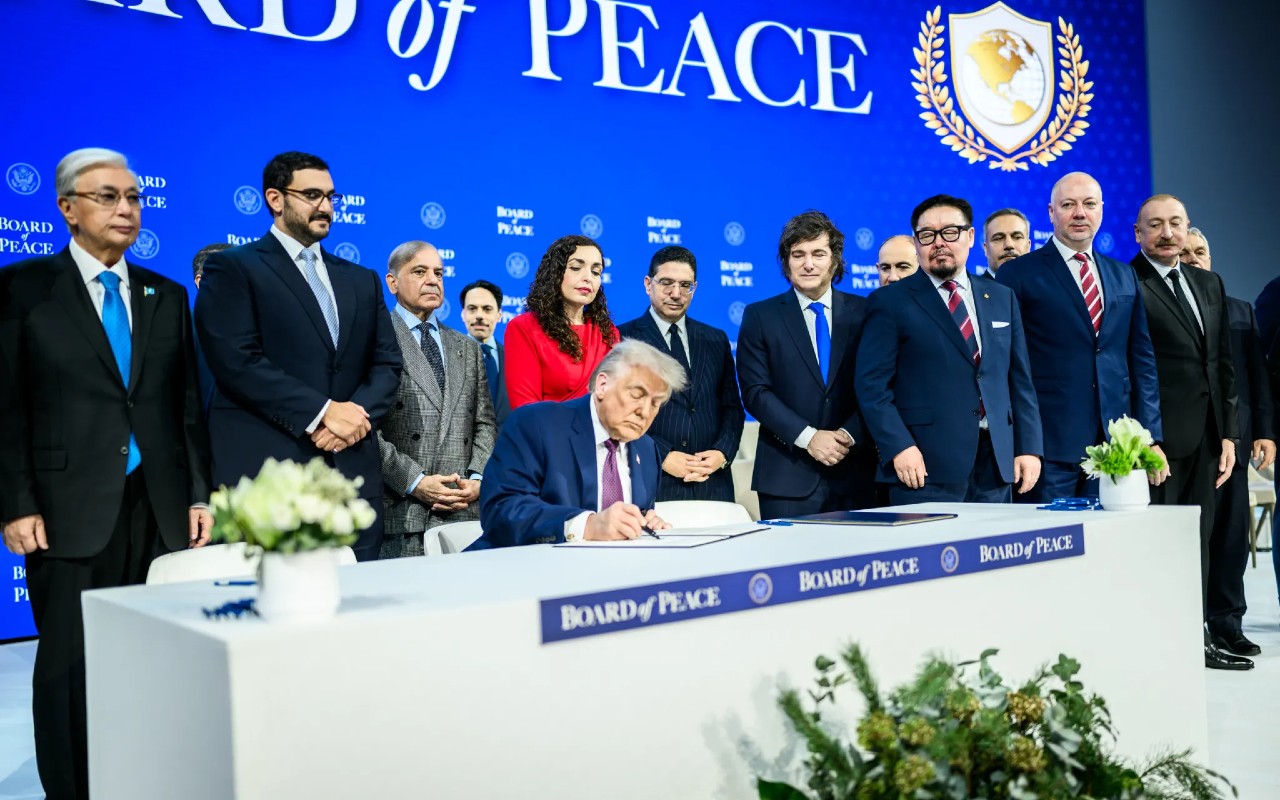
As the US-Israeli war on Iran and Lebanon drags on, bringing the world economy to the brink of collapse, U.S. President Donald Trump’s “Board of Peace,” charged with creating ‘peace’ (or its real-estate version) in Gaza, seems to have fallen into oblivion. Announced with great fanfare at the World Economic Forum in February and holding its foundational meeting shortly afterwards, the board was declared to become an alternative to the United Nations and to do a truly magnificent job in transforming Gaza from a rubble field into the “Riviera of the South Mediterranean.”
Yet, now, not even six months after its foundation, the project seems to have failed spectacularly. At a recent Senate hearing, Secretary of State Marco Rubio downgraded the Board of Peace from “the future new United Nations” to a banal “international non-governmental organization,” and the fund that had been set up at the World Bank to finance some of the reconstruction of Gaza seems to have received zero dollars. The board’s ‘private’ account at JP Morgan with Trump’s name on it seems to have received a couple of million US dollars, according to reports, but as with all payments made to Trump or his family directly it is unlikely that any of these dollars will ever find their way back to public funding.
In the mad whirlwind of the this and of the that of the Trump administration, and given the tiny timespan that anything is able to keep the attention of the president, it shouldn’t come as a surprise that the Board of Peace has failed so quickly and completely. Yet, even if it would have received sufficient support and finance to start working, the Board of Peace would have bitterly failed to deliver anything that would have resembled from far or near ‘peace’ for the simple reason that peace is not something that can be ‘built’ — as UN peace missions in the past three and a half decades have shown.
For three decades, the promise of international peacekeeping was simple, if ambitious: the world’s nations, acting through the United Nations, could bring lasting peace to societies shattered by conflict. At its height, the UN maintained 16 missions worldwide and employed more than 160,000 people. Yet the promise of peace was never adequately kept. And now, with the creation of Donald Trump’s Board of Peace, legitimized by UN Security Council Resolution 2803, what was already failing has been replaced by something far worse: a personalized, privatized arrangement that caricatures every dysfunction UN peacekeeping critics previously identified, while discarding even the residual protections that international law and UN accountability once provided.
The failures of UN peacekeeping were never incidental; the dysfunction was structural. Missions tasked with democratising countries from the outside reproduced the very hierarchies and power asymmetries that generate violence. David Chandler characterized international interventionism as “empire-building in denial“; Meera Sabaratnam excavated the deep Eurocentrism baked into peacekeeping theory and practice; Roland Paris identified the contradictions of imposing liberal democracy and market economics through external force.
Regionally, missions became arenas for great-power rivalry, transforming conflict zones into tokens in a game of influence recalling nineteenth-century colonial scrambles. At the local level, the picture was worse still: from Haiti to Kosovo to the Congo, peacekeepers were accused of sexual exploitation, trafficking, and abuse. Prosecutions were rare; punishment rarer. What bound these failures was a common thread: neo-imperial power structures, the systematic erasure of gender and sexual autonomy, and the equation of financial power with political legitimacy; a development now complete in Stephen Miller’s proclamation that the world is “governed by strength, governed by force, governed by power.“
Comes the Board of Peace. Its novelty lies not in mini-lateralism itself (post-conflict administrations authorized by smaller groups of states are not unprecedented), but in two features marking a qualitative break. First, the board was not created after UN-led negotiations were exhausted; it was designed from the outset to bypass collective multilateralism. Second, it is built entirely around the personality of a single leader and structured to generate staggering conflicts of interest. As the Carnegie Endowment for Peace noted, with Trump holding final authority over the board’s budget, there was little structural opportunity to ensure funds are spent in accordance with Resolution 2803’s stated purpose: the reconstruction of Gaza. And, indeed, the Board of Peace seems to be by now just another mechanism to add to the Trump’s family and friends’ breath-taking corruption.
Trump’s family enterprise had reportedly accumulated $4 billion in profits by January 2026, much of it from the Gulf states (Qatar, Saudi Arabia, the UAE) who are also the board’s principal financial contributors. His son-in-law Jared Kushner, simultaneously a principal American negotiator on Gaza, Iran, and Ukraine and managing partner of Affinity Partners (which received a $2 billion investment from Saudi Arabia’s sovereign wealth fund), was reportedly soliciting further billions from the same governments with whom he was conducting diplomacy. Representative Jamie Raskin (D-Maryland) launched a House Judiciary Committee investigation, concluding that Kushner’s obligations to his investors were simply irreconcilable with his obligations as a negotiator. Tony Blair, also on the executive board, carried analogous baggage from his tenure as the Quartet’s Middle East envoy, during which his consultancy was credibly reported to have facilitated arrangements, including advisory work for the Saudi government worth more than US$10 million, that blurred the line between diplomacy, commerce, and patronage.
The institutional architecture that is split between a public fund hosted by the World Bank and a private account under Trump’s personal name in a private Bank, JP Morgan, facilitates the diversion of those ‘reconstruction’ funds into the private pockets of the Trump family. The board’s founding press release announced $17 billion in pledged contributions without specifying whether these constituted membership fees or additional funds, where the money would be deposited, or under what conditions. It remains unclear whether disbursements have even been made. Crucially, the board’s own charter does not mention the reconstruction of Gaza, the explicit purpose for which Resolution 2803 authorised it. And while previous peacekeeping mandates required renewal every six months, forcing regular scrutiny, the board’s authorization runs until December 31, 2027 (nearing the end of Trump’s presidential term), a deadline that functions less as an accountability mechanism than as a guarantee of operational impunity.
The human cost is most visible in what has disappeared from view entirely: the Palestinian people themselves. The legal scholar Craig Makhiber described Resolution 2803 as the most baldly colonial act by the Security Council since the partition of Palestine in 1947. and as a resolution that rewards perpetrators, disempowers victims, and hands control of a people’s future to a state accused of complicity in their destruction. Palestinians have been granted no participation in decisions affecting their rights, their governance, or their lives.
What the Board of Peace represents is not merely the continuation of peacekeeping’s existing failures under new management. It is their grotesque amplification. Every critique leveled against UN missions for 30 years like about the absence of local ownership, the neglect of women and marginalised groups, the failure to address root causes, the imperial dynamics dressed in the language of universal values, the enrichment of actors from the global North, finds its most extreme expression here, stripped of even nominal oversight. The board does not respond to these critiques. It is a caricature of them: a traffic-of-influence club dressed up as a better United Nations, and ridiculing what little respect the efforts of the so-called international community to bring peace was still afforded.
More from this author