R Sánchez-Rivera on the Hidden Legacy of Eugenics
For those who think “eugenics” mostly represents just a nasty page in history, sociologist R Sánchez-Rivera, has some sobering news. What was the rage for Victorians and the Nazis remains a potent force in thinking today, whether in the salons of power where white supremacy and replacement theory are hot topics, or in practice.

Sánchez-Rivera, author of the new book Slippery Eugenics: An Introduction to the Critical Studies of Race, Gender and Coloniality, details eugenics’ history and present in this video interview with Delayna Spencer. At the time of the interview, Spencer was the editor of Sage’s Social Science for Social Justice book series, and Slippery Eugenics is one of four 2024 titles in the series. Sánchez-Rivera, who hails from Puerto Rico, offers particularly compelling examples from that territory of the United States, detailing how both proactive and reactive practices have hurt the island’s residents. “[B]y the mid-20th century,” they note, “one in three women were sterilized. So for example, under population control Law 116 in 1937, in Puerto Rico, it institutionalized encouragement for sterilization through the use of door-to-door visits by health workers, the financial subsidy of sterilization by both the federal and local government, and industrial employer favoritism towards sterilized women, pushed women towards having a hysterectomy or a tubal ligation.” In the interview, they detail the divergence in reproductive justice created by eugenics, with richer feminists often focused on the right to have an abortion, while marginalized feminists often focus on the right to have a child.
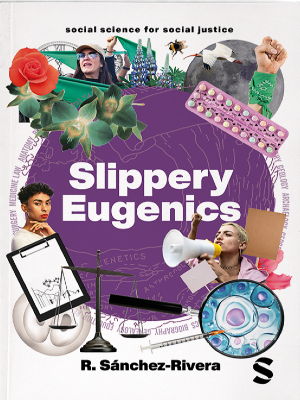
Slippery Eugenics traces the spread of eugenic ideas across different nations, revealing how they intersect with nationalism, populism and individual reproductive rights. The book uncovers how these intertwined legacies offer fresh insights into the subtle forces that define contemporary social and political landscapes, and have lasting impacts on reproductive control, racialization, colonialism, gender norms, and more.
Now residing in the United Kingdom, Sánchez-Rivera is an Economic Social and Research Council research fellow in the Study of Race and Anti-Racism in Gonville & Caius College and an affiliate lecturer in sociology at the University of Cambridge. Their areas of expertise are in the sociology of health and illness and historical sociology with a focus on scientific racism, critical eugenics studies, and reproductive justice in the Americas.
A transcript of the interview appears below the video.
Delayna Spencer: Welcome to this edition of our video series for the Social Science for Social Justice book series. Joining us today is Rachel Sánchez Rivera, who is the author of Slippery Eugenics. So Rachel, thank you for being here. Eugenics is a really meaty topic to get into, and a fantastic place to start when it comes to dismantling white supremacy. I was really excited when you came on board to write this book, and I’m still very excited for it now, and think everyone should get a copy.
So a core argument that you’re making in the book is that eugenic ideology has not gone away, as we like to think it has, indeed, in a recent documentary on the Human Diversity Foundation, where shown that race scientists are still going trying to prove the superiority of whiteness. Can you speak a bit about the conception of eugenic ideas and where they stem from?
R. Sánchez-Rivera: So first of all, thank you so much for having me. And I think that is a fantastic question to get us started, right? Because even if the Human Diversity Foundation was only founded in 2022 it’s part of a longer history, and it’s part of a longer history that involves the Pioneer Fund. But it also involves how eugenics was conceptualized in the first place. So basically defined as the science of the well born, eugenics, was pretty much intended as a social program dedicated to the improvement of racial stocks, like through the management and control of reproduction. So when Sir Francis Galton coined the term eugenics in 1883, it’s about this time that it began to attract widespread interest as a science and a social philosophy.
So basically, the eugenic movement within European nations wanted to ensure that the best of the white stock within a nation would prevail. This was in line with the fear that the Catholic Irish and the white working classes were breeding too much as poverty was seen as a sign of like innate moral inferiority. But it also influenced the rising intensity of imperialist feeling, like from the 1880s onwards, basically helping to build nationalist sentiment and providing what they thought was a convenient rationale for the subjugation of non-Europeans. So what I’m trying to say here is that at one level, eugenics provided that convenient rationale for the colonial subjugation of non-Europeans, but it also reflected a triumphant confidence in the superiority of the Anglo-Saxon race, particularly the upper and middle classes.
However, the other side of the coin here is that eugenics also reflected a deep sense of vulnerability and fear among the Victorian middle classes. So the prospect of a reversal in evolutionary progress, suggests that Western civilization was feeling threatened with social decline, that it could only be revived or maintained in relation to like whiteness and coloniality through the adoption of drastic measures, and one of them was eugenics.
Delayna Spencer: Thanks for answering that. So eugenics isn’t about people, you know, having children or not having children, and it’s not just about those kind of bigger events that we think about, such as the Holocaust. It’s about having a vision of the demographics of your ideal society. And this can lead into a variety of policy choices. Can you talk a bit through some of those policy choices and how they manifest?
R. Sánchez-Rivera: Just to provide a little bit of context, eugenics was broadly divided into two main courses of action, positive and negative eugenics. And that doesn’t mean that one of them is good and one of them is bad–both of them are bad. But positive eugenics was a series of measures that encourage people who were constructed as fit or viable to reproduce through, like, the implementation of my certificates, migratory measures that pretty much incentivize certain groups to come into X country. Among any other measures, for instance, in the particular case of the United States, there were contests that were ‘fitter family’ contests to prove who belonged to the best stock. In this series of tests, families would voluntarily go and rate them by virtue of their capacity to do sports, their lineage, verbal and mathematical reasoning, among other qualities. And then the family that would win would get their picture in the paper and everything. And you can Google that, there’s a ton of them. And while this started in Kansas, then it spread all over the Midwest and the US in general. And I think that contributes into thinking about eugenics as this part of common-sense ideology of who is fit and who is unfit.
However, the other side of the coin is negative eugenics. So these were different measures that pretty much restricted those considered unfit to reproduce, through, for example, limiting the migration of those considered unfit or undesirable, the court-enforced sterilizations of people that were very common in the United States context, especially after the ruling of Buck v. Bell, which I talk about in in the book. Negative eugenics, also pushed for different like population control policies all throughout the 20th century, and we can see it today in relation to gentrification, practices like incarceration, segregation, among many others. This mostly affected people of color, people with disabilities, people from working class backgrounds, and the LGBT community that at this particular point was considered abnormal or deviant or in need of fixing. So yeah, throughout the 20th century in the United States, the different states in the union, as well as different federal policies targeted specifically Black and brown women to get sterilized and sometimes without their consent.
Delayna Spencer: Wow. And you begin the book with the overturning of Roe v. Wade, which is, you know, a huge event that struck a chord across the world.
R. Sánchez-Rivera: So I think one of the things that I wanted to come across, especially in the introduction, where I started with that, is that what I wanted to show is that this is a continuation of a longer historical project whereby force and characterization, and that centrality of reproduction is present. In that idea of the application of negative eugenic principles to groups that have been historically categorized as unfit or undesirable, are still among this. And in this case, or in that particular case, it’s migrant women who in the majority are Black and brown. In a sense, this is a continuation of what we see, for example, in the case of Puerto Rico by the mid-20th century, where one in three women were sterilized. So for example, under population control Law 116 in 1937, in Puerto Rico, it institutionalized encouragement for sterilization through the use of door-to-door visits by health workers, the financial subsidy of sterilization by both the federal and local government, and industrial employer favoritism towards sterilized women, pushed women towards having a hysterectomy or a tubal ligation, or as some colloquially call it “tying the tubes,” or because of what’s common in Puerto Rico, it’s just known as “the operation,” or la operación.
And the coercive strategies used by these institutions, what I’m trying to argue in this book, is that it denied women access to informed consent. So in this particular case, like more than one third of the women in the 1968 study did not know that sterilization through tubal ligations was a permanent form of contraception. In this sense, the euphemism “tying the tubes” made women think that the procedure was easily reversible. Also some of the different workers that were the different social workers that were trying to push towards sterilization only spoke English, despite Spanish being the only or primary language that these women spoke.
So eugenic ideas that were around the 19th century and converged when Puerto Rican elites and US federal government, not only did force sterilization procedures, which is what I was talking about, but also tested the first contraceptive measures in Puerto Rico during the 1950s. So in this sense, while white women in the mid-20th century saw this as a sexual revolution, it was only because of experimentations with Black and brown women in a colonial context in the Global South. So in this sense, like, you know what mainstream feminist theories and what mainstream feminist history have told us, it wasn’t a sexual revolution for all, and I think we need to consider, who is the sexual revolution for.
Delayna Spencer: It’s amazing to see the kind of effects that gaining more rights and more freedoms in the West can impact negatively on other countries. What happened when they found out that the “tying of the tubes” wasn’t reversible?
R. Sánchez-Rivera: I think that’s a fantastic question. So there is an absolutely fantastic documentary that was published in 1982 and it’s called The Operation, or La Operación. It’s particularly telling to see how in the filming of the documentary, that they actually realized that this is a full sterilization, that it cannot be reversed, that they were the testing vessels of the first contraceptive pills ever made, and as a result, they receive 18 times more hormones than the contemporary contraceptive pill, which leads to, internal bleeding, a higher rate of cancer, etc., etc. But I think as a result from it, there was a lot of different movements for contestation.
And I think that is something that is very important to highlight in a very Patricia Hill Collins way. I think it is very important to highlight the instances of agency and resistance to the structural dynamics of oppression and racialization. And I think reproductive justice, like in the reproductive justice framework, comes as a result of that as well.
Delayna Spencer: I wanted to ask you a bit more about reproductive justice. And this was coined, I think, by black feminists the 1990s …
R. Sánchez-Rivera: 1994
Delayna Spencer: Amazing. So just speaking about that more widely, because I think when most people think of reproductive justice, they’re thinking about access to healthcare and abortion. But it’s actually a lot wider than that. Could you speak about what reproductive justice means for social justice generally?
R. Sánchez-Rivera: Yeah, that’s a great question. So I think I’m gonna rely on Black feminist theorists that have come before us, right? So in Reproductive Justice by Loretta Ross and Rickie Solinger, they explain how the passing of Roe has been closely associated with the concept of choice and its own of privacy, within which women could make reproductive decisions. During the 1970s and 80s, however, women of color activist groups–through their legal and community work–were pointing out quite clearly that these concepts of choice and privacy were essentially useless for many, many working class and racialized women who did not have the resources to exercise that choice.
And that comes as a result, because, as for this idea of making decisions in private conversation with your family and doctors for working class women and women of color and Black women, doctors and the medical profession had historically and systematically exercised violence over them. So in a sense, they couldn’t trust doctors. So this idea of a private medical decision between you and your doctor was also quite problematic, and as affluent white feminists press on for abortion rights, using electoral politics, women of color activists adopted a different focus, a different focus based on their needs and the structural dynamics of oppression. It’s a focus that engages with an intersectional analysis, to analyze how reproductive violence oppress women along different axes of their identities at the same time.
And they also pointed out the mainstream white liberal reproductive rights movement has historically focused predominantly on the right to prevent contraception and birth. So women of color and black women activists objected to this focus, or this singular focus on prevention, and they wanted to also safeguard each woman’s right to have a child and to raise their children in dignity and safety. So drawing on the histories of their own communities, they argue that reproductive safety and dignity depend on having the resources to get good medical care, decent housing, a living wage and live in environments like free from institutional like racism and racist violence.
And I think all of those conditions were just as important as having access to abortion and contraception. So in a sense, it’s a more all-encompassing way of thinking about politics and reproduction.
Delayna Spencer: Thank you, Rachel. You’ve got a wealth of case studies throughout the chapters that many people might not know about. And I really saw the book as giving voice to stories which have often gone unheard. Could you speak a bit about using the book to shed light on different stories?
R. Sánchez-Rivera: I feel that I cannot take all the credit in the world for that. I think there is a long history of decolonial theorist and black feminist thinking that highlights the stories and connections that have been, and are currently, ostracized by transnational and seemingly common-sense understandings of history. And I think too these frameworks allow us to think about transnational connections of coloniality, as well as looking more into vocalized understandings of a particular context or a specific context. So following these two frameworks, I centered the stories of colonialism, gender, sexuality and racialization, as well as the longer histories of science, as a way of understanding the ways in which eugenics has and is currently being used as a tool for coloniality and maintaining whiteness.
Delayna Spencer: And the book ends on two very urgent topics which I think will absolutely resonate with readers of the book, and that’s the COVID-19 pandemic, and also climate change. Can you say a bit about how eugenic ideologies and policies have had an impact of these two areas?
R. Sánchez-Rivera: Yeah, that’s a fantastic question. We have seen that during the COVID-9 pandemic, a lot of countries, in both the Global North and the Global South, made use of different cultural tropes as a way of rationalizing the high death rates of minorities in their own countries. For example, Deb and Rao argue that due to the social inequalities produced by coloniality, the global South started to face the pandemic in an already disadvantaged position in comparison to the Global North. Nonetheless, even in the Global North, like in the United States and here in the UK, Black and Latinx communities were already dying in disproportionate numbers in comparison to their white counterparts.
For example, there is a fantastic article by Ali Meghji and Sophie Marie Niang that argues that in Britain, Muslim-focused social policy was operationalized so that cultural lifestyles gave way to understanding the BAME COVID-19 death rate was a constant consequence of their own biological composition. And I think in a sense, this attribution of the UK Government of the high death rate of minority communities blaming their own biological composition, or, dare I say, the implication that there is a race gene that supposedly makes minorities more susceptible to COVID, then it’s used by the state to exonerate itself from providing socio economic restitutions to those racialized people whose material circumstances were put at risk of a disease.
And I think in a sense, if we expanded to a more international way, we see how different social inequalities arose in relation to vaccine nationalism, which passports allowed you to move or didn’t allow you to move. In that sense, even if eugenics is not named, is still used as a driving force and rationale of policy, or in the particular case of climate change as a possible solution to climate change. And I think those are the kind of things that we should be looking at into the future, especially in relation to climate change, especially in relation to ideas around pronatalism, between particular groups of people, like tech individuals like arguing for biological essentialism as well as for natalism. But then, on the other hand, putting population control policies as a possible solution for climate change.
Delayna Spencer: I guess just thinking about the impact that COVID had on BAME communities in the Global North, know often they will be living in areas of high environmental damage. There are other things that might be impacting them, such as socio-economic access to health care. And you know, things that race science is still is still actively impacting. So, for instance, Black women, Black men not feeling pain, which then doesn’t get them the health care that they need. So I guess in that way as well, you can see the way that eugenic policies has put them in a position where they are more in harm’s way than that white counterparts.
R. Sánchez-Rivera: Yeah, and I think one of the most important things this particular book can provide are the tools to the reader to see and try and be able to pinpoint when eugenics things — even if they’re not being named — they’re being used as a driving force, or the rationale for particular policies, like particular policies in relation to contagion and containment, as well as like healthcare provision.
Delayna Spencer: What positives do you want people or what do you want people to come away with from the book, if they’re just thinking about their own activism, their own research, their own work?
R. Sánchez-Rivera: I think that’s a fantastic question that I think doesn’t get asked as much to academics. So I think one of the most important things about this book is yes, to provide the tools like, to be able to pinpoint exactly what comes from scientific racism that it’s now seen as, like, almost imperceptible or slippery or common sense. And I think that is something that everyone should be very conscious about. I think in the world where the rights of populism and the rise of the far right is very important, is that all of us, are the culprits. I think in a sense, ideas around ableism, ideas around the gender binary, ideas about racism or classism are somehow rationalized by these old tropes of science.
So I think it’s very important for us to step back and try to reconceptualize what are the legacies and continuations of those particular mainstream science, right? Because at that particular point in the beginning of the 20th century, this was everybody’s cup of tea. It was the turn of modernization, civilization and progress. And I think in a sense, things like the Human Diversity Foundation, the Aporia Podcast, as well as digital heretic, among many, many others are part of bringing that back or continuing that legacy. So I think it is our work as activists and academics to bring that to the fore.
Delayna Spencer: Amazing. Thank you so much for your time, Rachel.
R. Sánchez-Rivera: Thank you so much for having me. You.
Additional Resources Cited Above
Sterilization and Social Justice Lab
Sacred Bundles Unborn | Morningstar Macredi and Fire Keepers
Fighting for Control: Power, Reproductive Care, and Race in the US-Mexico Borderlands | Lina-Maria Murillo
Killing the Black Body: Race, Reproduction and the Meaning of Liberty | Dorothy Roberts
Race, Racism and Development: Interrogating History, Discourse and Practice | Kalpana Wilson
Other Videos in the Social Science for Social Justice Series
Hongwei Bao on Queering the Asian Diaspora