How Publishers Extract Money, Labor, and Data from Universities
On this platform, growing attention is paid to structural issues in academia, including trust in science and the role of metrics and rankings. In the open-access book Fixing Academia, I focus on another, but related problem: the dominance of a small number of academic publishers, the Big Five: Elsevier, Taylor & Francis, Sage, Wiley, and SpringerNature. [Ed. – Sage is the parent of Social Science Space. Dr. van der Kolk’s article represents his observations, not Sage’s.]
Drawing on interviews with experts, policy documents and reports, I found that there are three interrelated streams through which academic publishers extract value from universities- money, free labor, and data – which I will discuss below. While it’s not easy to change this, I conclude by highlighting various inspiring alternatives for the current publication practices in academia.
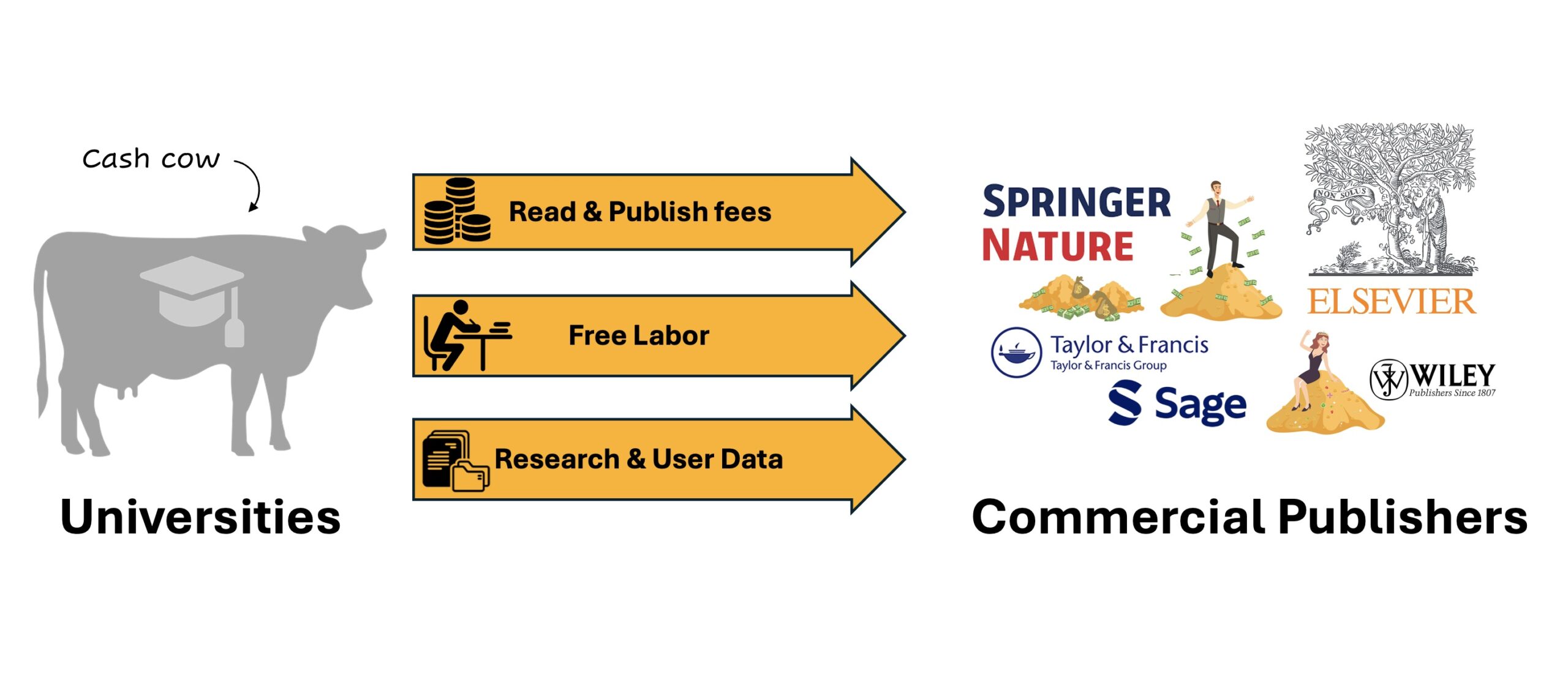
1. The Money Stream
The most visible and well-known form of value extraction is through fees for publishing and reading. Through both subscription fees and article processing charges, universities often pay in essence double to publishers, to read and publish their work. For the Dutch universities alone, the amount paid to commercial publishers is estimated to be about €50 – 60 million annually.
By pivoting to Open Access infrastructures, publishers have not lowered costs; they have moved the paywall from the reader to the university. Their profit margins remained largely untouched (Elsevier’s parent company RELX had a 33.9% profit margin in 2024) while many universities worldwide struggle financially.
2. The Free Labor Stream
The academic publishing industry is a multi-billion-dollar sector built on a foundation of uncompensated expert labor. Academics engage in various tasks that together form the production and quality control of the “products” sold by publishers: the journal articles, (meta)data and knowledge. Academics carry out research, write, review, and serve as editors, most often as an unpaid service to academic journals owned by the publishers.
3. The Data Stream
More recently, a third extraction stream was added: data-harvesting. While some publishers are rebranding as “information-based analytics” companies, it becomes increasingly clear that the vast amounts of data that are gathered by them are also monetized.
For instance, by owning the platforms where we search (ScienceDirect), publish drafts (SSRN), cite (Mendeley), register work on university websites (Pure), assess performance (SciVal), and track impact (PlumX), Elsevier’s parent company RELX captures behavioral data, which can be repackaged and sold to institutions and governments. Some critics have described this development as a form of “surveillance publishing,” highlighting how routine academic practices generate monetizable behavioral data. The Intercept reported that LexisNexis (part of RELX) sold data to the US Immigrations and Customs Enforcement, or ICE, while another publisher’s parent company (Informa) sold access to their data for about US$ 10 million annually to Microsoft to train their AI models.
Other research data is packaged and sold back to university administrators as “Research Intelligence” tools to help them decide whom to hire or promote. In short, publishers are now profiting from the metadata of the very labor they already receive for free.
Change is possible
First, I should acknowledge that it’s not easy to change this. Precisely because incentives at universities build on journals and their reputations, and university rankings build further on that, changing the publishing landscape is not something that is easy.
However, while studying the publisher-university relations, I also saw inspiring initiatives that challenged the status quo. The case of the walkout of the editorial board of Neuroimage, an Elsevier journal, for instance, demonstrates that scholars can take action and move the reputation of a journal to another – nonprofit – publisher. Because academic reputation is tied to editorial boards and reviewer communities, such collective resignations can effectively transfer a journal’s symbolic capital elsewhere. When scholars and editorial boards organize themselves, it is possible to change things for the better.
Also, other publishing models such as “publish-review-curate” promoted by journals such as MetaROR are also worth noting. “This involves articles first being published online, after which reviews are invited. The reviews are also published online, and authors are able to respond,” editor Ludo Waltman, who I interviewed, shared. This means that the process is transparent, faster, and the data is still owned by the community – and not by a for-profit publisher.
Collective action
Writing about publishers and universities taught me that large amounts of public money intended for research flow to private publishers, but also, more encouragingly, that change is possible. Scholars must stay informed and reduce their dependence on the Big Five by making collective, institutionally supported choices about where and how they publish.

Fixing Academia
A fuller account of this analysis appears in chapter 9 of the open-access book Fixing Academia (VU University Press), available at fixingacademia.com.




























































































The article frames Publish-Review-Curate (PRC) as an alternative to publishers, but I think that is a category error. The “C” in PRC stands for curation, and curation is precisely the function traditionally performed by journals and publishers. Publishing is not merely the act of hosting a manuscript or organizing peer review. Curation involves associating a work with a trusted brand, selecting and organizing content, ensuring discoverability, maintaining metadata, securing indexing, preserving the scholarly record, disseminating research to relevant audiences, and managing post-publication responsibilities such as corrections, expressions of concern, and retractions. Many reviewed-preprint initiatives have demonstrated that peer review can… Read more »