 Recognition
 Hazel Markus: We Don’t Have to be Afraid of Difference
Stanford psychologist Hazel Rose Markus has been a leading scholar in understanding how culture and psychology interact, a research portfolio that saw her receive the 2026 Sage-CASBS Award last month at the Center for Advanced Study in the Behavioral Sciences campus at Stanford University.
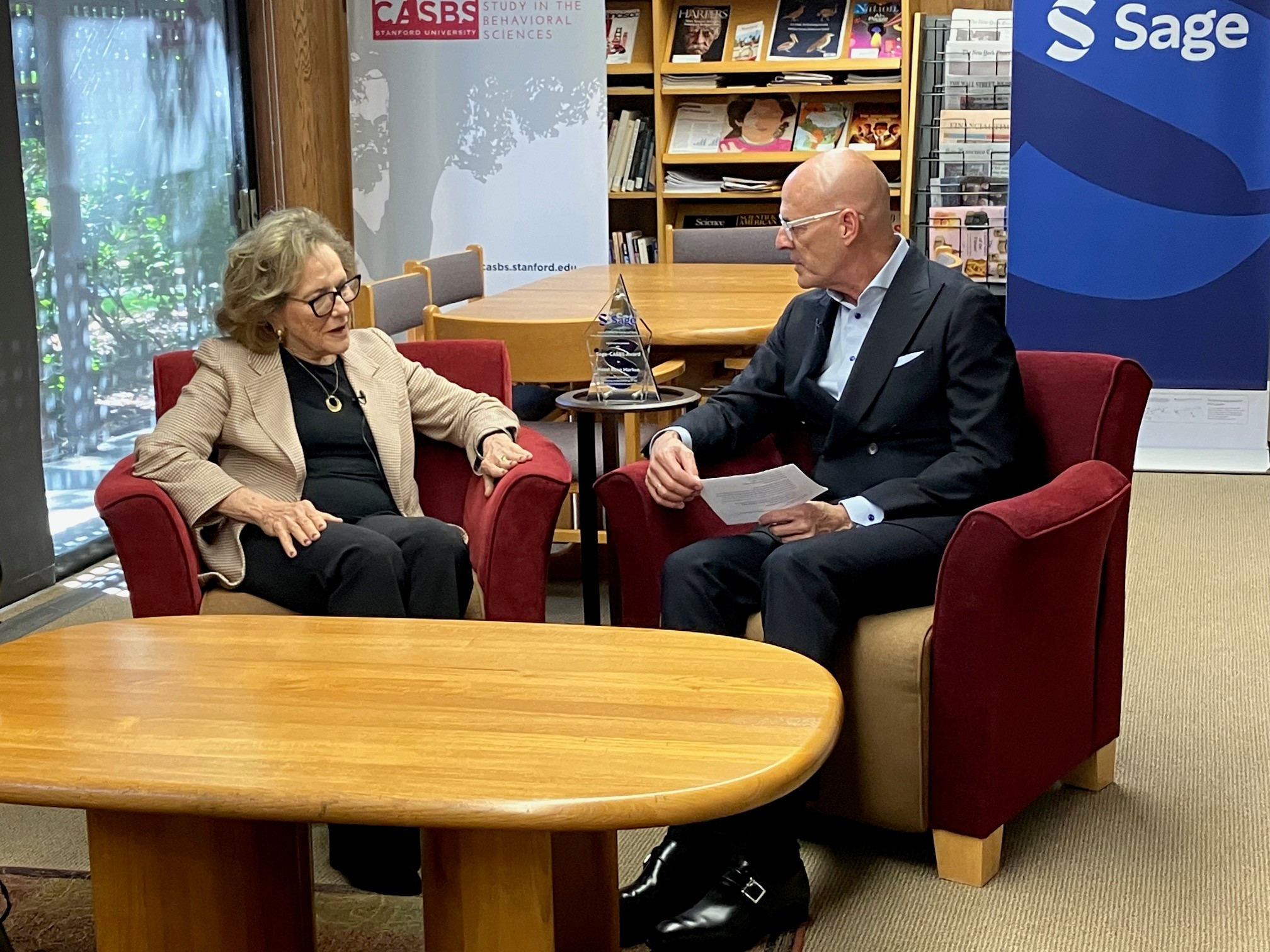
In this video, Blaise Simqu, the CEO of Sage (Social Science Space’s parent), interviews Markus about her path to prominence and how she came to recognize that people “make their own worlds.” In short, different people aren’t just people; people are different people.
“People … are differently situated in different cultures, different cultural contexts of all sorts, that they create different worlds,” she tells Simqu, “and then they create themselves differently in their worlds, their institutions, their practices, their policies.”
The transcript of their conversation appears below the video.
Blaise Simqu: My name is Blaise Simqu, and I’m the CEO of Sage Publishing. I’m here this afternoon with Professor Hazel Markus, who is the Sage-CASBS Award winner for 2026. Congratulations on your achievement.
Hazel Markus: Thank you. It’s an amazing honor. I’m so pleased and proud, and I just want to thank Sage and Sara Miller McCune and the center over the years. It’s really been a mainstay of my academic life, and I am just thrilled to be here.
Blaise Simqu: That’s great. Well, it was a thrill to be on the committee. There were many, but it’s also a thrill to offer, or to give you, the 2026 award.
Hazel Markus: Thank you.
Blaise Simqu: I thought I would just ask you a few questions that we could record today for future generations. I would love to talk to you a bit about your journey into psychology, particularly social and cultural psychology. And then the second part would be what drew you to issues of race and class.
Hazel Markus: Oh, there’s a lot to say. Let me start with social psychology. I was born in England. My parents are English, and we came to the U.S. when I was young. I think that sort of somewhat outsider status, not very outsider, because, of course, you know, English speaking and all of that, I think it made us all aware of where we fit and kind of where we didn’t fit.
I was always very interested in in behavior and observing people and I think that was true in my family, too. Both of my parents were teachers, and the conversation was all about the class that day, and this student, and that student, and what had happened, and the principal who thinks this or that. To me, reality was people and their interactions, and I just gravitated to it.
I was very interested in journalism in high school as editor of a high school paper, and I thought that’s what I wanted to do, because I wanted to help people find their way to the truth and get the information out there. I started in journalism in college, and then I took a psychology class, and I had a professor, I remember him, Dr. Even McCullum, and he did this. It’s when I think back of it as a trivial class demonstration, you know, but he divided us into two groups, out of each other’s earshot. It was a big auditorium, and he went over to one side, and he talked about shoe shopping, and the difficulty of finding shoes that fit for men and women. Then he moved to the other side of the room — out of earshot again — and he talked to that side of the room about traveling in Africa, and what you can learn, and what he has learned, and how much difference it had made in his life. Then he moved to the middle of the room, between the two, and he said, “Please write down what I say.” And he said “Triple E.”
Of course, the people who’d heard about shoe shopping, they wrote “Triple E,” which was a size of men’s shoes. I think some women’s very wide shoes in those times, I think it’s probably not relevant right now, but then the other side that had heard about traveling in Africa, they wrote “Tripoli.” These are small things, but it was stunning to me that one thing had come out of his mouth, yet it had been heard and understood and interpreted in two different ways, depending on what the people in either side of the room were bringing to the situation.
For me that was an insight into the social construction of reality, which is a complex idea. People struggle with it, but I saw that it was a combination of what the perceiver brings and what stimulus is coming in, and that just blew my mind. Here I was thinking I was going to be a journalist and get to the truth, get to the facts, you know, “inquiring minds want to know,” and here was an obvious problem, depending on what people were thinking in the beginning, the same facts were not going to be the same facts, they were going to interpret it, hear it in different ways. Even when I tell it, it sounds a bit crazy, but I remember the day when I decided, “OK, I have to do psychology,” That was striking to me, that you, that as people we are creating the world.
Braise Simqu: For those of you who are less familiar with your work in psychology and as an academic researcher, can you explain the impact of your research, or what you believe to be the impact of your research?
Hazel Markus: Well, I think one of the things that led me from social and being fascinated with people and how they make their own worlds, participate in making their own worlds, was of course time that I spent in Japan. When I spent time in Japan, I was like, “I don’t know what’s going on here, and the more I stayed there, the less I understood!” But I knew one thing for sure, that the world as I understand it, societies, how it was organized, was very different from what I had experienced at home in the U.S. Something was going on there, and it was fascinating to me. That experience led me to think about how people who are differently situated in different cultures, different cultural contexts of all sorts, that they create different worlds, and then they create themselves differently in their worlds, their institutions, their practices, their policies. They’re part of their cultures, and, and that we are, we are quite different.
A common view that’s comfortable to people, is that basically people are people, that’s it. When it gets right down to it, we’re all the same. No! Because once you recognize how powerful our cultural contexts are in making us up, you know that we are going to be different in important ways, and so it’s incumbent on us to figure out how to build a world where we actually have multiple worlds within that one world, and we’re going to be OK with that, and figure out how to do that without blowing each other up.
I think that, is what was always in the back of my mind: How can we operate across difference? How are we actually going to make a multicultural, multiracial world in which we’re going to be able to appreciate each other, appreciate that there are different ways, appreciate that there’s more than one right answer to what’s good, true, beautiful, and efficient in the world.
Blaise Simqu: The challenges of race, class, and culture.
Hazel Markus: Absolutely, As I went to graduate school at the University of Michigan. I came from Southern California, and I lived in San Diego, very, very segregated city. And when I got to Ann Arbor, close to Detroit, which is largely a Black city, I was very interested in looking at how that particular context would make for different ways of thinking and feeling and being in the world.
At the time. It was, “No, Don’t do that. That’s not a good topic to do research on.” And so then I was interested in, “Well, if I can’t do race, maybe I can do gender,” and that also was “No, that will marginalize you and make your work not in the center of the field. Why don’t you just work on how, in general, our social worlds influence the self?” I was very irritated by that, because I didn’t understand who got to say what was a problem, a real problem. I knew it was a real problem, a real-world problem, and it took getting through graduate school before I could begin to work on race and class.
One thing about class in graduate school, I met a colleague who was my office partner for many years. He was from Alabama. He grew up in a very poor community, and actually, during college, he lived in his car. He was one of the most brilliant people I had ever met in all sorts of ways, and it opened my eyes to, “Wait a minute, there’s a lot of value being left on the table” (as I like to say in the business school, when we don’t understand people and their contexts, and that’s been sort of a mantra for me).
Blaise Simqu: Well, talking about real world examples leads me in a very handy way to my next question. You’re about your work with Stanford SPARQ, and SPARQ stands for Social Psychological Answers to Real-world Questions, and so explicitly combining social and behavioral scholarship and practice, which is the very heart of the Sage-CASBS Award, which makes you just absolutely the perfect recipient. What does it take to translate academic research and your insight into real world impact?
Hazel Markus: A lot of patience. First of all, I would say, and I would say that at SPARQ we no longer spell out the whole thing. We just call it Stanford SPARQ, because people couldn’t remember it, but we did start with the insight that it was going to be social psychological questions that we’re going to answer.
I do this with my colleagues, Jennifer Eberhardt and MarYam Hamedani, and we have various research scientists that work with us, and lots of research associates. We’re all sort of dedicated to bridging research and practice. Your question was what does it take? It takes a lot of patience, a lot of studying, and being aware of the problems that you want to bridge. I think, as academics, we sometimes think, “Look, I was in the third grade, I know how classroom goes, I know what needs to be done to make these classes more effective,” and not having been in the classroom for, you know, decades, but you think you understand that process. Or look at the police. “Well, I can see what police are doing.”
It sounds obvious, but I think it’s hard to come to — there needs to be a real partnership between the researchers and the whatever is the problem, the practice group that you’re working with, and the research needs to be co-constructed, co-designed. Which is easy to say, but actually working so that people in various partnerships — who think that they would like to be in partnership with researchers and find out something more about the problem, or be connected with science in some way — but often people are not patient enough. They can’t understand that a study takes a long time, and sometimes you have to start over, and sometimes it doesn’t work out the way you want, and sometimes something happens in the middle, and you have to abandon the whole thing. Very often people are “OK! OK! What did you find? What did you find? And can we use that, and can we tell it to our all-hands meeting next week?” and you know that sort of thing.
So it’s a constant back and forth. I think that what we found, if you can connect with one person who’s sort of a change maker, you know, who is a person that really sees the need for some research on some aspects of the problem and will stay with it and work with you, and then work with their organization, that’s one of the secrets to making it work.
It’s fascinating work, and I think so many of us here at Stanford Psychology and connected with us at SPARQ, see the real value of doing that, because many times we’ve been asking questions and trying to answer those questions, but those really aren’t the questions that people need the answers to.
Blaise Simqu: So we talked earlier about the moment in time when you decided to pursue an academic career, but as a researcher, was there a moment in time in which you had an unexpected scientific discovery, which does happen in the social and behavioral sciences, and do you remember that moment, a pivotal moment in your research?
Hazel Markus: I do remember a moment that sent me really on the path of research that I’ve been doing for quite multiple decades now, and that was giving a presentation on
the self and how you think about yourself shapes your behavior and how you behave in the world. Analyzing the self as a collection of schemas, which during the social cognitive heyday was an important way to think about the self — it wasn’t something fluffy — something that has no essence, you could actually study it — so I was excited about those results. I remember being here at the center, actually, and talking about that work, which had been the work of my dissertation. A group of fellows were listening very attentively, and then one, an anthropologist, said, “Hazel, that’s a very American analysis.”
And you know, I didn’t know what to say, but I knew it wasn’t a compliment. Ever since, that has stuck with me, that comment, and that was very clear to me, that our theories, our frameworks, our measures, are rooted in our own particular cultural context and understanding of as we’re studying behavior as, as social psychologists, and so it was, it was one model of how to be a person, and I was talking as if it was a universal theory. So CASBS was very central in it.
Blaise Simqu: So, if you think back about your research and your career retrospectively, you think about your research and perhaps lessons learned for the future. Can you make sense of what’s happening in society today? It’s a two-part question. And then are you feeling optimistic or pessimistic?
Hazel Markus: I’ll answer the second first. I think I think I’m optimistic, as I will say later in my talk. It’s kind of an American default to be optimistic. It comes with the territory. Even in some dark times we’re pretty optimistic because we believe that we can make a difference, we can influence the world ourselves, we can be in control.
So I think I’m optimistic because what I see happening in our fields of social science now, and how we are connecting with problems. Really more and more people feel that we could come together, more multidisciplinary efforts really pull what we know together and be powerful about it. So that’s making me very optimistic.
I think what’s happening in the world is a neglect of what I think I’m trying to urge people to study, which is a neglect of difference. We don’t have to be afraid of difference. We don’t have to think that it’s necessarily going to polarize us and separate us and divide us. It can. We can see that happening, but to the extent that we can help people understand that look at how people are living, where they’ve come from, what’s important to them, what they value, what matters. Take some time to ask questions to really try to get their perspective, give your perspective. There’s a lot of talk about that, and I think sometimes people think you know too much about that already.
No, that’s what we need to do. In the process of doing that, you understand a lot about a person, you find out fascinating things about the world, about difference.
At the same time, you also see what people share. So, even though it’s not the best time for some of the movement towards a more just society with that we’ve been working on for some decades. I think there’s some retrenching going on. I’m still optimistic that there’s enough people out there who understand that different ways of thinking and feeling and doing can be our strength. It can be resources we don’t have to think of that as factors that can pull us apart. But that takes situations, institutions that allow that, that foster that, that make that happen.
That, of course, is why I’m so happy to be here at CASBS, and to see this honor from CASBS, because that’s what CASBS does: brings you together and makes you realize, “Oh wait a minute, I never pay any attention to those people in that field, but wait a minute, they really have something to say.”
Blaise Simqu: Exactly, it’s remarkable. Well, here at the CASBS Center on the Stanford campus, on what is an absolutely gorgeous spring day, it would be almost impossible not to be optimistic. I think
Hazel Markus: I agree. I agree.
Blaise Simqu: We have a large group of people joining us for a reception and a dinner. You’ll be doing a talk. I’ll be giving you your award and grant formally, and I’m looking forward to the evening.
Hazel Markus: Oh, thank you. What a joy. What real pleasure to be here.
Blaise Simqu; Congratulations again, and thank you to everybody in the audience.