

Could Distributed Peer Review Better Decide Grant Funding?
The landscape of academic grant funding is notoriously competitive and plagued by lengthy, bureaucratic processes, exacerbated by difficulties in finding willing reviewers. Distributed […]

In a ‘Dear Colleague’ letter released September 9, the NSF issued a ‘request for information,’ or RFI, from those interested in research ethics.

Charlie Smith reflects on his interest in psychedelic research, the topic of his research article, “Psychedelics, Psychedelic-Assisted Therapy and Employees’ Wellbeing,” published in Journal of Management Inquiry.
In this month’s edition of The Evidence newsletter, Josephine Lethbridge explores reproductive rights after the end of Roe v Wade, highlighting research on the potentially unsafe methods used in self-managed abortions.
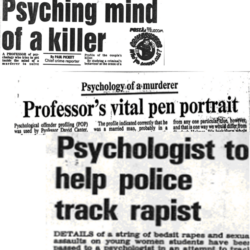
David Canter considers the confusions inherent in being (even very moderately) well-known. That has implications for the considerably greater misinformation that gets linked to those who are very well-known indeed.
In 2011, anti-government protests and uprisings erupted in Northern Africa and the Middle East in what is often called the “Arab Spring.” […]

After viewing the the televised version of the The Decameron, our Robert Dingwall asks what the farce set during the Black Death says about a more recent pandemic.

Co-authors Amélie Cloutier and Andrew Webb reflect on the inspiration behind their recently published academic article – the rescue of a soccer team from a cave in Thailand.

In this month’s installment of The Evidence newsletter, journalist Josephine Lethbridge explores recent research into sexual violence prevention programs and interviews experts […]
Jürgen Habermas, a globally known social theorist whose explorations of democracy, validity and communication have gained new prominence in the current moment, […] People often see science as a world apart: cool, rational and untouched by persuasion or performance. In this view, scientists simply discover […] “Research impact” means different things to different people. Some refer broadly to how science changes behaviors, beliefs, or practices outside academic institutions. […] David Canter considers informal places where people socialize, suggesting they’re an arena ChatGPT and other LLMs can’no’t replicate. As someone who lives […] It’s become cliche since Clive Humbly coined it in 2006, but data is indeed the new oil. It’s a mantra repeated by […] In September 2025, The Guardian reported about a lawyer in Australia having faced sanctions due to false citations. These citations were not […]
EXPLORE
Impact

Jürgen Habermas, 1929-2026: Exponent of the Public Sphere
READ MORE

Scientists Should Keep in Mind It’s Called the ‘Marketplace of Ideas’ for a Reason
READ MORE

Survey Finds Social Scientists Feel Unsupported in Seeking Societal Impact
READ MORE
Innovation

Reaching Parts to Which AI Has No Access
READ MORE

Andrea Medina-Smith on Making Research Data More FAIR
READ MORE

A Status Check on Hallucinated Case Law Incidents
READ MORE