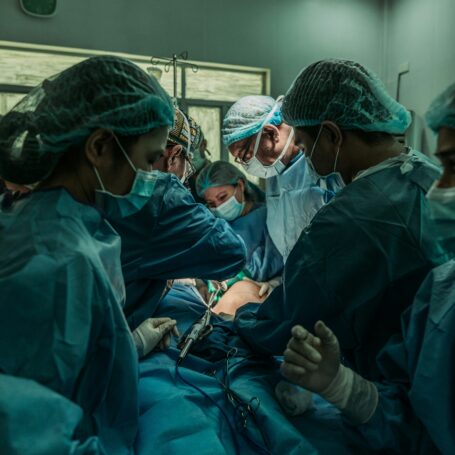


Could Distributed Peer Review Better Decide Grant Funding?
The landscape of academic grant funding is notoriously competitive and plagued by lengthy, bureaucratic processes, exacerbated by difficulties in finding willing reviewers. Distributed […]
Applications are open for the annual NOMIS & Science Young Explorer Award, which recognizes early-career M.D., Ph.D., or M.D./Ph.D. scientists who have conducted research that connects the social and life sciences.

It’s “the revolution of common sense,” President Donald Trump announced in his second inaugural address. And so it is. The latest installment […]

The constitutional processes are now complete and Robert F Kennedy, Jr. has been confirmed as U.S. Secretary for Health and Human Services […]

Decisions taken now around how generative AI is used by academics and universities will shape the future of research. Mark Carrigan argues whilst optimistic scenarios are possible, generative AI stands ready to feed into an existing productivity oriented framing of academic work.

Research into pressing societal challenges increasingly depends on data coming from across different disciplines and research contexts. Gordon Blair argues that to create a research culture that makes the best use of available data, the 2016 FAIR principles need to be extended in ways that address issues that have emerged in the decade following their creation.

A typical student wants a university degree as a ticket to a salary. For this young person, education is a journey towards […]
Sage (the parent of Social Science Space) and Surviving Society’s collaborative podcast series, Social Science for Social Justice, has returned for a […]
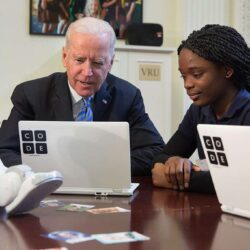
President Joe Biden was inaugurated in January 2021 amid a devastating pandemic, with over 24 million COVID-19 cases and more than 400,000 […]

Four Americans working in the social and behavioral sciences are among the 20 people named MacArthur Fellows this year. Recipients may be […] Euan Adie, the founder of Altmetric and later of Overton, discusses the reasons the led to Overton’s focus on showing researchers how […] Here’s a couple of quick questions for you. What is the smallest of the eight discipline-based directorates at the United States’ National […] I was adding some final flourishes on the topic of ‘iatrocracy’ to my forthcoming book with Natewindé Sawadogo – Sickness and Social […] How is AI changing the shape and space of higher education? Critical thinking continues to rank highly among key skills and attributes […] My colleagues and I recently spoke with a group of talented, interesting students who just completed their first year of college about […]
EXPLORE
Impact
Four From Social Science World Receive 2026 MacArthur Fellowships
READ MORE

Quick Insight: Euan Adie on Getting Academics Credit for Their Impact
READ MORE

NSF’s Embattled SBE Directorate Shown as Agency’s Policy Heavyweight
READ MORE
Innovation

AI and ‘Iatrocracy’ – A Cautionary Tale
READ MORE

The Critical Student: How GenAI Reshapes Critical Skills and Higher Education’s Role Preparing Students For It
READ MORE

AI Doesn’t Drive Student Cheating. It Just Hitches a Ride
READ MORE