The Day the Earth Moved: Canada’s Muzzled Researchers
This is the first of two excerpts from Social Science Space partner Index on Censorship dealing with scientific free speech. The second story, on how the budget sequester affected U.S. scientists, click here.
***
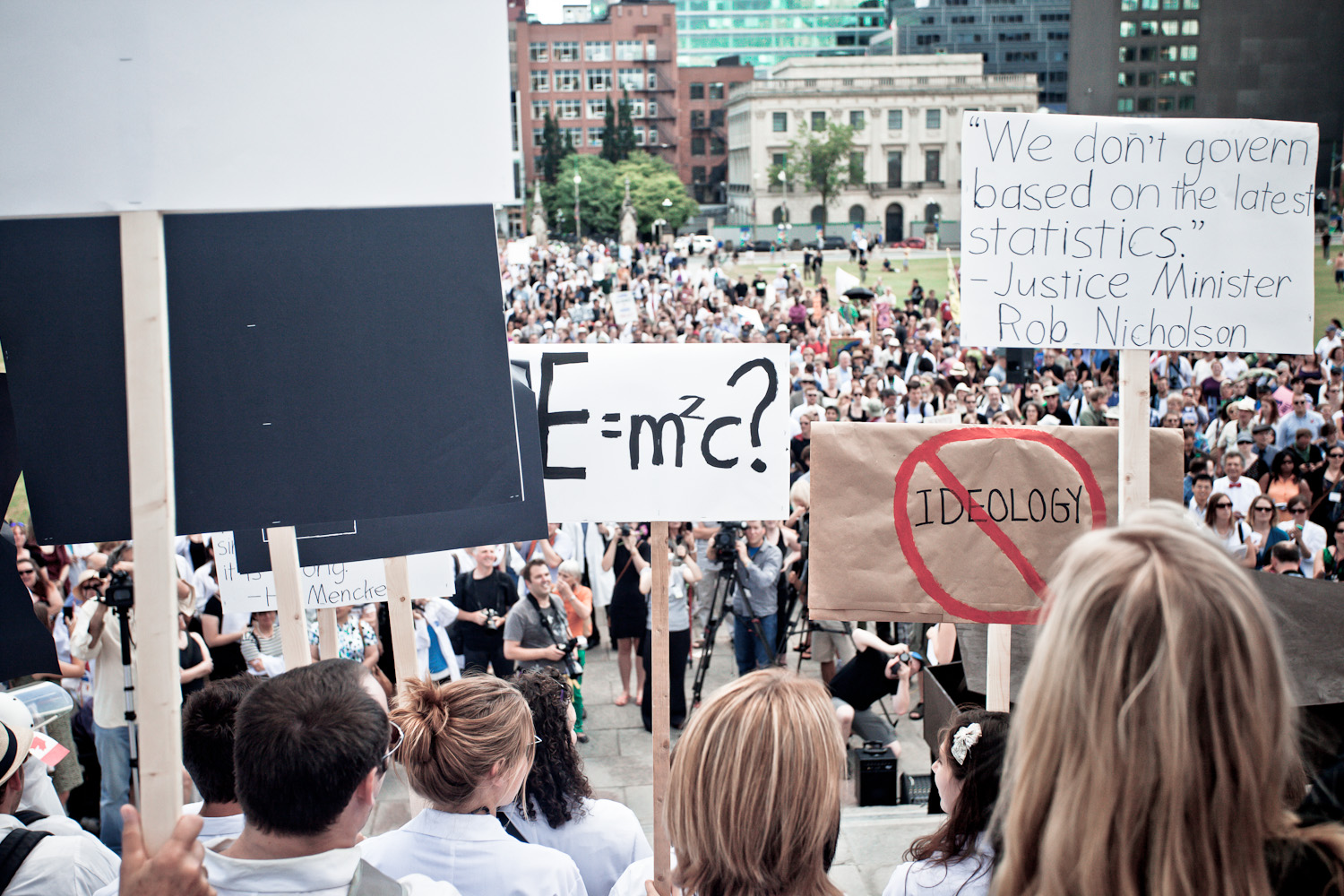
A rally mourns the “death of evidence” in decision making by the Canadian government.
On Wednesday 24 June 2010, something very unusual happened in Ottawa, the Canadian capital. Office workers returning from their lunch breaks were surprised to feel the earth move beneath their feet and their office buildings tremble, causing pictures to fall from the walls and objects from desks.
People in the city immediately suspected an earthquake, though they are relatively rare in the region. As might be expected, reporters at newspapers in the city contacted Natural Resources Canada to find out what was going on. The journalists were surprised to discover that government seismologists told them they were unable to speak about it.

This story by Mark Frary first appeared in the March 2014 edition of Index on Censorship under the title, “The day the earth moved.”
Meanwhile, the US Geological Survey was giving out plenty of information – a 5.5 magnitude quake had occurred at 1:41 p.m. some 19 km below ground on the Ontario-Quebec border.
One reporter hoping to find out more about the suspected earthquake was Tom Spears, a science reporter on the Ottawa Citizen newspaper. “The deputy minister’s office issued a statement saying there was no information and it was not until after 6 p.m. that we heard more.”
A four-hour delay may not sound like much – but in a world increasingly driven by the internet and social media, it’s a lifetime.
Spears says the delay is indicative of what some are calling censorship of the work carried out by scientists funded by the Canadian government. “The fastest way to find out information is to find out if they are working with America or with a university, because academics are still free to talk,” says Spears.
He says that the earthquake incident is one of many cases where scientists funded by the Canadian government have been unable to share information on seemingly innocuous research.
“I can understand it if a scientist doing research that has enormous bearing on a sensitive area of public policy, if a bill is working its way through parliament for example, he is going to be sensitive about talking about it in public,” says Spears. “What has been going on is the gagging of scientists over tiny little things.”
In another case, Spears asked scientists working for Canada’s National Research Council about work they were doing on snowfall. Spears says he was told by the organization’s communication chief that there would be no interview and that it would only provide a written statement.
So what are scientists allowed to say? The Canadian government has an official communications policy that was written in 2006 and updated in 2012. The policy states that government departments should “provide the public with timely, accurate, clear, objective and complete information about its policies, programs, services and initiatives” and “encourage public service managers and employees to communicate openly with the public about policies, programs, services and initiatives they are familiar with and for which they have responsibility.”
However, it also makes clear that government employees should “treat sensitive information with discretion” and that “communication specialists responsible for media relations” should “ensure that media requests, particularly for interviews or technical information on specialized subjects” are “directed to knowledgeable managers or staff designated to speak as official representatives of their institution.”
Communications professionals at Canada’s government scientific organizations say that the problems in communicating science are not about censorship but more about timely access to commentators.
To continue reading this at Index on Censorship, please click here.