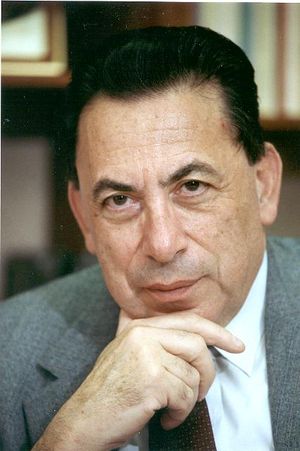
An Engineer at the NSF: Erich Bloch, 1925-2016

Erich Bloch
Former National Science Foundation Director Erich Bloch died on November 25 at the age of 91. Leading the foundation from 1984-1990, Bloch was the first non-academic to serve as director – and the eighth overall — and the first since NSF’s initial leader, Alan Waterman, to serve his full six-year term. Bloch was an engineer who was one of the giants of early computer science during his years at IBM. During his NSF tenure he brought new ideas that sometimes rattled the Foundation’s core constituency of academic researchers. These included his emphasis on collaboration through centers, partnerships with States and industry, and moving away from pure research to include technological implementation.
In his valedictory appearance before the Senate Commerce Committee before leaving NSF, Bloch declared that, “NSF is not the captive of individual investigators.” Given his background, he would also create NSF’s Computer and Information Sciences Directorate and help restore NSF’s role in science and technology education, which Congress had gutted in 1983.
With regard to the social and behavioral sciences, Bloch began his tenure in the wake of the Reagan Administration’s severe reductions in funding for these researchers. He spoke at the annual meeting of the Consortium of Social Science Associations in 1984, telling the group, “The social and behavioral sciences are necessary to understand changes in world economic competition, international competition in research, and the rapidly increasing complexity of science, technology, and the research process.” He also suggested that funding for these sciences would recover under his watch, which they did, albeit slowly.
Toward the end of his tenure, the process began to administratively separate the social, behavioral, and economic (SBE) sciences from the biological sciences and to create a separate directorate. Bloch’s successor, Walter Massey, would finish the process in late 1991 and thus the SBE Directorate was born. Years later, Bloch would tell me that he believed that should be no directorates by discipline, clearly reflecting his belief in the integration of all sciences and the flexibility that would allow NSF’s director more power.
In summing up his directorship in the COSSA Washington Update in September 1990, after Bloch had left NSF, I wrote:
“The social and behavioral sciences were clearly not on Bloch’s priority list. Bloch did, however, use social and behavioral science research results when it suited him. He often cited economic return on investment studies to bolster his arguments for increased research funding. He also used sociological research results to support his arguments for more funding to attract women and minorities into scientific and technological fields.”
He clearly changed NSF and was a significant spokesperson for science and technology both as director and in his later life. Voices like Bloch’s will be missed and new voices will have to shout loud during the next four years to preserve his legacy and the scientific research enterprise.