Kamala Harris’ Ambition: Free Chapter from ‘Why Don’t Women Rule the World?’
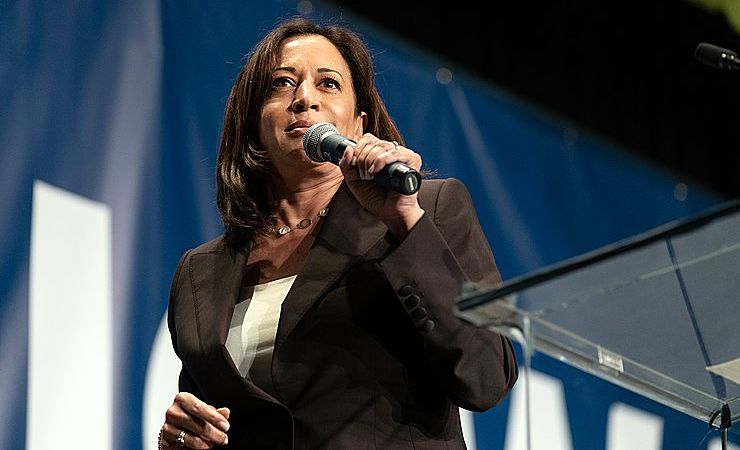
Kamala Harris, the U.S. senator from California who will be the Democratic candidate for vice president in the 2020 elections, reportedly was knocked in early handicapping for the position as being “too ambitious.” Nonetheless, Harris’ ‘ambition’ has landed her on the ticket with Joe Biden in the attempt to unseat Donald Trump, and makes her just the fourth woman ever to be on a major party’s presidential ticket.
Being ambitious is an odd criticism for anyone running for national office, since great ambition is a necessary trait (and sometimes even a sufficient one) to run in the first place. Since Harris is female, it’s been assumed that the criticism had more traction than it would if leveled against a male.
“Seeing women in the forefront of the political arena is still something our society is becoming accustomed to,” political consultant Danielle M. Winterhalter told The Lily in late July, “and whether folks like to admit it or not — it causes a decent amount of discomfort, and that discomfort is often quantified in terms like ‘overly ambitious’ and ‘quite sure of herself.’”
Such discomfort isn’t found only among the electorate. It’s found in women themselves (especially in the United States).
“U.S. women not only have lower levels of political knowledge and self-report lower levels of political interest but are also less apt to engage in political discussions, attempt to persuade others’ vote choice, donate money to a political candidate or cause, or volunteer to work for a candidate or political party,” note the authors of the new book, Why Don’t Women Rule the World? “Of particular consequence is that this reluctance to engage in traditional political activity extends to women’s political ambition, or their willingness to run for public office.”
In their chapter specifically on political ambition, the authors discuss the “half empty pipeline and a persistent plateau” as stifling even “nascent” political ambition. Citing Jennifer Lawless and Richard Fox’s work, they write that “nascent political ambition must precede expressive political ambition, where individuals engage in a cost-benefit analysis and consider whether to run for a specific seat.” Socialization, they write, continues to dampen full female participation, “yet, women respond just as positively as men when they are asked, suggesting that nascent political ambition can be cultivated through such requests.”
To read the full chapter on what social science tells us about political ambition, CLICK HERE.

Authored by four political scientists (see their bios below), Why Don’t Women Rule the World? Understanding Women’s Civic and Political Choices combines feminist and political research to analyze why women leaders are regarded differently even today, and to encourage women’s political interest and ambition. It includes “Ambition Activities,” such as “Name it, Shame it, Pivot,” an exercise that helps women respond to sexist comments, and a five-step action plan to begin dismantling the patriarchy.
“As four feminists who care deeply about dismantling patriarchal structures, we had many reasons for writing this book,” they write. “We know that young men’s political ambition begins to outpace young women’s ambition in late high school/early college. This book will prompt readers to think about their gendered assumptions of power and privilege, their role in rectifying patriarchal structures, their own political ambition, and the ways they can address gender inequalities in their personal lives and in the broader world.”
The authors are:
· J. Cherie Strachan is a at Central Michigan University. Her research addresses the effects of partisan polarization on elections, the role of civility in a democratic society, and the effect of college-level civic education interventions, deliberative forums, and campus organizations on students’ civic skills and identities.
· Lori M. Poloni-Staudinger is an associate dean for research, personnel, and graduate programs in the College of Social and Behavioral Sciences and a professor in the Department of Politics and International Affairs at Northern Arizona University. Her research and publications focus on social movements, political contention and extra-institutional participation, and political institutions, mainly in Western Europe. Her recent work examines questions around women and political violence.
· Shannon Jenkins is a professor in the Department of Political Science and the academic director of Online Learning at the University of Massachusetts Dartmouth. Her research and publications focus on decision making in state legislatures, with a specific interest in the role of political organizations and gender in shaping outputs in these institutions, and the impact of specific pedagogical practices on student learning outcomes in political science courses.
· Candice D. Ortbals is a professor at Pepperdine University. Her publications relate to state feminism in Spain and gender and terrorism.