Social Science Bites

Molefi Kete Asante on Afrocentrism

September 7, 2021 16901

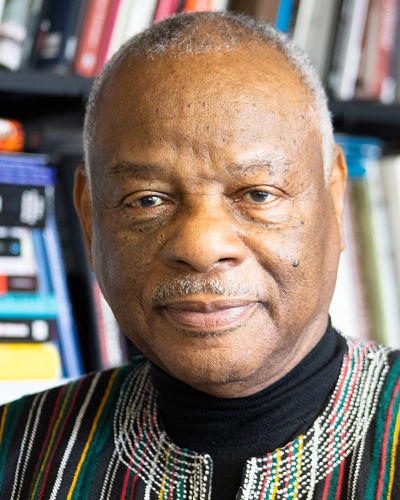
Molefi Kete Asante, the chair of the Department of African American Studies at Philadelphia’s Temple University, has long been at the forefront of developing the academic discipline of  Black studies and in founding  the theory of Afrocentrism, “the centering of African people in their own stories.” In this Social Science Bites podcast, Asante offers an insiders view of the growth of the Afrocentric paradigm, from the founding of the Journal of Black Studies a half century ago to the debates over critical race theory today.

“Afrocentricity,” Asante tells interviewer David Edmonds, “is a paradigm, an orientation toward data, a perspective, that says that African people are subjects, rather than objects, and that in order to understand narratives of African history, culture, social institutions, you must allow Africans to see themselves as actors rather than on the margins of Europe, or the margins of the Arab culture, or the margins of Asian culture.”

While that might seem a mild prescription, it’s one that has been often ignored. Asante offers the example that the waterfalls between Zimbabwe and Zambia had a name (Mosi-oa-Tunya for one) before European explorer David Livingstone arrived and dubbed them Victoria Falls.

“Livingstone is operating in the midst of hundreds of thousands of African people – kings and queens and royal people – yet the story of southern Africa turns on David Livingstone. The Afrocentrist says that’s nonsense; here’s a white guy in the midst of Africa and that you turn the history of Southern Africa on him does not make any sense to us.”

Asante then details some of his own efforts in centering the stories of Africa and the African diaspora in their own narratives, including the founding of the first academic journal focused on doing so. He details how as a PhD student in 1969, he and economist Robert Singleton (who had been one the famed Freedom Riders) started the effort to create the Journal of Black Studies as a forum for the nascent academic discipline. (The story sees SAGE Publishing, the parent of Social Science Space, and its founder Sara Miller McCune taking an important role as the one publisher that embraced Asante’s proposal in 1970.)

“The journal survives,” he explains in its 50th year, “based on its relevance to contemporary as well as historical experiences.”

At the time the journal was founded, Asante directed the University of California Los Angeles’ Center for Afro American Studies from 1969 to 1973. He chaired the Communication Department at State University of New York-Buffalo from 1973 to 1980. After two years training journalists in Zimbabwe, he became chair of the African American Studies Program at Temple University where he created the first Ph.D. Program in African American Studies in 1987. He has written prodigiously, publishing more than 90 books, ranging from novels and poetry on Afrocentric themes to high school and university texts to the Encyclopedia of Black Studies.

To download an MP3 of this podcast, right-click HERE and save.

Join the debate and discuss this episode with fellow listeners on our Multytude conversation. Multytude is a new social media app that aims to make sense of the online conversation. With support from the SAGE Concept Grant, the Multytude team is working to create a new method of qualitative research for social scientists to better understand what people are saying about the big issues of today.


For a complete listing of past Social Science Bites podcasts, click HERE. You can follow Bites on Twitter @socialscibites and David Edmonds @DavidEdmonds100.

Welcome to the blog for the Social Science Bites podcast: a series of interviews with leading social scientists. Each episode explores an aspect of our social world. You can access all audio and the transcripts from each interview here. Don’t forget to follow us on Twitter @socialscibites.

View all posts by Social Science Bites

Related Articles

Quick Insight: Ted Knight on the Secret Sauce for an Academic Conference
Infrastructure
September 1, 2026

Quick Insight: Ted Knight on the Secret Sauce for an Academic Conference

Read Now
Rafael Schacter on Graffiti
Insights
September 1, 2026

Rafael Schacter on Graffiti

Read Now
Quick Insight: Euan Adie on Getting Academics Credit for Their Impact 
Impact
August 25, 2026

Quick Insight: Euan Adie on Getting Academics Credit for Their Impact 

Read Now
Is Ill-Health Our Own Fault?
Insights
August 14, 2026

Is Ill-Health Our Own Fault?

Read Now
Quick Insight: Baba Sheba on Genuinely Integrating AI into Higher Ed

Quick Insight: Baba Sheba on Genuinely Integrating AI into Higher Ed

The exact role of artificial intelligence in higher education (and society itself) is currently being written, with sincere predictions veering from catastrophe […]

Read Now
Why Sociology Should Not Be Liquidated

Why Sociology Should Not Be Liquidated

“Once again the season of the anti-sociologists is upon us…[a]curious admixture of illogic and sentiment…makes up the creed and canons of anti-sociology.” […]

Read Now
Ariel Kalil on Parents’ Role in Child Development

Ariel Kalil on Parents’ Role in Child Development

When discussing youngsters’ life outcomes, school is often the first place someone starts investigating. And yet school time is dwarfed by the […]

Read Now
5 2 votes
Article Rating
Subscribe
Notify of
guest

This site uses Akismet to reduce spam. Learn how your comment data is processed.

1 Comment
Newest
Oldest Most Voted
Kwame Aboagye

Molefi Kente Asante is an inspiration when it comes to Africans and our own cultural beliefs such as Kwanzaa, Homowo and Panafest which what Africans celebrate every year on this earth.