Does Open Access Result In More Policy Citations?
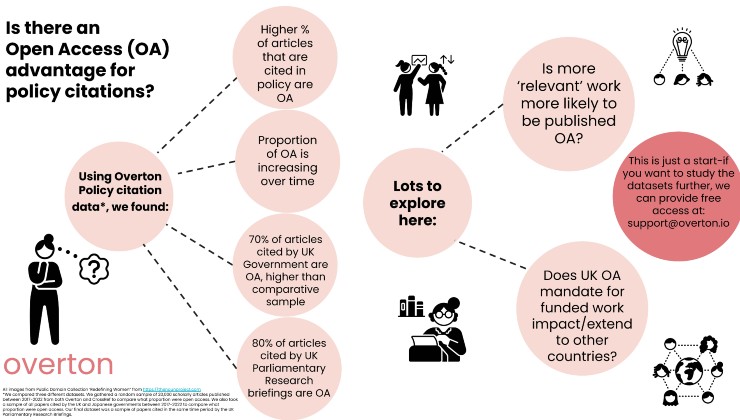
Overton — the world’s largest searchable index of policy documents, guidelines, think tank publications and working papers — recently presented a short lightning talk and poster at the Open Access Scholarly Publishing Association conference. Our talk focused on whether or not there was an open access citation advantage (OACA) when it comes to policy documents.

There is some evidence that there is an OACA when it comes to citing research. It could (and should?) follow that if something is easier to read, then it would at least be accessible to cite. On the flip side, we were distinctly aware that policymakers may not know, or care, about OA if they aren’t routinely engaged in the academic sphere.
We wanted to discover whether, if research is more accessible, this translates into more OA papers being cited within policy so our data scientist Angel did a small analysis of some of our data.
He:
- Gathered a random sample of 20,000 scholarly articles published between 2017 and 2022 from CrossRef to estimate the proportion of scholarly articles that are open access.
- Also took a sample of 20,000 scholarly articles cited in policy from Overton’s database, to estimate what proportion of them are open access.
- He then collected all of the scholarly articles cited by the UK government between 2017 and 2022, and examined the proportion of open-access articles in these citations and compared it to those cited by the Japanese government during the same time period.
- Lastly, he repeated the same above analysis for UK Parliament Research Briefings.
We found a number of interesting things for our samples between 2017-2022:.
- There is a higher percentage of open access v not open access papers cited within policy
- The proportion of open-access papers is also increasing over time
- 70 percent of articles cited by the UK government within policy were open access vs around 67 percent for Japan
- 80 percent of articles cited by the UK parliamentary research briefings are open access
Now this also brings up a lot of questions that could be explored:
- Is the work cited because it is relevant/because it is open access/is a certain type of work more likely to be open access?
- Are policymakers intentionally trying to cite more OA papers?
- What impact does the UK open access mandate on government-funded research have on citations within policy?
- Will the new mandate for USA federally funded research and the NHMRC in Australia to be made OA have an impact on policy citations?